Commercial Sensor Faucet Commissioning Guide: Sensor Range, Flow, Timeout & Final Handover
A commercial sensor faucet is not fully specified when it arrives on site—and it is not fully installed when the plumber tightens the last connection. Detection range, basin interaction, flow, timeout, power, filtration and valve response should all be verified before handover. Proper commissioning turns a collection of electronic fixtures into a predictable restroom system.
Why Factory Settings Are Only a Starting Point
Factory sensor settings are designed to work across many installations. They cannot account perfectly for every basin depth, countertop setback, stone finish, lighting condition or restroom layout.
Sensor Range
Confirm hands activate naturally without detecting the empty basin.
Flow Pattern
Verify stream placement, splash and user hand clearance.
Timeout
Confirm automatic shutoff operates exactly as documented.
Power
Verify battery, AC, hybrid or alternative power architecture.
Valve
Confirm immediate opening and complete shutoff without dripping.
Documentation
Record final configuration before facilities staff assume ownership.
Before Turning the Water On
| Check | What to Verify |
|---|---|
| Faucet alignment | Spout centerline coordinates with the intended handwashing zone. |
| Basin | No unexpected reflective or physical obstruction enters the sensor field. |
| Supply | Stops are open and piping has been properly flushed. |
| Strainer | Debris protection is installed before the electronic valve. |
| Power | Correct battery type, transformer or wiring configuration is present. |
| Connections | Sensor, controller and valve cables are secure. |
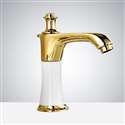
Fontana Marsala White and Gold Commercial Electronic Sensor Faucet
The Fontana Marsala White and Gold Electronic Sensor Faucet is particularly useful as a commissioning example because Fontana publishes a complete AEC document package: BIM files, specifications, installation instructions, repair and maintenance guidance, 3D rendering and warranty documentation.
That documentation should become part of the commissioning record rather than disappearing after procurement.
Excellent project-documentation package for contractors and facility teams.
Record the installed power, flow and sensing configuration—not only the product name.
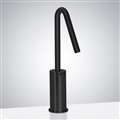
BathSelect Matte Black Hands Free Commercial Sensor Faucet
BathSelect’s commercial platform highlights exactly why commissioning matters. The sensor can self-adjust to the color and shape of the lavatory, but the sensing range is also manually adjustable. The factory auto-shutoff is set to 30 seconds and can also be changed.
Diagnostic indicators identify power-up, low-battery and solenoid conditions, providing facilities staff with a valuable troubleshooting baseline after handover.
Adjustable sensing, timeout and diagnostic architecture.
Record final range and timeout instead of leaving undocumented field changes.

Sloan BASYS® EFX-250 Commercial Sensor Faucet
Sloan’s BASYS platform is valuable during commissioning because the faucet exposes multiple programmable operating parameters rather than functioning as a sealed black box.
Sensor range, timeout, line purge and service diagnostics should all be checked against the project specification before occupancy.
Strong diagnostic and operating-parameter control.
Provide facilities teams with the finalized programming record.
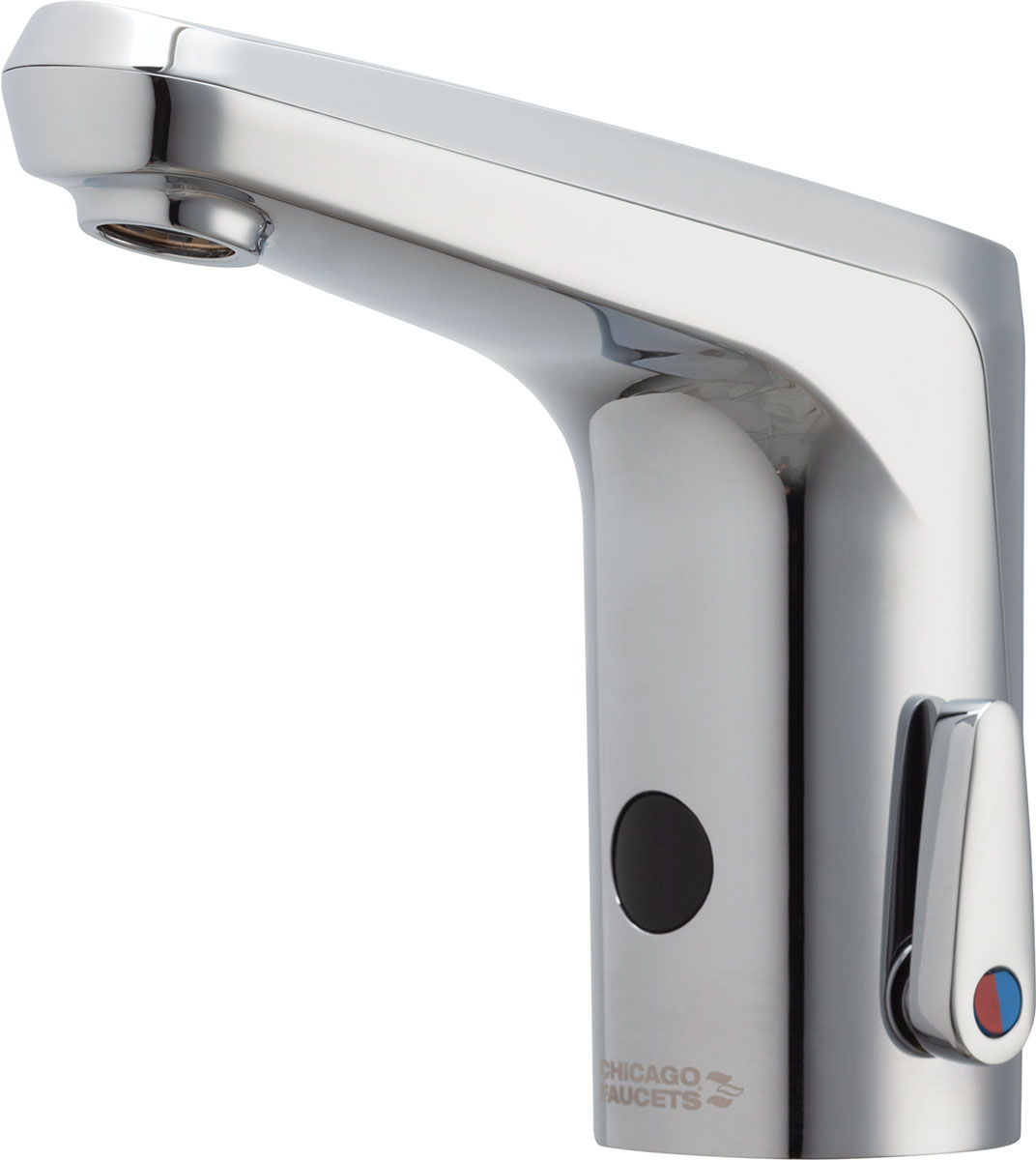
Chicago Faucets E-Tronic® 80 Commercial Sensor Faucet
E-Tronic 80 shows how digital commissioning can simplify commercial handover. The selected configuration includes Bluetooth communication, a defined 10-second hand-presence runtime and safety auto-timeout.
Those settings should be confirmed during final testing rather than assumed from the submittal.
Digital operating adjustment and clearly published runtime logic.
Archive Bluetooth/programming settings with O&M documentation.

Zurn Serio Series® Gear-Driven Commercial Sensor Faucet
ZG6950 demonstrates how commissioning increasingly extends beyond sensor range. Zurn’s Bluetooth application supports programming of metering, automatic line flushing, timeout and sensor sensitivity.
The gear-driven ceramic cartridge also changes the water-control architecture, so facilities teams should receive the correct model-specific service documentation rather than generic solenoid instructions.
Extensive point-of-use digital adjustment.
Record app settings and gear-cartridge service requirements.
Image standard: all featured products use large product-specific imagery, remain uncropped at 500+ px desktop presentation, and each image links to the corresponding product page.
Seven Tests Every Faucet Should Pass
| Test | Acceptance Intent |
|---|---|
| 1. Empty-basin test | No unintended activation when the station is unoccupied. |
| 2. Hand-entry test | Activation occurs naturally without waving or searching. |
| 3. Hand-exit test | Water stops predictably after hands leave. |
| 4. Maximum-runtime test | Safety timeout operates according to programmed value. |
| 5. Flow test | Actual outlet performance matches specified flow. |
| 6. Splash test | Stream stays within the basin during realistic washing. |
| 7. Power-loss test | Facilities staff understand behavior under low battery or power failure. |
Do Not Commission Only One Faucet
In a six-station restroom, every sensor interacts with a slightly different basin position, lighting angle and surrounding surface. Testing only the first faucet does not prove that the remaining five operate correctly.
What Facilities Should Receive
| Exact model | Full product name and configuration. |
| Flow rate | Installed aerator/spray-head value. |
| Sensor setting | Final range or calibration mode. |
| Timeout | Programmed automatic shutoff value. |
| Power | Battery, AC, hybrid, solar or hydropower configuration. |
| Service components | Battery, strainer, valve/cartridge and repair-part identification. |
| Digital settings | Bluetooth/app programming where applicable. |
Commercial Sensor Faucet Commissioning Platforms
Commercial Sensor Faucet Commissioning FAQ
Should every sensor faucet be commissioned?
Yes. Factory settings cannot account perfectly for each basin, countertop and installation environment.
When should sensor range be adjusted?
After the final basin, countertop, lighting and surrounding finishes are installed.
What is the empty-basin test?
Observe the completed sink station without a user and confirm the faucet does not activate unintentionally.
Why record timeout settings?
Facilities staff need to know normal control behavior before diagnosing a perceived malfunction.
Should flow rate be field verified?
Yes, especially when multiple outlet options exist within the same faucet family.
Who should receive the commissioning record?
The building owner or facilities team should receive it with the final operations-and-maintenance documentation.
Professional Sources
U.S. EPA — Bathroom Faucet Efficiency
Current guidance for efficient public-lavatory faucet flow.
American Society of Plumbing Engineers
Professional plumbing engineering and commercial commissioning resources.
International Code Council
Building and plumbing code resources relevant to commercial fixture installation.
U.S. Department of Justice — ADA Standards
Accessibility requirements for commercial lavatories and operable components.
Commissioning Converts Hardware Into a Working System
The best commercial sensor faucet can still perform poorly if range, timeout, flow or basin interaction is never verified. A proper commissioning process tests every part of the user experience and leaves facilities staff with an exact operating record. Fontana, BathSelect, Sloan, Chicago Faucets and Zurn each demonstrate why modern sensor faucets should be commissioned—not simply installed.
Review Fontana Marsala Commercial Sensor Faucet →Independent editorial disclosure: CommercialSensorFaucets.com provides independent engineering-oriented information based on published manufacturer documentation. Commissioning procedures should follow the exact manufacturer’s installation instructions, applicable project specifications, electrical requirements and plumbing codes.
Leave a Reply