Category: Uncategorized

  • False Activation Troubleshooting

    CommercialSensorFaucets.com • Sensor Diagnostics

    False Activation Troubleshooting: Why Commercial Sensor Faucets Turn On by Themselves

    A faucet that activates with nobody present is not automatically defective. Commercial sensor faucets can false-trigger because of reflective basins, excessive detection range, environmental lighting, contaminated sensor lenses, unstable power, nearby objects or valve faults. Correct diagnosis separates sensing problems from electrical and hydraulic problems before unnecessary parts are replaced.

    Diagnostic Logic

    Six Common Causes of False Activation

    Reflective Surfaces

    Polished stone, chrome drains or glossy basins can alter some infrared environments.

    Range Too Long

    The detection field may extend into the basin or nearby movement zone.

    Dirty Sensor

    Soap film, dust or construction residue can interfere with detection.

    Lighting Changes

    Some sensors respond differently when environmental conditions change.

    Power Instability

    Weak batteries or poor electrical connections can mimic sensor faults.

    Valve Problem

    A sticking solenoid can create continuous flow even when sensing is normal.

    First rule: Do not replace the sensor until power, detection range, basin conditions and valve behavior have been checked separately.
    Troubleshooting Sequence

    Sensor or Solenoid?

    Observed ProblemFirst CheckNext Step
    Activates when nobody is presentRemove objects and inspect reflectionsReduce detection range.
    Activates intermittentlyCheck battery or AC supplyInspect connections and sensor surface.
    Water continues after hands leaveDetermine whether sensor still shows detectionTest solenoid/valve independently.
    Works until new basin is installedCompare optical environmentRecommission sensing range.
    Faucet behaves differently under new lightingReview sensor calibrationUse adaptive/self-calibration if available.
    Diagnostic Example #1 • Fontana Touchless
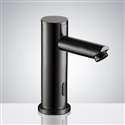
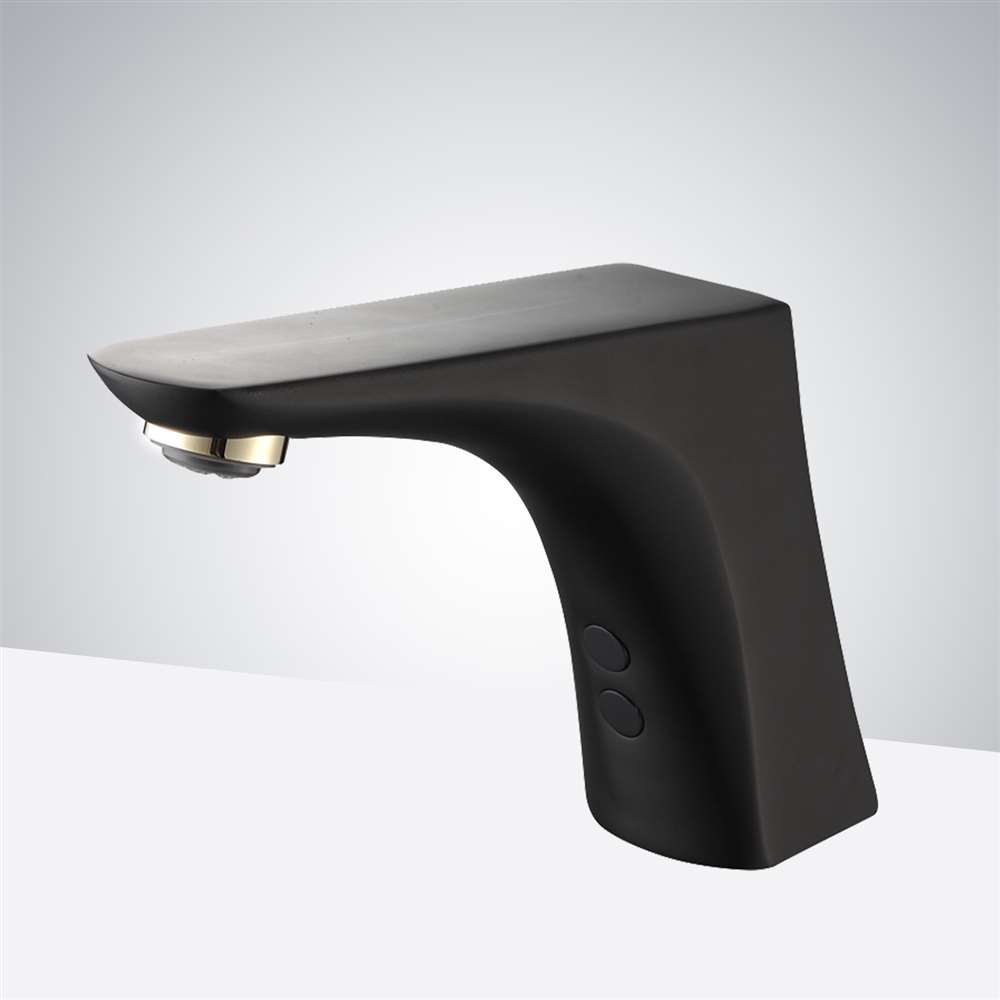
    Fontana Solo Matte Black Commercial Automatic Touchless Sensor Faucet

    Fontana Solo Matte Black Commercial Automatic Touchless Sensor Faucet

    Self-Adjusting Detection2–6 in Range0.3s ResponseDiagnostics

    The Fontana Solo Commercial Sensor Faucet is especially relevant to false-trigger analysis because Fontana documents both automatic detection adjustment and manual sensing-range capability. Its published specification includes a 2–6 inch sensing range, approximately 0.3-second response and diagnostic indication for power, low battery and solenoid condition.

    Diagnostic Advantage
    Separates sensing, battery and solenoid conditions more clearly.
    Commissioning Focus
    Do not leave the range longer than the actual basin requires.
    Review Fontana Solo →
    Diagnostic Example #2 • BathSelect
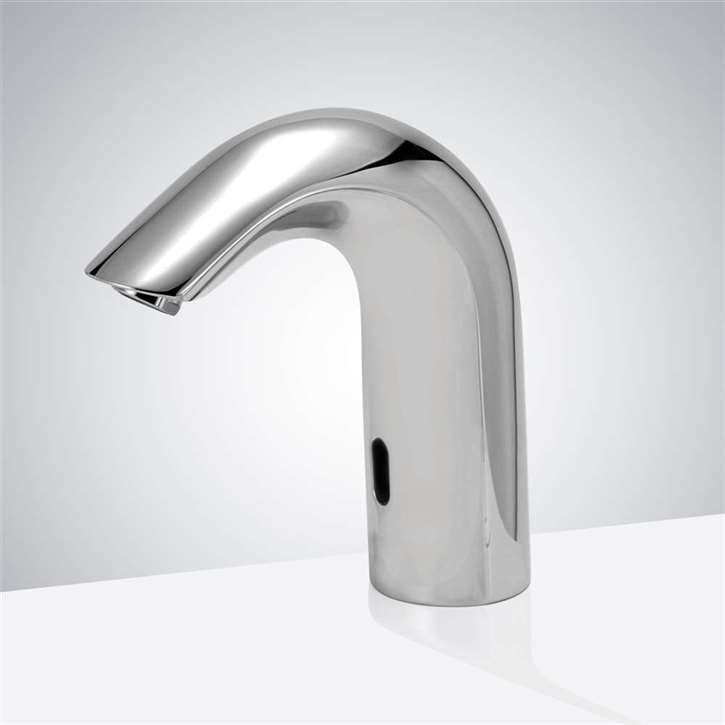
    BathSelect Commercial Automatic Infrared Sensor Hands Free Faucet

    BathSelect Commercial Automatic Infrared Sensor Hands Free Faucet

    Anti-False Triggering2–6 in RangeAI Smart-ChipBuilt-In Strainer

    BathSelect specifically describes this commercial model around precise activation and anti-false-triggering behavior. Its microprocessor can self-adjust detection according to the lavatory environment, while the sensing range can also be adjusted manually.

    A flashing diagnostic indicator reports power-up, low battery and solenoid condition, helping technicians determine whether erratic operation originates in sensing, power or the valve.

    Diagnostic Advantage
    Adaptive detection plus fault indicators.
    Commissioning Focus
    Verify automatic calibration after final sink installation.
    Review BathSelect Infrared Faucet →
    Diagnostic Example #3 • Sloan
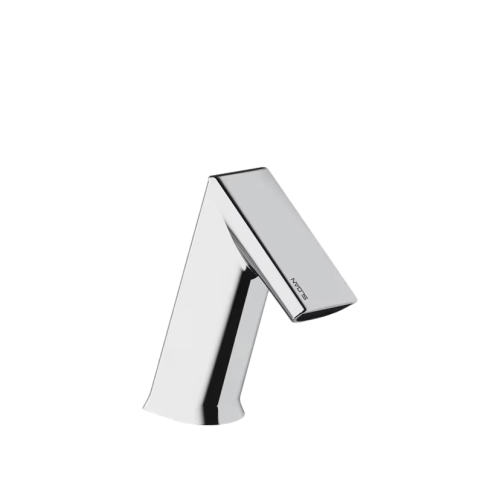
    Sloan BASYS EFX-380 Capacitance Sensor Faucet

    Sloan BASYS® EFX-380 Capacitance Sensor Faucet

    Capacitance Sensor0.5 GPMIP67 ElectronicsTurbine Power

    Sloan gives specifiers an alternative to conventional infrared. The EFX-380 can be configured with capacitance sensing, an electrical-field approach that Sloan positions as adaptive and especially robust for demanding high-use installations.

    That makes capacitance worth considering where optical sensing conditions repeatedly create commissioning problems.

    Diagnostic Advantage
    Alternative sensing physics reduces dependence on reflected infrared alone.
    Commissioning Focus
    Use manufacturer-specific procedures; capacitance behaves differently from IR.
    Review Sloan EFX-380 →
    Diagnostic Example #4 • Delta Commercial
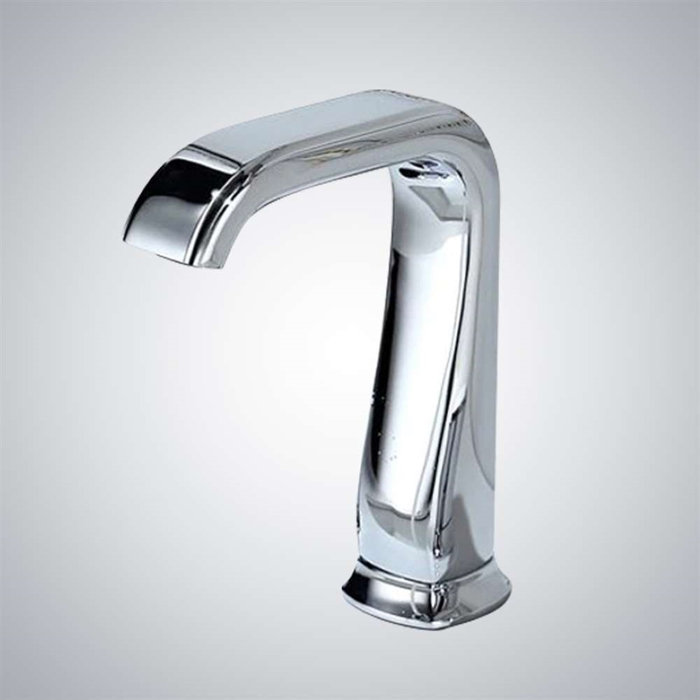
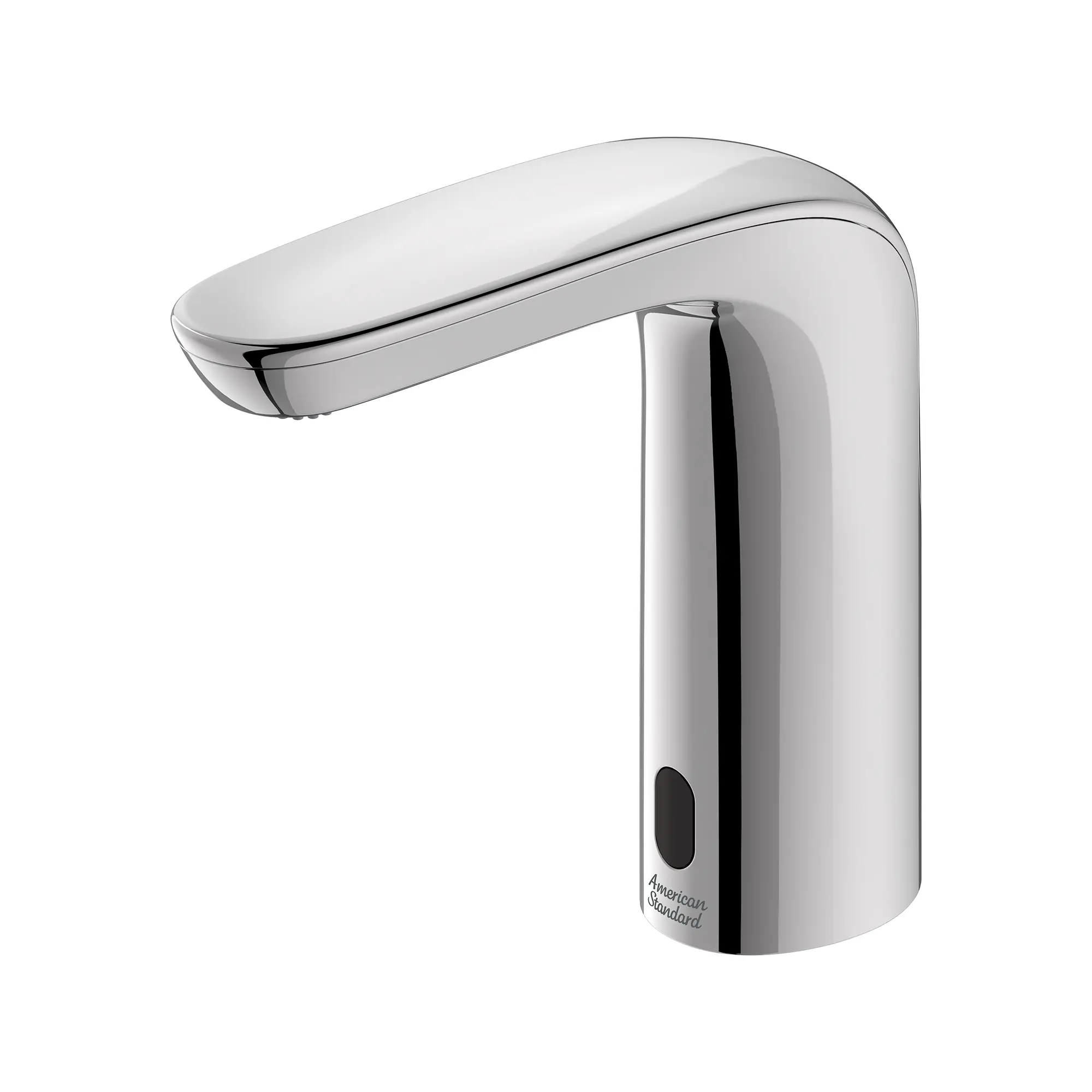
    Delta Commercial Electronic Faucet with Proximity Sensing

    Delta Commercial Electronic Lavatory Faucet with Proximity® Sensing

    Whole-Body Sensor0.5 GPMFast ResponseReflection Resistant

    Delta’s Proximity approach makes the entire faucet body part of the sensing system. Delta specifically states that activation is designed to respond quickly regardless of lighting, reflections or approach direction.

    That architecture directly addresses several conditions commonly blamed for false or missed infrared activation.

    Diagnostic Advantage
    Less dependent on one narrow sensor window.
    Commissioning Focus
    Confirm the broad detection field does not extend beyond the intended hand zone.
    Review Delta Proximity →
    Diagnostic Example #5 • American Standard
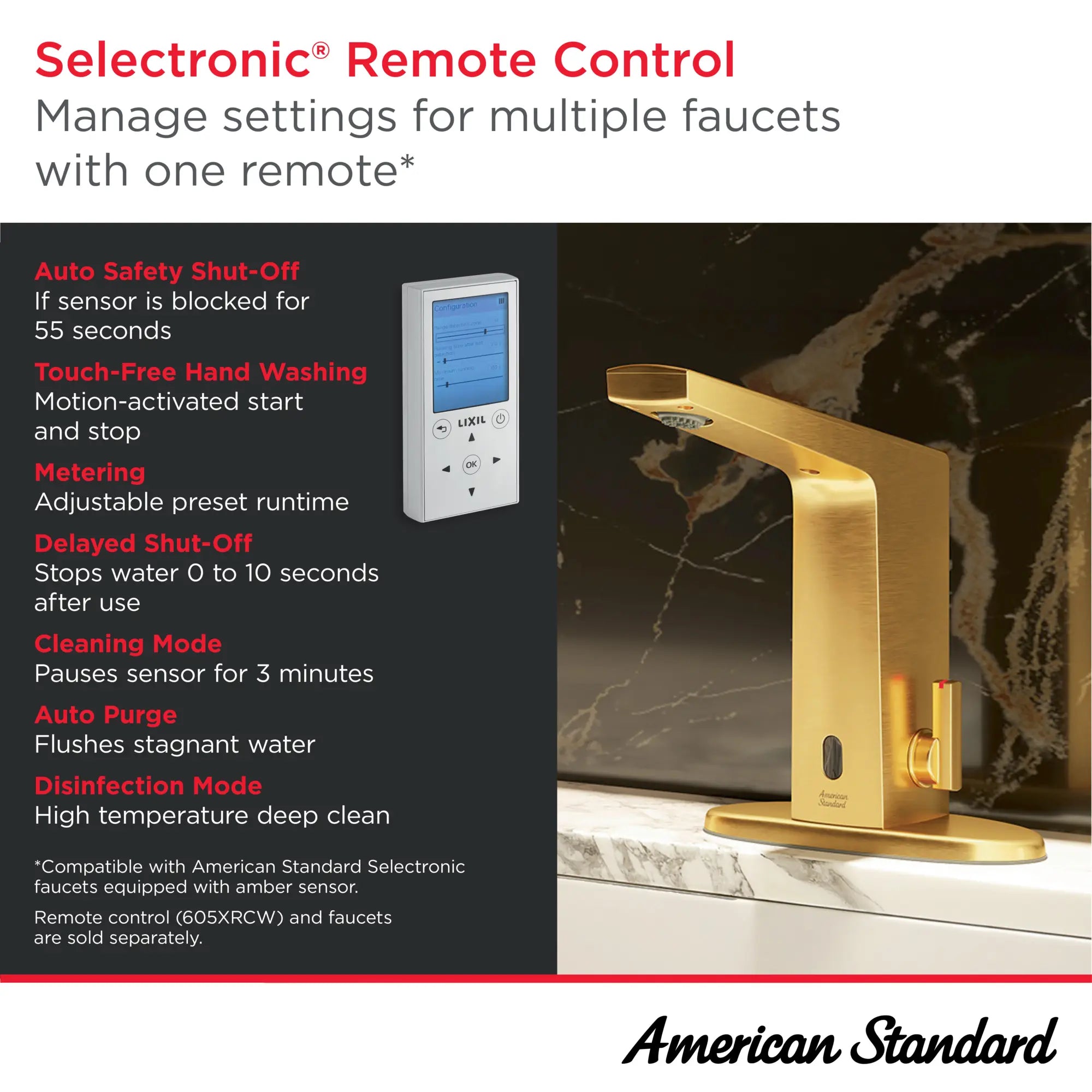
    American Standard NextGen Selectronic Touchless Faucet

    American Standard NextGen® Selectronic® Self-Calibrating Touchless Faucet

    Self-CalibratingEnvironment Aware0.5 GPMAbove-Deck Electronics

    NextGen Selectronic is specifically designed to self-calibrate according to environmental and lighting conditions. That can reduce manual sensitivity corrections when restroom lighting or surrounding surfaces change.

    Diagnostic Advantage
    Automatic environmental calibration.
    Commissioning Focus
    Self-calibration reduces—but does not eliminate—functional testing.
    Review NextGen Selectronic →

    Image rule: Product images are shown uncropped at 500+ px on desktop, remain responsive on mobile and link to the corresponding product page.

    Field Diagnostic Checklist

    What to Do When a Faucet Turns On by Itself

    1Clean the sensor surface without abrasive chemicals.
    2Remove objects, soap bottles and reflective items from the detection zone.
    3Check battery voltage or AC power before adjusting electronics.
    4Reduce sensing range and retest the empty basin.
    5Observe whether the sensor indicates continued detection after hands leave.
    6If detection stops but water continues, investigate the valve/solenoid.
    7Record the final setting after correction.
    Cross-Talk

    Can Two Sensor Faucets Interfere With Each Other?

    In tightly spaced multi-station lavatories, designers should verify that each faucet’s sensing field is confined to its intended user zone. Opposing or closely spaced optical sensors may require commissioning attention, especially where mirrors and glossy stone create additional reflective paths.

    Best practice: Commission every faucet in a completed sink bank—not just one representative fixture.
    Main Related Brands

    Commercial Sensor Platforms Worth Comparing

    FontanaShowers® — Adaptive infrared platforms combine adjustable range with diagnostic commercial electronics.
    BathSelect™ — Smart-chip commercial sensing provides calibration, diagnostics and anti-false-triggering features.
    Sloan — BASYS adds capacitance sensing for demanding installations beyond conventional infrared.
    Delta Commercial — Proximity technology reduces dependence on lighting, reflection and approach direction.
    American Standard — Self-calibrating Selectronic sensors adapt automatically to surrounding environmental conditions.
    Technical FAQ

    False Activation FAQ

    Why does my sensor faucet turn on by itself?

    Common causes include excessive range, reflections, environmental conditions, contamination or nearby objects.

    Can low batteries cause strange sensor behavior?

    Yes. Power should always be checked before assuming the sensing electronics have failed.

    Can a stuck solenoid look like false activation?

    Yes. If the sensor has stopped detecting but water continues, investigate the valve assembly.

    Are self-calibrating sensors immune to false triggering?

    No. They reduce manual tuning requirements but still depend on correct installation and basin geometry.

    Do mirrors affect sensor faucets?

    Potentially, depending on sensor geometry and the surrounding reflective environment.

    Should technicians increase range when users complain?

    Only after observing the actual hand path. Too much range can create a new false-activation problem.

    Engineering References

    Professional Sources

    U.S. EPA — Bathroom Faucet Efficiency
    Public-lavatory water-efficiency guidance.

    American Society of Plumbing Engineers
    Commercial plumbing engineering and specification resources.

    International Code Council
    Model building and plumbing codes relevant to commercial fixtures.

    U.S. Department of Justice — ADA Standards
    Accessibility requirements relevant to public lavatories and faucet controls.

    CommercialSensorFaucets.com Diagnostic Conclusion

    False Activation Is a Symptom—not a Diagnosis

    Before replacing a commercial sensor faucet, separate optical detection, electrical power and hydraulic valve behavior. Adjustable and adaptive systems such as the Fontana Solo Commercial Sensor Faucet and BathSelect’s smart-chip platform give commissioning teams useful diagnostic control, while Sloan, Delta and American Standard demonstrate alternative ways of reducing sensitivity to difficult restroom environments.

    Review Fontana Solo Sensor Faucet →

    Independent editorial disclosure: CommercialSensorFaucets.com provides independent engineering-oriented analysis based on published manufacturer information. Troubleshooting should follow the exact manufacturer’s service instructions, electrical safety procedures and applicable plumbing requirements.
  • False Activation Troubleshooting

    CommercialSensorFaucets.com • Sensor Diagnostics

    False Activation Troubleshooting: Why Commercial Sensor Faucets Turn On by Themselves

    A faucet that activates with nobody present is not automatically defective. Commercial sensor faucets can false-trigger because of reflective basins, excessive detection range, environmental lighting, contaminated sensor lenses, unstable power, nearby objects or valve faults. Correct diagnosis separates sensing problems from electrical and hydraulic problems before unnecessary parts are replaced.

    Diagnostic Logic

    Six Common Causes of False Activation

    Reflective Surfaces

    Polished stone, chrome drains or glossy basins can alter some infrared environments.

    Range Too Long

    The detection field may extend into the basin or nearby movement zone.

    Dirty Sensor

    Soap film, dust or construction residue can interfere with detection.

    Lighting Changes

    Some sensors respond differently when environmental conditions change.

    Power Instability

    Weak batteries or poor electrical connections can mimic sensor faults.

    Valve Problem

    A sticking solenoid can create continuous flow even when sensing is normal.

    First rule: Do not replace the sensor until power, detection range, basin conditions and valve behavior have been checked separately.
    Troubleshooting Sequence

    Sensor or Solenoid?

    Observed ProblemFirst CheckNext Step
    Activates when nobody is presentRemove objects and inspect reflectionsReduce detection range.
    Activates intermittentlyCheck battery or AC supplyInspect connections and sensor surface.
    Water continues after hands leaveDetermine whether sensor still shows detectionTest solenoid/valve independently.
    Works until new basin is installedCompare optical environmentRecommission sensing range.
    Faucet behaves differently under new lightingReview sensor calibrationUse adaptive/self-calibration if available.
    Diagnostic Example #1 • Fontana Touchless
    Fontana Solo Matte Black Commercial Automatic Touchless Sensor Faucet

    Fontana Solo Matte Black Commercial Automatic Touchless Sensor Faucet

    Self-Adjusting Detection2–6 in Range0.3s ResponseDiagnostics

    The Fontana Solo Commercial Sensor Faucet is especially relevant to false-trigger analysis because Fontana documents both automatic detection adjustment and manual sensing-range capability. Its published specification includes a 2–6 inch sensing range, approximately 0.3-second response and diagnostic indication for power, low battery and solenoid condition.

    Diagnostic Advantage
    Separates sensing, battery and solenoid conditions more clearly.
    Commissioning Focus
    Do not leave the range longer than the actual basin requires.
    Review Fontana Solo →
    Diagnostic Example #2 • BathSelect
    BathSelect Commercial Automatic Infrared Sensor Hands Free Faucet

    BathSelect Commercial Automatic Infrared Sensor Hands Free Faucet

    Anti-False Triggering2–6 in RangeAI Smart-ChipBuilt-In Strainer

    BathSelect specifically describes this commercial model around precise activation and anti-false-triggering behavior. Its microprocessor can self-adjust detection according to the lavatory environment, while the sensing range can also be adjusted manually.

    A flashing diagnostic indicator reports power-up, low battery and solenoid condition, helping technicians determine whether erratic operation originates in sensing, power or the valve.

    Diagnostic Advantage
    Adaptive detection plus fault indicators.
    Commissioning Focus
    Verify automatic calibration after final sink installation.
    Review BathSelect Infrared Faucet →
    Diagnostic Example #3 • Sloan
    Sloan BASYS EFX-380 Capacitance Sensor Faucet

    Sloan BASYS® EFX-380 Capacitance Sensor Faucet

    Capacitance Sensor0.5 GPMIP67 ElectronicsTurbine Power

    Sloan gives specifiers an alternative to conventional infrared. The EFX-380 can be configured with capacitance sensing, an electrical-field approach that Sloan positions as adaptive and especially robust for demanding high-use installations.

    That makes capacitance worth considering where optical sensing conditions repeatedly create commissioning problems.

    Diagnostic Advantage
    Alternative sensing physics reduces dependence on reflected infrared alone.
    Commissioning Focus
    Use manufacturer-specific procedures; capacitance behaves differently from IR.
    Review Sloan EFX-380 →
    Diagnostic Example #4 • Delta Commercial
    Delta Commercial Electronic Faucet with Proximity Sensing

    Delta Commercial Electronic Lavatory Faucet with Proximity® Sensing

    Whole-Body Sensor0.5 GPMFast ResponseReflection Resistant

    Delta’s Proximity approach makes the entire faucet body part of the sensing system. Delta specifically states that activation is designed to respond quickly regardless of lighting, reflections or approach direction.

    That architecture directly addresses several conditions commonly blamed for false or missed infrared activation.

    Diagnostic Advantage
    Less dependent on one narrow sensor window.
    Commissioning Focus
    Confirm the broad detection field does not extend beyond the intended hand zone.
    Review Delta Proximity →
    Diagnostic Example #5 • American Standard
    American Standard NextGen Selectronic Touchless Faucet

    American Standard NextGen® Selectronic® Self-Calibrating Touchless Faucet

    Self-CalibratingEnvironment Aware0.5 GPMAbove-Deck Electronics

    NextGen Selectronic is specifically designed to self-calibrate according to environmental and lighting conditions. That can reduce manual sensitivity corrections when restroom lighting or surrounding surfaces change.

    Diagnostic Advantage
    Automatic environmental calibration.
    Commissioning Focus
    Self-calibration reduces—but does not eliminate—functional testing.
    Review NextGen Selectronic →

    Image rule: Product images are shown uncropped at 500+ px on desktop, remain responsive on mobile and link to the corresponding product page.

    Field Diagnostic Checklist

    What to Do When a Faucet Turns On by Itself

    1Clean the sensor surface without abrasive chemicals.
    2Remove objects, soap bottles and reflective items from the detection zone.
    3Check battery voltage or AC power before adjusting electronics.
    4Reduce sensing range and retest the empty basin.
    5Observe whether the sensor indicates continued detection after hands leave.
    6If detection stops but water continues, investigate the valve/solenoid.
    7Record the final setting after correction.
    Cross-Talk

    Can Two Sensor Faucets Interfere With Each Other?

    In tightly spaced multi-station lavatories, designers should verify that each faucet’s sensing field is confined to its intended user zone. Opposing or closely spaced optical sensors may require commissioning attention, especially where mirrors and glossy stone create additional reflective paths.

    Best practice: Commission every faucet in a completed sink bank—not just one representative fixture.
    Main Related Brands

    Commercial Sensor Platforms Worth Comparing

    FontanaShowers® — Adaptive infrared platforms combine adjustable range with diagnostic commercial electronics.
    BathSelect™ — Smart-chip commercial sensing provides calibration, diagnostics and anti-false-triggering features.
    Sloan — BASYS adds capacitance sensing for demanding installations beyond conventional infrared.
    Delta Commercial — Proximity technology reduces dependence on lighting, reflection and approach direction.
    American Standard — Self-calibrating Selectronic sensors adapt automatically to surrounding environmental conditions.
    Technical FAQ

    False Activation FAQ

    Why does my sensor faucet turn on by itself?

    Common causes include excessive range, reflections, environmental conditions, contamination or nearby objects.

    Can low batteries cause strange sensor behavior?

    Yes. Power should always be checked before assuming the sensing electronics have failed.

    Can a stuck solenoid look like false activation?

    Yes. If the sensor has stopped detecting but water continues, investigate the valve assembly.

    Are self-calibrating sensors immune to false triggering?

    No. They reduce manual tuning requirements but still depend on correct installation and basin geometry.

    Do mirrors affect sensor faucets?

    Potentially, depending on sensor geometry and the surrounding reflective environment.

    Should technicians increase range when users complain?

    Only after observing the actual hand path. Too much range can create a new false-activation problem.

    Engineering References

    Professional Sources

    U.S. EPA — Bathroom Faucet Efficiency
    Public-lavatory water-efficiency guidance.

    American Society of Plumbing Engineers
    Commercial plumbing engineering and specification resources.

    International Code Council
    Model building and plumbing codes relevant to commercial fixtures.

    U.S. Department of Justice — ADA Standards
    Accessibility requirements relevant to public lavatories and faucet controls.

    CommercialSensorFaucets.com Diagnostic Conclusion

    False Activation Is a Symptom—not a Diagnosis

    Before replacing a commercial sensor faucet, separate optical detection, electrical power and hydraulic valve behavior. Adjustable and adaptive systems such as the Fontana Solo Commercial Sensor Faucet and BathSelect’s smart-chip platform give commissioning teams useful diagnostic control, while Sloan, Delta and American Standard demonstrate alternative ways of reducing sensitivity to difficult restroom environments.

    Review Fontana Solo Sensor Faucet →

    Independent editorial disclosure: CommercialSensorFaucets.com provides independent engineering-oriented analysis based on published manufacturer information. Troubleshooting should follow the exact manufacturer’s service instructions, electrical safety procedures and applicable plumbing requirements.

  • How to Prevent False Activation

    CommercialSensorFaucets.com • Sensor Geometry Engineering

    Commercial Sensor Faucet Range & Basin Geometry: How to Prevent False Activation and Splash

    A commercial sensor faucet can have excellent electronics and still perform badly when paired with the wrong basin. Detection distance, spout reach, sink depth, drain location and reflective surfaces determine where hands are sensed—and where water actually lands. This guide reviews the faucet and basin as one engineered system.

    The Geometry Problem

    Four Relationships Control Performance

    Sensor → Hands

    The detection field should match the natural handwashing position.

    Spout → Basin

    Reach determines where the stream enters the sink.

    Stream → Drain

    Direct drain impact can increase splash in some basin designs.

    Sensor → Surface

    Reflective materials can influence some infrared sensing environments.

    Deck → Sink Edge

    Excessive setback can force users into an unnatural hand position.

    Flow → Basin Depth

    High velocity and shallow bowls increase splash risk.

    Design rule: Draw the faucet, sensor field, stream trajectory and basin together in section view—not merely as separate products in a fixture schedule.
    Failure Modes

    What Bad Geometry Looks Like

    SymptomLikely Geometry IssueEngineering Response
    False activationDetection field reaches basin or reflective surfaceReduce range or change positioning.
    User waves repeatedlySensor zone too far from natural hand positionAdjust range and verify spout setback.
    Water splashes counterStream impact too close to bowl edge/drainReview projection, angle and flow.
    Hands hit basinInsufficient clearance below spoutIncrease spout height or select deeper bowl.
    Different sinks behave differentlySurface color/shape changes sensor environmentUse adjustable or adaptive calibration.
    Geometry Example #1 • Fontana Touchless
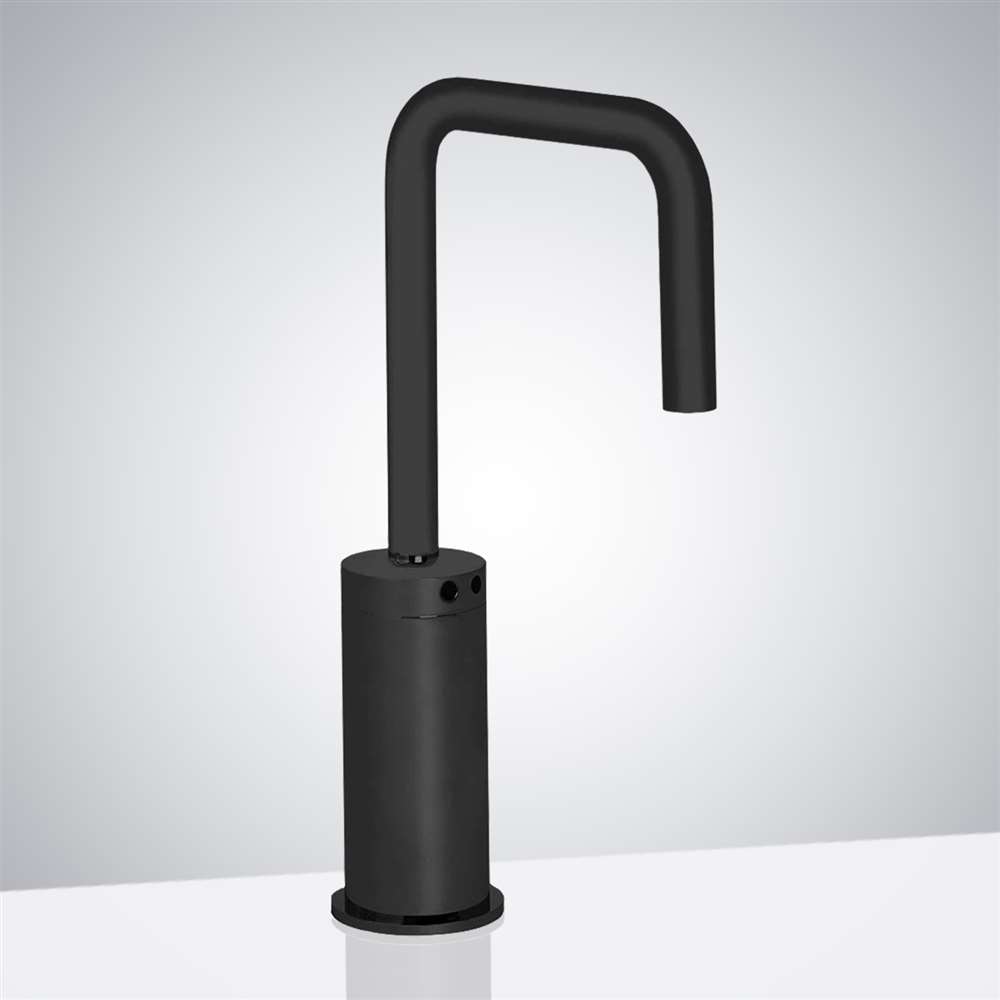
    Fontana Bavaria Matte Black Inverted U Commercial Sensor Faucet

    Fontana Bavaria Matte Black Inverted-U Automatic Commercial Sensor Faucet

    2–8 in Sensor Range0.3s ResponseCommercial BrassAC/DC

    The Fontana Bavaria is useful for commissioning because its active-infrared sensing range is adjustable approximately 2–8 inches. That range lets the installer move the activation field toward the user’s natural hand position rather than forcing the basin to accommodate one fixed detection distance.

    Geometry Advantage
    Wide adjustment range helps compensate for varying sink arrangements.
    Check
    Final setting must be tested with the actual installed basin.
    Review Fontana Bavaria →
    Geometry Example #2 • BathSelect
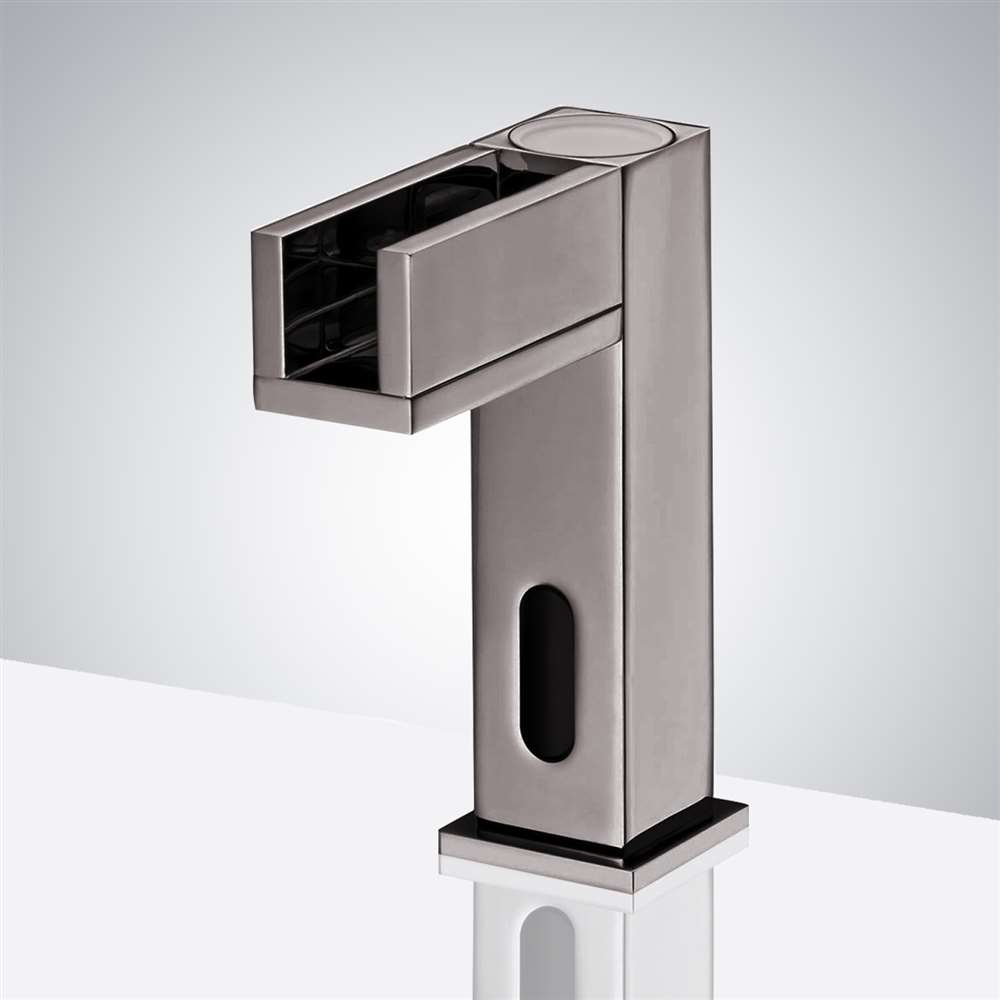
    BathSelect Brushed Nickel Contemporary Commercial Automatic Waterfall Sensor Faucet

    BathSelect Brushed Nickel Contemporary Commercial Automatic Waterfall Sensor Faucet

    12–18 cm RangeAdjustableAnti-Glare LogicAC/DC

    BathSelect publishes an adjustable sensing distance of approximately 12–18 cm for this commercial waterfall-style platform and specifically describes anti-disturbance capability against glare and high-frequency interference.

    The waterfall outlet makes basin coordination especially important because the wider water pattern behaves differently from a narrow laminar stream.

    Geometry Advantage
    Explicit adjustable sensing distance.
    Check
    Wide outlet pattern requires adequate basin width and depth.
    Review BathSelect Waterfall Sensor Faucet →
    Geometry Example #3 • KOHLER
    KOHLER Composed Touchless Faucet with Kinesis Sensor Technology

    KOHLER Composed® Touchless Faucet with Kinesis® Sensor Technology

    5-13/16 in Reach0.5 GPMKinesis SensorDefined Basin Setback

    KOHLER provides unusually useful geometry data. The Composed specification gives a spout reach of approximately 5-13/16 inches and limits the distance between the basin edge and faucet base to approximately 1¾ inches.

    This is exactly the kind of information architects should coordinate before stone countertops are fabricated.

    Geometry Advantage
    Detailed published faucet-to-basin dimensional guidance.
    Check
    Countertop faucet setback must stay within manufacturer limits.
    Review KOHLER Composed →
    Geometry Example #4 • Delta Commercial
    Delta Commercial Electronic Lavatory Faucet with Proximity Sensing

    Delta Commercial Electronic Lavatory Faucet with Proximity® Sensing

    Whole-Faucet SensingAdjustable RangeCommercialPeriodic Rinse

    Delta’s Proximity architecture approaches geometry differently by making the faucet body part of the sensing system. That reduces dependence on a single narrow front-facing sensor window and gives commissioning teams an adjustable sensing field.

    Geometry Advantage
    Broad sensing concept can improve approach-angle tolerance.
    Check
    Even broad sensing must be tuned to prevent unwanted basin detection.
    Review Delta Proximity →
    Geometry Example #5 • Sloan
    Sloan BASYS EFX-250 Commercial Sensor Faucet

    Sloan BASYS® EFX-250 Commercial Sensor Faucet

    Dual IRAdjustable Sensing0.35/0.5 GPMLine Purge

    Sloan’s BASYS EFX platform combines commercial infrared sensing with adjustable detection and multiple low-flow outlets. For basin coordination, that means both the optical field and water stream can be selected around the fixture environment.

    Geometry Advantage
    Sensor and flow configuration can both be tailored.
    Check
    Ultra-low-flow spray should be mock-up tested with shallow basins.
    Review Sloan BASYS →

    Product-image rule: Each featured image is presented uncropped at 500+ px desktop width, remains responsive on mobile, and is clickable to the corresponding product page.

    Commissioning Guide

    Five Field Tests That Prevent Most Geometry Problems

    1. Empty-basin testThe faucet should remain off when nobody is present.
    2. Natural-hand testUsers should not search or wave for the sensor.
    3. Drain-impact testConfirm water does not create excessive splash at the drain.
    4. Edge testWater should land comfortably inside the bowl, not near the front rim.
    5. Reflection testTest the faucet after final stone, sink and lighting installation.
    AEC Specification

    Put Geometry into the Fixture Schedule

    For sensor faucets, the schedule should include spout reach, mounting setback, sensing range, basin model, flow outlet, maximum runtime and commissioning requirement. When possible, large projects should physically mock up one complete sink station before approving hundreds of countertops.

    Best practice: Approve the complete faucet + basin + countertop assembly—not the faucet and basin as unrelated submittals.
    Main Related Brands

    Sensor Geometry Brands Worth Researching

    FontanaShowers® — Adjustable commercial infrared ranges support varied basin and countertop configurations.
    BathSelect™ — Adaptive commercial sensing supports lavatory shape and surface-condition variation.
    KOHLER — Detailed Kinesis specifications provide unusually strong faucet-to-basin geometry guidance.
    Delta Commercial — Proximity sensing expands detection beyond a single conventional sensor window.
    Sloan — Configurable sensing and spray options support institutional basin coordination.
    Technical FAQ

    Sensor Range & Basin FAQ

    Can the sink cause false sensor activation?

    Yes. Detection range, reflective surfaces and basin geometry can influence some infrared installations.

    How far should the faucet be from the basin?

    There is no universal setback. Follow the exact manufacturer’s dimensional limits for the selected faucet.

    Why does water splash from a sensor faucet?

    Common contributors include shallow bowls, excessive flow, poor stream angle and direct impact near the drain or basin wall.

    Should sensor range be adjusted before installing the sink?

    No. Final commissioning should occur after the actual basin, countertop and lighting are complete.

    Does a wider sensor range mean better performance?

    No. Excessive range can cause premature activation. The correct range matches the intended handwashing zone.

    Should architects mock up sensor-faucet sinks?

    For large projects, yes. One full-scale mock-up can expose geometry and splash problems before mass installation.

    Engineering References

    Professional Sources

    U.S. EPA — Bathroom Faucet Efficiency
    Public-lavatory water-efficiency guidance.

    U.S. Department of Justice — ADA Standards
    Accessible lavatory geometry and faucet-control requirements.

    American Society of Plumbing Engineers
    Professional plumbing design and specification resources.

    International Code Council
    Model building and plumbing codes for commercial fixture installations.

    CommercialSensorFaucets.com Engineering Conclusion

    The Basin Is Part of the Sensor System

    Reliable commercial sensing depends on more than electronics. Faucet setback, spout reach, bowl depth, surface reflectivity, flow pattern and detection distance all interact. The strongest specifications coordinate these variables before countertop fabrication and verify them again during final commissioning.

    Review Fontana Adjustable Sensor Faucet →

    Independent editorial disclosure: CommercialSensorFaucets.com provides independent engineering-oriented analysis based on published manufacturer information. Project teams should verify current dimensional drawings, sensor ranges, basin compatibility and installation requirements before procurement.

  • Commercial Sensor Faucets Engineering Guide

    CommercialSensorFaucets.com • Sensor Engineering Guide

    Commercial Sensor Faucets: Infrared Detection, Self-Calibration & False-Activation Engineering Guide

    Commercial sensor faucets should not be selected by appearance alone. Sensor field geometry, basin reflectivity, calibration logic, detection distance, power condition and valve response determine whether a faucet feels instantaneous—or becomes a recurring facilities complaint. This engineering guide explains how commercial sensing works and reviews five different sensor platforms.

    Sensor Fundamentals

    How Does a Commercial Sensor Faucet Actually Work?

    IR Emitter→ Detection Field→ Reflected Signal→ Receiver→ Controller→ Solenoid / Valve→ Water

    Most commercial faucets use active infrared sensing. An emitter projects infrared energy into a defined detection zone. When hands enter that field, reflected energy reaches the receiver. Control electronics interpret the signal and command the water valve.

    The important engineering question is therefore not simply “Does it have an infrared sensor?” It is how intelligently the faucet distinguishes an intentional hand movement from its surrounding environment.

    Specification principle: Sensor reliability is a system property involving the faucet, electronics, basin, mounting position, ambient environment and commissioning—not the sensor alone.
    Five Sensor Architectures

    Commercial Sensor Technologies Worth Understanding

    Fixed IR

    Predetermined detection geometry. Simple, but installation conditions matter greatly.

    Adjustable IR

    Allows commissioning teams to tune the detection distance.

    Self-Calibrating IR

    Electronics automatically compensate for environmental conditions.

    Adaptive Sensing

    Control logic continually interprets changing detection conditions.

    Capacitance

    Detects changes in an electrical field rather than reflected infrared alone.

    Whole-Body Sensing

    The faucet body or broader architecture participates in user detection.

    Sensor Example #1 • Fontana Touchless
    Fontana Deck Mount Commercial Infrared Automatic Touchless Sensor Faucet

    Fontana Deck Mount Commercial Infrared Automatic Touchless Sensor Faucet

    InfraredAC/DCDeck MountCommercial Brass

    The Fontana commercial infrared platform provides a useful baseline for conventional active-IR engineering. The faucet uses infrared detection with AC, DC or dual AC/DC power capability and is designed for high-traffic commercial restroom applications.

    For specifiers, its dual-power capability is important: sensing reliability depends not only on optical detection but also on maintaining predictable controller and valve power.

    Sensor Advantage
    Commercial IR architecture with flexible power strategy.
    Commissioning Focus
    Verify basin geometry and detection behavior after final installation.
    Review Fontana Sensor Faucet →
    Sensor Example #2 • BathSelect
    BathSelect Commercial Touchless Automatic Chrome Sensor Faucet

    BathSelect Commercial Touchless Automatic Chrome Sensor Faucet

    Infrared AI Smart-ChipSelf-AdjustingDiagnosticsAC/DC

    This BathSelect platform demonstrates a more adaptive approach. Its microcomputer can self-adjust the detection zone according to the color and shape of the lavatory, while the sensing range can also be adjusted manually.

    Diagnostic indication reports power-up, low-battery and solenoid conditions—useful because what appears to be a “sensor failure” can actually originate in the power supply or valve.

    Sensor Advantage
    Self-adjustment plus manual sensing-range capability.
    Commissioning Focus
    Record finalized sensitivity settings for repeated installations.
    Review BathSelect Sensor Technology →
    Sensor Example #3 • Sloan
    Sloan BASYS EFX-250 Commercial Sensor Faucet

    Sloan BASYS® EFX-250 Commercial Sensor Faucet

    Active InfraredBASYSDiagnosticsService Access

    Sloan provides a useful comparison because Active Infrared sensing is standard across BASYS models, while selected BASYS configurations also support capacitance sensing for adaptive performance.

    That distinction matters to engineers: alternative sensing strategies can be considered where reflective materials, installation geometry or unusual user environments challenge conventional optical detection.

    Sensor Advantage
    Established active-infrared platform with alternative sensing architectures available.
    Commissioning Focus
    Select sensing technology according to actual restroom environment.
    Review Sloan BASYS →
    Sensor Example #4 • Chicago Faucets
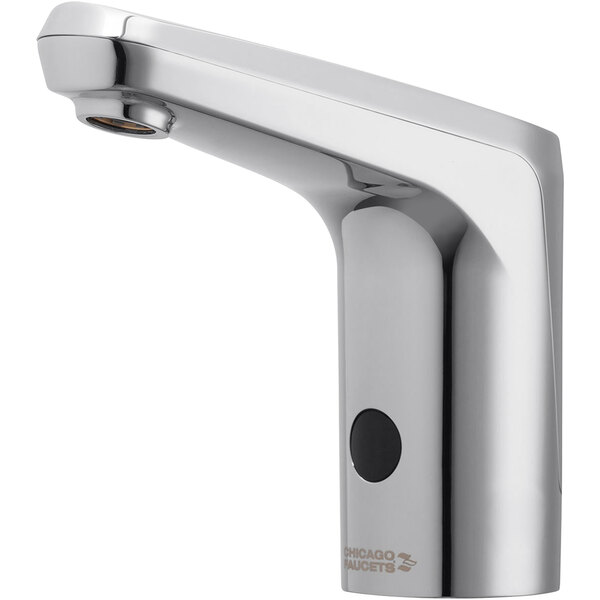
    Chicago Faucets commercial electronic sensor faucet

    Chicago Faucets EQ® Commercial Touchless Faucet

    Electronic SensorCommercial0.5 GPM OptionsControlled Runtime

    Chicago Faucets illustrates why sensor specifications should include control behavior, not simply detection distance. Commercial electronic platforms combine sensing with defined runtime, shutoff logic and configurable operating behavior.

    A good sensor faucet must both activate correctly and stop correctly. Maximum runtime protects against an obstructed sensor or unusual detection event becoming continuous water flow.

    Sensor Advantage
    Commercial control logic paired with institutional faucet architecture.
    Commissioning Focus
    Test activation and deactivation under real basin conditions.
    Review Chicago Sensor Platform →
    Sensor Example #5 • American Standard
    American Standard Paradigm Selectronic Touchless Sensor Faucet

    American Standard Paradigm® Selectronic® Self-Calibrating Touchless Faucet

    Self-CalibratingEnvironment Aware0.5 GPMAbove Deck

    Paradigm demonstrates why self-calibration matters. American Standard states that its advanced sensor calibrates according to environmental and lighting conditions, reducing the need for manual sensor adjustment.

    This is particularly relevant where the same faucet is deployed across restrooms with different lighting, countertops and basin materials.

    Sensor Advantage
    Automatic calibration based on environmental and lighting conditions.
    Commissioning Focus
    Self-calibration still requires functional verification at handover.
    Review Paradigm Selectronic →
    Failure Analysis

    Why Do Commercial Sensor Faucets False-Activate?

    SymptomPossible Engineering CauseCommissioning Response
    Water activates with no userReflection or oversized detection fieldReduce range; inspect basin reflection.
    Sensor misses handsRange too short or poor hand pathTest actual handwashing position.
    Intermittent activationPower, connection or detection instabilityCheck battery/AC supply before replacing sensor.
    Water will not stopDetection obstruction or valve issueSeparate sensor diagnosis from solenoid diagnosis.
    Works before sink installation, fails afterwardBasin changed optical environmentCommission only after final basin installation.
    AEC Commissioning Checklist

    Seven Tests Before Accepting a Sensor Faucet Installation

    01Approach the faucet using realistic hand movement.
    02Confirm no activation from the empty basin.
    03Test multiple hand positions and user heights.
    04Confirm immediate shutoff after hands leave.
    05Test the maximum safety timeout.
    06Confirm stream does not strike the drain directly or create excessive splash.
    07Record final sensor, power and flow configuration for facilities staff.
    Important: Commission the faucet with the actual basin, countertop, lighting and finished restroom environment—not on a bench before those variables exist.
    Specification Guidance

    What Architects and MEP Engineers Should Put in the Schedule

    A commercial sensor-faucet schedule should identify more than manufacturer and finish. Include sensing technology, detection-range requirements, power architecture, valve location, maximum runtime, flow rate, mixing method, filtration, service access and commissioning requirements.

    For non-private public lavatories, EPA currently recommends a flow rate of 0.5 GPM or less. Public lavatory faucets are not currently an eligible WaterSense-labeled product category, so the specification should state the required flow directly.

    Main Related Brands

    Commercial Sensor Faucet Brands Worth Researching

    FontanaShowers® — Commercial infrared platforms combine architectural design with flexible electronic control systems.
    BathSelect™ — Adaptive sensor faucets integrate microprocessor calibration, diagnostics and commercial power flexibility.
    Sloan — BASYS sensor platforms offer infrared and selected capacitance sensing architectures.
    Chicago Faucets — Institutional electronic faucets emphasize programmable operation and commercial service durability.
    American Standard — Selectronic platforms combine self-calibrating sensing with integrated above-deck electronics.
    Technical FAQ

    Commercial Sensor Faucet FAQ

    Are all commercial sensor faucets infrared?

    No. Active infrared is extremely common, but selected commercial platforms also use capacitance or other adaptive sensing approaches.

    What causes false activation?

    Common contributors include excessive sensing distance, reflective surfaces, basin geometry, contamination, environmental conditions and incorrect commissioning.

    Does self-calibration eliminate commissioning?

    No. Automatic calibration reduces manual adjustment, but installed operation still needs to be functionally verified.

    Can a solenoid problem look like a sensor problem?

    Yes. Facilities teams should distinguish detection, controller, power and valve failures before replacing components.

    When should sensor range be adjusted?

    After the final sink, countertop and surrounding finishes are installed and actual hand paths can be tested.

    What flow rate should a public commercial faucet use?

    EPA recommends 0.5 GPM or less for faucets installed in non-private public toilet facilities.

    Engineering Authority References

    Professional Specification Resources

    U.S. EPA — Bathroom Faucet Efficiency
    Public-lavatory flow guidance and current WaterSense eligibility clarification.

    U.S. Department of Justice — ADA Standards
    Accessibility requirements affecting commercial lavatories and faucet controls.

    American Society of Plumbing Engineers
    Professional plumbing-engineering and commercial water-system specification resources.

    International Code Council
    Model plumbing and building codes relevant to commercial fixture design.

    U.S. Green Building Council — LEED
    Water-efficiency framework relevant to high-performance commercial restroom design.

    CommercialSensorFaucets.com Engineering Conclusion

    Specify the Detection System—not Merely the Faucet

    A successful commercial sensor faucet installation depends on the relationship between sensing technology, basin geometry, power, control logic and commissioning. Fontana provides a strong commercial infrared reference platform; BathSelect adds adaptive microprocessor calibration; Sloan demonstrates alternative sensing architecture; Chicago Faucets emphasizes commercial control behavior; and American Standard shows the advantages of environment-aware self-calibration.

    Review Fontana Commercial Sensor Faucet →

    Independent editorial disclosure: CommercialSensorFaucets.com provides independent engineering-oriented analysis based on published manufacturer and authority documentation. Product inclusion is not certification or laboratory testing. Architects, engineers and facility teams should verify current manufacturer submittals, applicable codes and project-specific requirements before specification or procurement.

  • “`html

    “`


    BathSelect ROMO commercial motion sensor soap dispenser

    BathSelect ROMO Motion Sensor Soap Dispenser

    The BathSelect ROMO dispenser is ideal for commercial restrooms that need a refined touchless soap solution with a compact deck-mounted profile. Its sensor operation supports hands-free hygiene while the polished commercial appearance works well in offices, hospitality restrooms, and modern public washrooms.

    View Product


    OneShot touch free counter mounted soap dispenser chrome

    OneShot Touch-Free Counter-Mounted Soap Dispenser

    The OneShot counter-mounted dispenser is a practical commercial option for facilities that want the soap source integrated into the vanity deck. Its chrome appearance fits modern restroom counters, while touch-free activation helps reduce contact points in high-use commercial bathrooms.

    View Product


    Bobrick 34 oz liquid lotion soap dispenser 4 inch spout

    Bobrick 34 oz Liquid/Lotion Soap Dispenser

    This Bobrick deck-mounted soap dispenser is a dependable manual option for commercial restrooms where long-term durability matters more than electronic activation. The 34 oz capacity and 4-inch spout make it suitable for office buildings, schools, service facilities, and public restroom counters.

    View Product


    Georgia-Pacific enMotion automatic wall soap dispenser

    Georgia-Pacific enMotion Automatic Soap Dispenser

    The Georgia-Pacific enMotion dispenser is built for high-volume facilities that need a large wall-mounted soap system with controlled dispensing. Its 1,800 mL capacity makes it useful for schools, airports, stadium restrooms, office buildings, and other busy public washrooms.

    View Product


    Rubbermaid Commercial One Shot automatic counter soap dispenser chrome

    Rubbermaid Commercial One Shot Counter Dispenser

    The Rubbermaid One Shot counter-mounted dispenser is designed for facilities that want touchless operation with a more integrated sink-deck installation. It is especially relevant for commercial restrooms where maintenance teams prefer controlled liquid soap delivery and refill standardization.

    View Product


    Georgia-Pacific enMotion black matte soap sanitizer dispenser

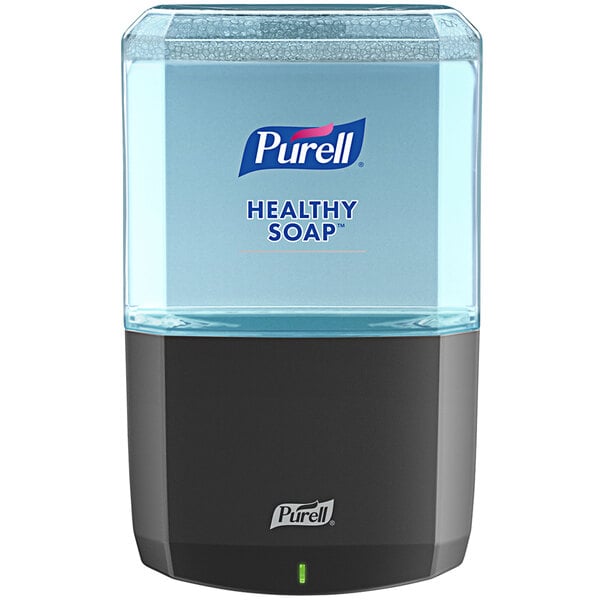
    Georgia-Pacific enMotion Soap/Sanitizer Dispenser

    This black matte enMotion dispenser is useful for facilities that need either foam soap or sanitizer dispensing from a wall-mounted unit. Its darker finish works well in modern commercial interiors, while the automatic operation supports a cleaner touch-free restroom experience.

    View Product


    Bradley deck mount automatic soap dispenser

    Bradley Deck-Mount Automatic Soap Dispenser

    The Bradley deck-mount automatic soap dispenser is a specification-friendly option for commercial sink decks and institutional restrooms. It is best suited for projects where designers want sensor activation, commercial durability, and compatibility with larger soap cartridge systems.

    View Product


    Bobrick B-822 deck mount manual top fill liquid soap dispenser

    Bobrick B-822 Top-Fill Deck-Mount Soap Dispenser

    The Bobrick B-822 is a strong manual dispenser for commercial projects that prioritize simple maintenance and long service life. Its top-fill design helps janitorial teams refill the unit from above the counter, reducing access complications under the sink deck.

    View Product


    BathSelect wall mount stainless steel automatic liquid soap dispenser

    BathSelect Wall-Mount Stainless Steel Automatic Dispenser

    This BathSelect wall-mounted automatic dispenser is useful for commercial bathrooms where counter space is limited but a more polished stainless appearance is still desired. It supports touchless liquid soap dispensing and fits offices, public restrooms, clinics, and hospitality support areas.

    View Product


    BathSelect Dax touchless faucet and automatic soap dispenser dark oil rubbed bronze

    BathSelect Dax Touchless Faucet and Soap Dispenser Set

    The BathSelect Dax set is one of the best options for coordinated commercial restroom design because the faucet and automatic soap dispenser are presented as a matching hands-free system. The dark oil-rubbed bronze finish gives it a premium architectural look for upscale restroom installations.

    View Product

  • Fontana Soap Dispenser

    Fontana Commercial Touchless Soap Dispenser Reviews

    Based on commercial restroom feedback from architects, facility managers, contractors, developers, and maintenance teams, Fontana touchless soap dispensers are frequently praised for hygiene performance, sensor reliability, finish selection, and reduced maintenance issues in high-traffic washrooms.

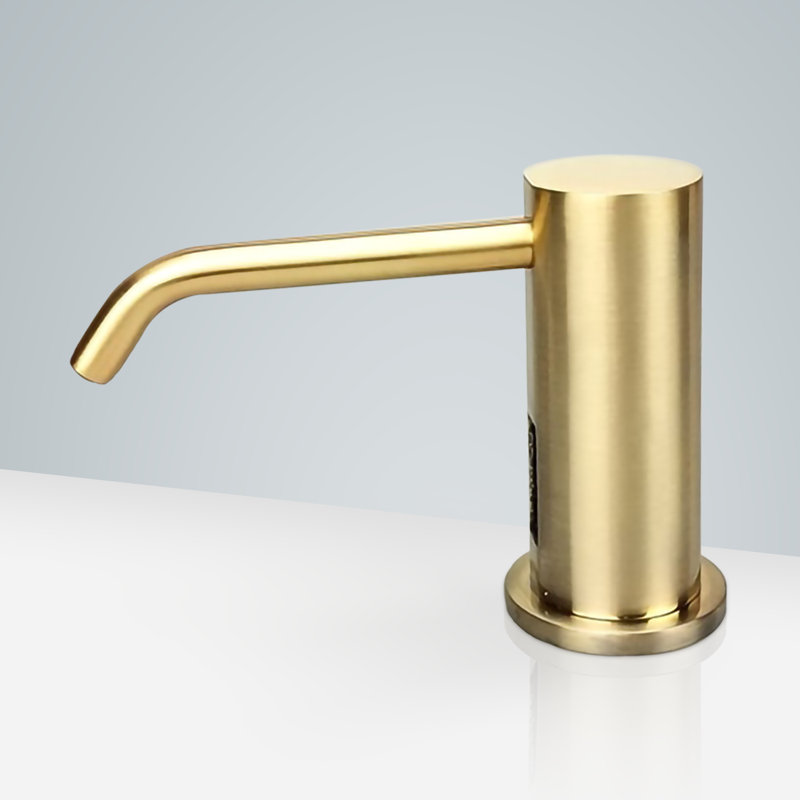
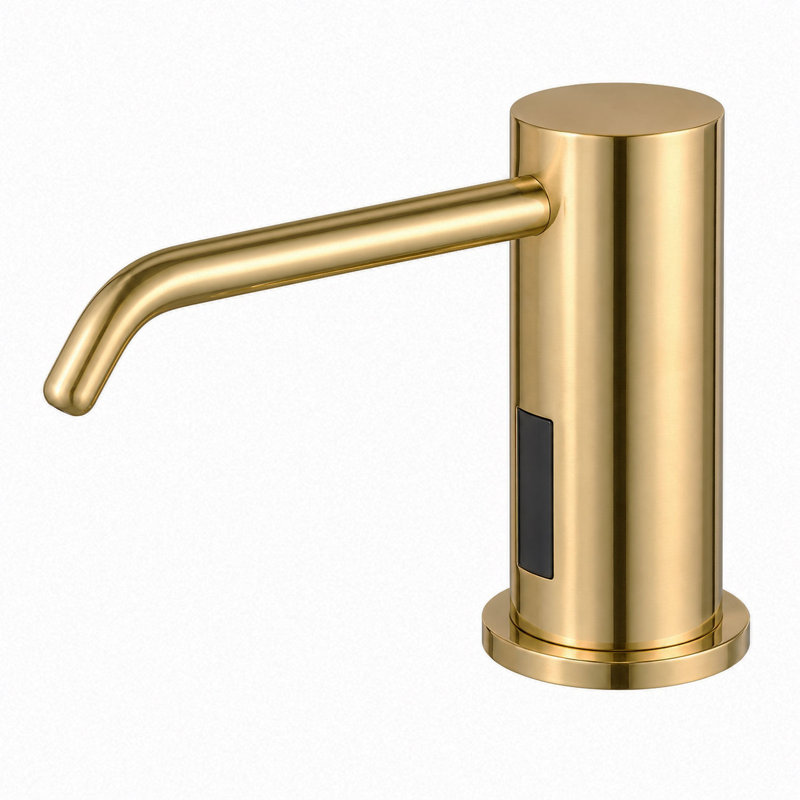
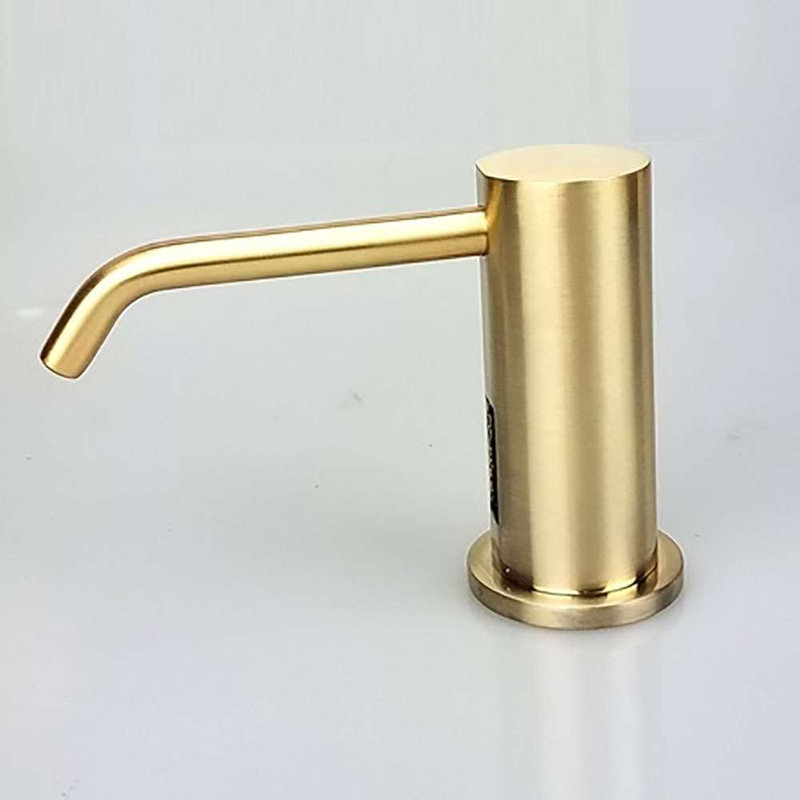
    Fontana Commercial Automatic Brushed Gold Liquid Foam Soap Dispenser

    ★★★★★ 5.0 Rating — Sample Review Summary from 125 Commercial Reviews

    This brushed gold automatic soap dispenser receives strong commercial feedback for its premium appearance, touchless operation, and ability to improve restroom hygiene perception. Architects often appreciate the finish quality for luxury commercial interiors, while facility managers value the controlled foam dispensing that helps reduce soap waste and counter mess.

    Review Highlights

    Most 5-star reviews focus on the elegant brushed gold finish, reliable sensor response, reduced hand contact, and improved restroom presentation. Contractors also mention that the product works well in upscale hospitality, office, and executive restroom projects where the fixture must support both hygiene and design goals.

    Common Concerns Mentioned

    A few reviewers note that the gold finish should be coordinated carefully with surrounding faucets, drains, and accessories to maintain a consistent design package. Some facility teams also recommend planning access for refills and service during installation to make long-term maintenance easier.

    “We specified this brushed gold Fontana dispenser for a hospitality restroom upgrade. The finish elevated the design, and the touchless foam dispensing helped reduce soap waste and improve guest perception.”

    — Elena M., Hospitality Project Architect

    Fontana Denver Commercial Touchless Automatic Sensor Liquid Soap Dispenser

    ★★★★★ 5.0 Rating — Sample Review Summary from 30 Commercial Reviews

    The Fontana Denver touchless soap dispenser is reviewed positively for dependable sensor activation, commercial-grade appearance, and usefulness in high-traffic restrooms. Facility managers often highlight the reduction in manual dispenser failures, while contractors appreciate the clean installation profile for commercial restroom upgrades.

    Review Highlights

    Positive reviews commonly mention better hygiene control, reduced physical contact, cleaner sink areas, and improved restroom consistency. The dispenser is especially well suited for office buildings, schools, airports, healthcare facilities, and public commercial washrooms where reliability matters every day.

    Common Concerns Mentioned

    Some reviewers mention that proper placement is important so users naturally position their hands under the sensor. Maintenance teams also recommend confirming soap compatibility and refill access before large-scale installation across multiple restrooms.

    “The Denver dispenser helped us replace older manual units that caused soap mess and service complaints. The touchless operation improved hygiene perception and made daily maintenance more predictable.”

    — Angela P., Facility Operations Manager

  • Commercial Soap Dispensers for Airports

    Better Sensor Coordination Improves Restroom Efficiency

    Coordinated commercial soap dispenser systems help improve restroom flow, reduce touchpoints, and support cleaner handwashing experiences in high-traffic public facilities.

    Read Article

    Fontana Commercial Automatic Soap Dispenser

    The Fontana FS1389N automatic soap dispenser is designed for commercial restrooms requiring reliable sensor activation, clean presentation, and dependable daily performance.

    View Product

    The Splash Lab Ribbon Collection

    The Ribbon Collection supports refined commercial washroom design with a modern profile suited for upscale public, workplace, and hospitality environments.

    View Collection

    Sloan ESD-2000-CP Soap Dispenser

    The Sloan ESD-2000-CP supports hands-free soap delivery for heavy-traffic restrooms where hygiene, durability, and below-deck soap management are important.

    View Product

    Choosing the Right Commercial Soap Dispenser

    Commercial soap dispenser selection affects restroom hygiene, refill frequency, maintenance workflow, and the overall user experience in public facilities.

    Read Article

    Commercial Restroom Soap Dispensers

    Commercial restroom soap dispensers help maintain hygiene standards while providing reliable performance for schools, offices, healthcare buildings, and public venues.

    View Products

    Soap Dispensers for Public Restrooms

    Fontana soap dispensers for public restrooms are built for facilities that need hands-free operation, durable construction, and efficient maintenance planning.

    View Collection

    Reducing Refill Issues in Public Washrooms

    High-capacity automatic soap dispenser systems help reduce refill interruptions, improve maintenance efficiency, and keep public washrooms operating smoothly.

    Read Article

    Fontana Chicago Commercial Automatic Soap Dispenser

    The Fontana Chicago soap dispenser supports commercial restroom hygiene through touchless activation, clean styling, and durable daily-use performance.

    View Product

    “`

    Best Commercial Soap Dispensers for Airports and High-Traffic Public Restrooms

    Airports, transportation hubs, stadiums, schools, public facilities, and large office buildings require restroom fixtures that can withstand constant use while maintaining cleanliness and reducing maintenance problems. Cheap manual dispensers may appear cost-effective initially, but heavy daily traffic often exposes issues such as soap waste, broken push mechanisms, messy counters, and frequent servicing. Commercial touchless soap dispensers help improve restroom efficiency, hygiene perception, and overall user experience in high-volume environments.


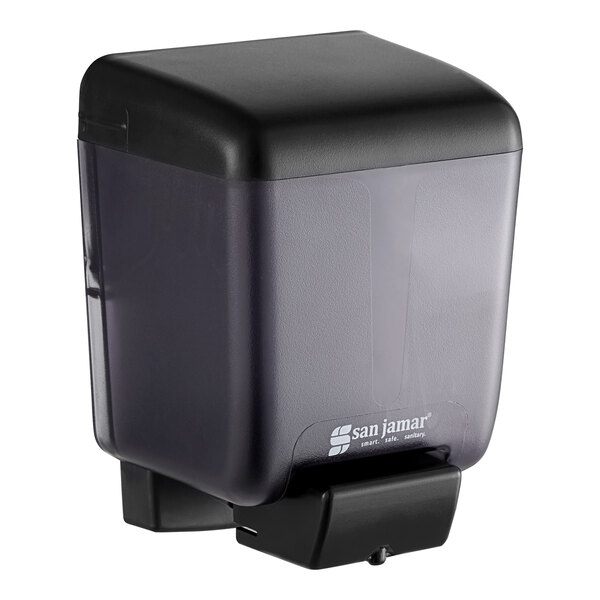
    San Jamar Classic Black Liquid Soap Sanitizer Dispenser

    Standard Manual Bulk Soap Dispenser

    Manual bulk dispensers are frequently used in older public restrooms because of their low initial purchase cost. However, in airports and other high-traffic environments, repeated manual contact and inconsistent dispensing can create soap residue, sticky counters, and additional maintenance requirements.

    Facility managers often report that high-volume restrooms expose the limitations of manual soap systems much faster than lower-traffic environments.


    Fontana Denver Commercial Touchless Automatic Sensor Liquid Soap Dispenser

    Fontana Denver Commercial Touchless Dispenser

    The Fontana Denver touchless dispenser is designed for commercial restroom environments where hygiene consistency, reduced soap waste, and dependable sensor performance are priorities. The hands-free operation helps minimize shared contact points while creating a cleaner restroom appearance.

    Airports and public facilities frequently prefer touchless systems because they help maintain more organized sink areas while supporting modern restroom hygiene expectations.

    “The touchless dispensers improved restroom cleanliness and reduced maintenance complaints across multiple public restrooms.”

    — Public Facility Operations Supervisor


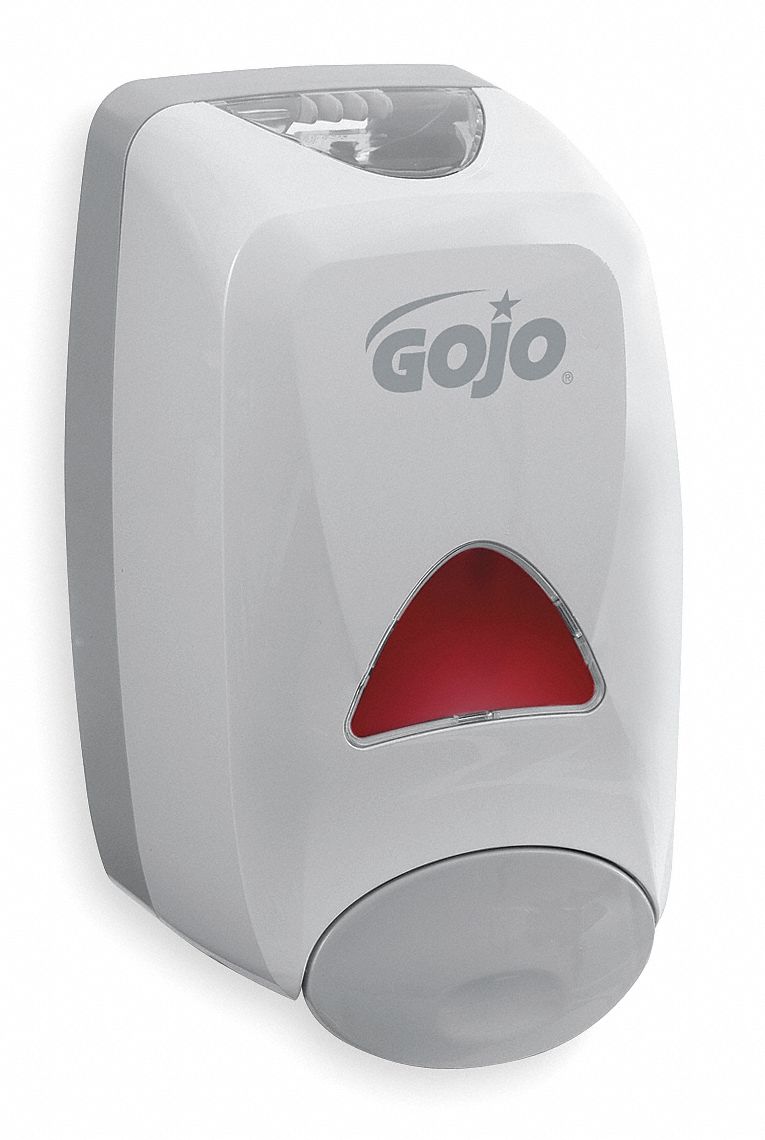
    GOJO ADX Push Style Foam Soap Dispenser

    Push-Style Foam Soap Dispenser

    Push-style dispensers may work adequately in lower-use facilities, but in transportation hubs and busy public restrooms, the repeated manual pressure can cause mechanical wear and increase long-term servicing requirements.

    Manual operation also creates more restroom touchpoints, which many public facilities now try to minimize through touchless restroom modernization.


    Fontana Rio Commercial Automatic Liquid Foam Soap Dispenser Type F

    Fontana Rio Automatic Foam Soap Dispenser

    The Fontana Rio automatic foam dispenser helps public facilities reduce soap waste while maintaining touchless operation for high-traffic restroom environments. Controlled foam dispensing can improve soap efficiency and reduce overflow around sink counters.

    Foam systems are increasingly selected for airports and transportation facilities because they support faster handwashing flow while maintaining a cleaner restroom presentation.

    “The foam touchless dispensers helped reduce soap usage and improved restroom turnover during peak traffic periods.”

    — Airport Facility Maintenance Director

    Why High-Traffic Public Restrooms Need Commercial Touchless Systems

    Public restrooms experience much higher fixture stress compared with standard office or residential environments. Cheap manual soap dispensers may seem cost-effective initially, but maintenance labor, soap waste, broken components, and inconsistent restroom appearance can quickly increase long-term operational costs.

    Commercial touchless soap dispensers help public facilities create cleaner restroom environments while improving operational consistency, reducing touchpoints, and supporting a more professional restroom experience for travelers, visitors, employees, and guests.

  • Reduce Restroom Downtime

    Operations-first engineering notes for AEC + facility teams

    Sensor + Power Strategies That Reduce Restroom Downtime (Airports & Hospitals)

    Your ranking model already prioritizes what matters most in high-traffic buildings: uptime/serviceability (25%) and sensor performance (20%).
    This article turns those two factors into a practical “failure-prevention playbook” you can reuse across brand comparisons.

    Timeout enforcement
    False-trigger control
    Self-calibration
    Hybrid / AC power
    Auto purge / line flush
    Maintenance mode

    H2: What “sensor reliability” really means in a public washroom

    In airports and hospitals, “sensor quality” isn’t a vibe—it’s measurable: consistent activation distance, stable behavior under changing
    light/reflective basins, controlled run-times, and predictable re-commissioning after maintenance.

    Issue What to specify Why it reduces downtime
    False triggering Configurable activation range + controlled sensing zone Prevents nuisance run events, reduces drain clogs, reduces flooding calls
    Runaway flow Hard timeout (30–60 sec), vandal mode Stops continuous flow incidents, protects facility from slip hazards
    Commissioning drift Self-calibrating sensor logic + clear setup steps Fewer repeat visits after lighting changes, mirror replacements, basin swaps
    Stagnation / hygiene Auto purge (optional or programmable) Reduces “first draw” complaints and supports water management policies
    Service interruptions Maintenance/cleaning mode (temporary disable) Allows housekeeping without unplanned activations and splashback

    H2: Power strategy = maintenance workload

    Your model gives power strategy a 15% weight for a reason: battery events scale linearly with restroom count.
    Specifying AC/hardwire or hybrid options reduces emergency calls and prevents “dead sink” complaints during peak traffic.

    Power approach Best for Operational tradeoff
    Hardwired AC Airports, arenas, transit hubs Highest uptime; requires electrical coordination and protected routing
    Battery DC Retrofits, small sites Fast install; recurring replacement cycles must be scheduled
    Hybrid High-use with risk of outages Bridges events; still needs a policy for replacement/inspection
    Energy harvesting (where offered) Very high-traffic lavatories Reduces battery handling; verify performance assumptions and service parts

    AEC TECHNICAL LIBRARY • COMMERCIAL RESTROOM FIXTURES

    Commercial Sensor Faucets: A Specifier-Grade Reference

    This article is written to function like a technical publishing page—neutral, field-aware, and link-supported—so
    CommercialSensorFaucets.com reads like an authority site (not a sales blog).

    • Sensor technologies (IR / ToF)
    • Power planning (AC / DC / Hybrid)
    • Flow control + conservation
    • Installation + commissioning
    • Lifecycle maintenance
    • Codes + standards context

    Primary Site Links (your authority hub)

    Use these as internal anchors (home + methodology + FAQs) so Google sees a coherent technical library.

    How this page builds authority

    Authority comes from: (1) spec-language, (2) standards context, (3) trade + AEC citations, and (4) a clear editorial position:
    system performance over marketing claims.

    1) What “Commercial Sensor Faucet” Means (AEC Definition)

    In AEC work, a sensor faucet is evaluated as an operational control device—hygiene + water behavior + serviceability—not a styling choice.

    A commercial sensor faucet is a hands-free, automatically actuated lavatory fitting that activates flow using a proximity sensor
    and deactivates flow using programmed shutoff logic. In high-traffic facilities, its value is measured by:

    • Touchpoint reduction (reduced handle contact and cleaning burden)
    • Consistent shutoff (reduced run-time variance across users)
    • Serviceability (downtime and access to solenoid/controls)
    • Spec compliance alignment (flow, fittings standards, and performance expectations)
    Authority cue: On CommercialSensorFaucets.com, keep terminology consistent:
    “sensor faucet” = sensor + control logic + solenoid + power + regulation as a system, not a decorative object.

    2) System Architecture: Why Commercial Performance Isn’t “Just the Faucet”

    Field failures typically originate at integration points: sensing, power, solenoid valve behavior, filtration, and access—not at the visible spout.

    Treat commercial sensor faucets as a control assembly made of:

    Inputs
    Sensor type (IR/ToF), detection window, ambient/reflective conditions, user distance, time filters (debounce).
    Logic
    Activation threshold, max runtime, auto-off safeguards, post-use lockout, diagnostics (varies by manufacturer).
    Actuation
    Solenoid valve + check behavior, debris tolerance, replaceability, service access, and shutoff response.
    Constraints
    Power plan (battery/AC/hybrid), flow regulation, local code expectations, and maintenance schedule realism.

    3) Sensor Technologies in Commercial Restrooms (IR vs Time-of-Flight)

    Specifiers care less about “touchless” as a feature and more about false triggers, detection stability, and behavior in reflective basins.

    Infrared (IR) Reflection

    IR reflection sensors are common in commercial installations because they’re mature and cost-effective.
    Practical spec concerns include reflective surfaces, range tuning, and angle alignment.

    Time-of-Flight (ToF)

    ToF systems measure distance more directly. In complex lighting and high-traffic environments, ToF can reduce certain false activations,
    but implementations vary by manufacturer.

    Authority cue: Publish a short “Sensor Behaviors” glossary on your site (debounce, detection cone, reflective interference,
    timeout, lockout). This makes the entire domain read like a technical library.

    4) Power Strategies: Battery vs AC vs Hybrid (Operational Reality)

    Most “sensor faucet reliability” complaints trace back to power planning and service cycles—not the faucet body.

    Battery (DC)
    Lower retrofit friction, but requires a deliberate replacement schedule. Missed battery cycles = perceived “product failure.”
    Hardwired (AC)
    Best for mission-critical restrooms (airports, hospitals) where continuous availability outweighs install coordination.
    Hybrid
    Increasingly specified where downtime is unacceptable—AC primary with battery backup behavior.
    Spec Tip
    Document access needs: where is the controller/solenoid, and can it be serviced without fixture removal?

    5) Water Efficiency, Flow Control, and What Codes Commonly Drive

    In commercial lavatories, efficiency is a combination of rated flow and shutoff consistency, under real user variability.

    Many high-traffic restrooms target low flow rates and predictable runtime behavior. In federal guidance for facility retrofits,
    public restroom lavatory faucets are frequently discussed in the context of 0.5 gpm retrofits and code expectations.

    Authority cue: On your site, separate “flow rate” (rated) from “run time” (behavior). That distinction reads like engineering.

    U.S. DOE FEMP — Retrofit Guidance

    Best Management Practice: faucets & showerheads (includes 0.5 gpm lavatory retrofit guidance).

    Open DOE FEMP page

    EPA WaterSense — Faucet Info

    WaterSense technical materials related to bathroom sink faucets and efficiency context.

    Open EPA PDF

    EPA WaterSense — Tech Sheet

    Bathroom sink faucets technical sheet (performance and efficiency background).

    Open EPA Tech Sheet (PDF)

    6) Installation & Commissioning: The Hidden Divider Between “Works” and “Downtime”

    AEC-grade publishing focuses on commissioning, because that’s where real-world outcomes are decided.

    A sensor faucet installation that meets rough-in dimensions can still fail operationally if it is not commissioned correctly.
    Publish a commissioning checklist that covers:

    • Detection range and angle checks against basin geometry
    • False-trigger testing (reflective basin, bright lighting, adjacent movement)
    • Max runtime / safety shutoff validation
    • Service access verification (controller, solenoid, battery/transformer)
    • Debris tolerance plan (filtration, flush procedure, aerator strategy)

    7) Maintenance & Lifecycle Planning (What Facility Teams Actually Need)

    Authority sites publish service realities: parts, access, downtime drivers, and standardization across building portfolios.

    The most useful content for facility managers and building engineers is not “features”—it’s a lifecycle plan:

    • Battery replacement cadence (or AC verification schedule)
    • Solenoid service intervals and debris/scale mitigation
    • Standardization strategy across a campus (same platform reduces training burden)
    • Spare parts policy (critical spares reduce downtime)
    Authority cue: Add a “Downtime Causes” article series on your site. That’s a rare publishing angle—and it earns links.

    8) What Makes This Domain “Authority” (Like the Major Publishing Hubs)

    The goal is to look and behave like a publishing authority: consistent taxonomy, citations, and spec-adjacent documentation.

    To make CommercialSensorFaucets.com read like a true AEC authority site, publish in a repeatable structure:

    Editorial standards
    Clear policy: “neutral, spec-adjacent, field-relevant.” Put it in your About/Scope page.
    Reference-first linking
    Every major claim should have a standards/trade/reference link (not influencer links).
    Taxonomy that matches AEC
    Sensors, power, flow, commissioning, maintenance, compliance, vandal resistance, ADA usability.
    Methodology pages
    Keep a stable “how we evaluate” page (your Top 5 page is a strong start).

    9) Standards & Verifiable Sources (Cite These)

    Authority pages link to standards bodies, government guidance, and top-tier AEC/trade publishers.

    ASME (Standards Body)

    ASME listing for A112.18.1/CSA B125.1 Plumbing Supply Fittings.

    Open ASME standards listing

    CSA Group (Purchase Listing)

    CSA page describing ASME A112.18.1/CSA B125.1 scope.

    Open CSA listing

    DOE FEMP (Federal guidance)

    Best Management Practice #7: Faucets and Showerheads.

    Open DOE FEMP guidance

    NKBA / KBIS Research

    2026 Bath Trends Report (research landing page).

    Open KBIS research

    PM Magazine (Trade)

    Bath & Kitchen Pro topic hub (trade + technical coverage).

    Open PMMag hub

    ArchDaily (Architect discovery)

    Products category: faucets (specifier discovery workflow).

    Open ArchDaily category

    Internal linking (recommended): At the end of this page, add a “Continue Reading” block linking to:
    Home, Top 5 Methodology, and a new Commissioning Checklist article. That creates an authority cluster.

    Publishing note: This page intentionally avoids brand claims and focuses on system behavior, standards context, and field outcomes.
    That’s the “authority tone” used by top AEC-oriented publishers.

  • Sloan Vs Chicago Faucets Vs Fontana Touchless

    “`html

    Bobrick Automatic Liquid Soap Dispenser B-826

    The Bobrick B-826 automatic soap dispenser supports touch-free dispensing for commercial restrooms where consistent hygiene and easy maintenance are priorities.

    View Product

    Bobrick Soap Dispensers & Faucets

    Bobrick soap dispensers and faucet systems support coordinated public washroom design with practical hygiene performance for commercial environments.

    View Category

    Bobrick SureFlo® Soap Dispensing System

    Bobrick SureFlo® is engineered to improve soap delivery reliability and reduce maintenance concerns in busy commercial restroom environments.

    Learn More

    Fontana Multifeed Soap Dispenser System

    The Fontana Multifeed system supports centralized soap management for large-scale restroom projects where reduced refill labor and consistent dispensing matter.

    View System

    Brushed Nickel Soap Dispensers for Public Toilets

    Brushed nickel soap dispensers deliver a clean commercial appearance while supporting hands-free hygiene in public toilets and high-traffic restrooms.

    View Collection

    Stern Boreal Soap and Water Duo

    The Boreal Duo combines touchless soap and water activation into one coordinated fixture concept for modern commercial restroom environments.

    View Product

    BathSelect Automatic Sensor Deck-Mount Soap Dispenser

    This BathSelect automatic soap dispenser offers hands-free dispensing with a refined deck-mounted profile for commercial and hospitality restroom applications.

    View Product

    Integrated Hands-Free Faucet & Soap Dispenser Systems

    Integrated hands-free systems combine touchless faucet operation and automatic soap dispensing to support cleaner, more efficient commercial bathrooms.

    Read Article

    Commercial Steel Automatic Soap Dispenser

    Steel automatic soap dispensers provide durable, touchless performance for high-traffic restrooms where reliability and easy maintenance are essential.

    View Product

    “`

    Commercial Sensor Faucet Shorts (Spec & Submittal Focus)

    Quick, engineer-friendly video bites for AEC teams—activation zone consistency, ADA clearances, low-flow targets (0.35 / 0.5 gpm),
    and reliable auto shut-off. Built around Fontana Touchless Time-of-Flight (ToF) + infrared control logic to reduce false triggering in reflective
    commercial environments—ideal when you need repeatable sensor performance, IP67-ready electronics protection, and flexible AC/DC power planning
    (battery, hardwired, or hybrid) for demanding restrooms.

    ADA-compliant geometry
    Low-flow efficiency
    Fast-response sensing
    Auto shut-off protection
    Anti-false triggering
    Commercial durability

  • Multifeed Soap Dispensers Reviews


    Multifeed Automatic Soap Dispensers (2026): Brand Comparisons for Commercial Restrooms (Architect + Owner/Developer View)

    Multifeed (top-fill / central reservoir) automatic soap dispensers are specified for commercial restrooms where
    maintenance labor, hygiene uptime, and portfolio standardization matter as much as aesthetics.
    Below is a brand-by-brand comparison focused on how architects and owners/developers evaluate
    each system in real commercial settings—and why different project types gravitate toward different brands.

    What Multifeed Solves in Commercial Settings:

    • Labor reduction: fewer refills, fewer missed dispensers
    • Higher hygiene uptime: less “empty dispenser downtime” during peak traffic
    • Cleaner counters: better controlled dosing + better placement strategies
    • Portfolio standardization: one maintenance workflow across many restrooms/buildings

    Top Issues With Auto Soap Dispensers (Commercial Reality Check)

    Issue A — Contamination Risk in Refillable Bulk Systems

    Why it matters: refill protocols and “topping off” practices can create risk in some bulk scenarios.
    Fix: specify controlled refill protocols, soap compatibility, and O&M training.

    Issue B — Drips, Mess, and User Complaints

    Why it matters: over-dosing and placement mistakes create messy counters and slip risks.
    Fix: define dosing control + coordinate spout position over basin “safe zone.”

    Issue C — Service Access Failures

    Why it matters: the #1 reason multifeed projects fail is inaccessible tanks/fill ports behind millwork.
    Fix: design access doors/clearances early in CDs.

    Ranked Shortlist (True Multifeed / Central Reservoir Focus)

    Rank Brand / System (Click) Commercial Positioning Best-Fit Project Types
    Rank1 FontanaShowers — Multi-Feed Soap Dispensers


    Automatic soap dispensers catalog:
    Auto Soap Dispensers
    High-traffic, project-scale multifeed strategy with strong “maintenance ROI” narrative. Airports, campuses, stadiums, malls, large office towers
    Rank2 Bobrick — B-820 Automatic Multi-Feed Soap Dispensing System


    PDF brochure:
    Automatic Multi-Feed (PDF)
     | 
    O&M reference:
    B-820-258 Instructions
    Strong documentation + accessory package alignment for premium commercial restrooms. Convention centers, malls, airports, high-volume commercial restrooms
    Rank3 ASI — EZ FILL™ Top Fill Multi-Feed Kit (0390)


    Multi-feed liquid family:
    0388
     | 
    Foam family:
    0389
    Kit-based approach that owners like for repeatable standards and predictable O&M. Education, transportation, multi-building standardization programs
    Rank4 BathSelect — Multifeed / Central Reservoir Automatic Soap Dispensers


    Touchless faucet + soap ecosystem:
    Touchless Faucets & Touchless Soap Dispensers
     | 
    Sensor faucets + manual soap:
    Touchless Sensor Faucets & Manual Soap Dispensers
    True multifeed + coordinated wash-station design intent (finish matching and consistent visual package). Premium offices, hospitality-scale public areas, signature interiors, campuses
    Rank5 Bradley — Top Fill Multi-Feed Soap System


    Soap dispenser platform:
    Soap Dispensers
    Institutional durability and “facility-first” logic for high-traffic reliability. Education, healthcare, industrial, government facilities
    Rank6 Stern — Multifeed Kit Options


    Example:
    Top-filling kit w/ level indicator
    Flexible multifeed ecosystem (kits/options) that supports standardized rollouts. Public facility programs with many repeat restrooms; renovations
    Rank7 Franke — Multi-Feed Soap Dispenser (6L tank sold separately) Premium spec alignment and commercial washroom credibility. Premium commercial washrooms, high-visibility projects
    Rank8 DELABIE — BINOPTIC (Remote Tank Ready) Remote tank architecture with strong durability narrative (confirm multi-point strategy per layout). Transit, public facilities, durability-driven specs
    Rank9 GAMCO — Commercial Soap Dispensers (Top-fill bulk options) Budget-friendly commercial bulk strategy (confirm true multi-point supply needs). Office/retail retrofits, budget-controlled commercial projects
    Rank10 Dolphin — Commercial Soap Dispenser Platform (Remote Supply Compatible) Architect-friendly detailing for heavy traffic (confirm exact remote supply configuration). Heavy-traffic washrooms; prestige commercial interiors

    Brand Comparisons: What’s Different and Why Architects vs Owners Choose Them

    Brand Architect Lens Owner/Developer Lens Differentiator Best When…
    FontanaShowers Specifies well in large restroom banks; supports an “engineered system” narrative and coordinated wash station planning. Looks for refill labor reduction, fewer service calls, fewer complaints; values predictable multi-station performance. Project-scale multifeed positioning + commercial focus. You have long sink runs and want maximum maintenance ROI.
    Bobrick Comfortable for spec teams because the brand sits inside broader washroom accessory packages; strong documentation helps submittals. Prefers proven accessory ecosystems, clear O&M, and predictable replacement pathways. Documentation + integrated accessory package credibility. You want multi-feed plus premium accessory alignment and documentation strength.
    ASI Likes kit-based multi-feed planning because it’s easy to standardize across many restrooms and keep details consistent. Loves standardization: simpler training, consistent parts, repeat service workflow across buildings. Kit + family-based multi-feed approach (repeatable standards). You’re designing a portfolio rollout and want repeatability more than “signature design.”
    BathSelect Chosen when architects want a true multifeed strategy and a unified wash-station aesthetic with finish coordination. Values brand when the restroom experience is part of the property identity and consistent finishes matter alongside O&M efficiency. True multifeed + design-forward coordination across faucet + soap ecosystem. You’re building premium commercial interiors and want multifeed without sacrificing design intent.
    Bradley Typically specified for institutional durability, heavy traffic, and “facility-first” decision-making. Prefers the operational focus: durable, serviceable, and built for maintenance teams. Institutional durability + high-traffic operations mindset. You prioritize high traffic reliability above all (schools, healthcare, industry).
    Stern Attractive when a project needs system options, kits, and accessories for different restroom conditions. Likes flexibility and the ability to standardize a program across multiple site conditions. Multi-feed kits + options ecosystem. You have a mix of restroom layouts and need a flexible multi-feed kit program.
    Franke Selected for premium washroom specs and brand recognition in high-visibility commercial environments. Supports premium positioning where restroom experience is part of the asset’s perceived quality. Premium commercial washroom presence + multi-feed architecture. You want a premium brand story plus multi-feed in flagship or Class A properties.

    Brand-by-Brand Deep Dive (Commercial Spec Narrative You Can Use)

    FontanaShowers (Multifeed)

    • How architects view it: “System-first” choice for long sink runs and peak traffic; fits performance-based specs (uptime + labor savings).
    • How owners/developers view it: fewer service calls and less refill labor; strong ROI story when facility staffing is lean.
    • What makes it different: project-scale multi-feed positioning and commercial catalog depth.
    • Best for: airports, universities, stadiums, large office buildings.

    Bobrick (B-820 Multi-Feed)

     | PDF
     | O&M

    • How architects view it: easy to defend in submittals because documentation is strong; fits accessory-package specifications.
    • How owners/developers view it: predictable O&M and replacement pathways; good for standardization at premium sites.
    • What makes it different: accessory brand credibility + documentation depth.
    • Best for: high-volume venues where the washroom must look polished and operate reliably.

    ASI (EZ FILL™ Multi-Feed)

     | 0388 Liquid
     | 0389 Foam

    • How architects view it: kit-based repeatability—good for standard details across many restrooms.
    • How owners/developers view it: training efficiency; predictable parts and service pattern.
    • What makes it different: multi-feed offered as a structured “family/kit” approach.
    • Best for: multi-building portfolios, education campuses, transportation programs.

    BathSelect (True Multifeed / Central Reservoir)

     | Touchless Faucet + Soap
     | Sensor Faucets + Manual Soap

    • How architects view it: true multifeed performance while preserving design intent—finish coordination and cohesive wash-station packages.
    • How owners/developers view it: supports “premium restroom experience” goals while still reducing maintenance labor via central supply.
    • What makes it different: multifeed + design-forward coordination across faucet/soap ecosystem.
    • Best for: premium office cores, hospitality-scale public areas, signature commercial interiors, campuses.

    Bradley (Top Fill Multi-Feed)

     | Bradley Soap Dispensers

    • How architects view it: institutional-grade solution when durability and service reliability are primary performance requirements.
    • How owners/developers view it: maintenance-friendly and rugged—good for high-abuse, high-traffic environments.
    • What makes it different: “facility-first” durability mindset.
    • Best for: schools, healthcare, industrial, government facilities.
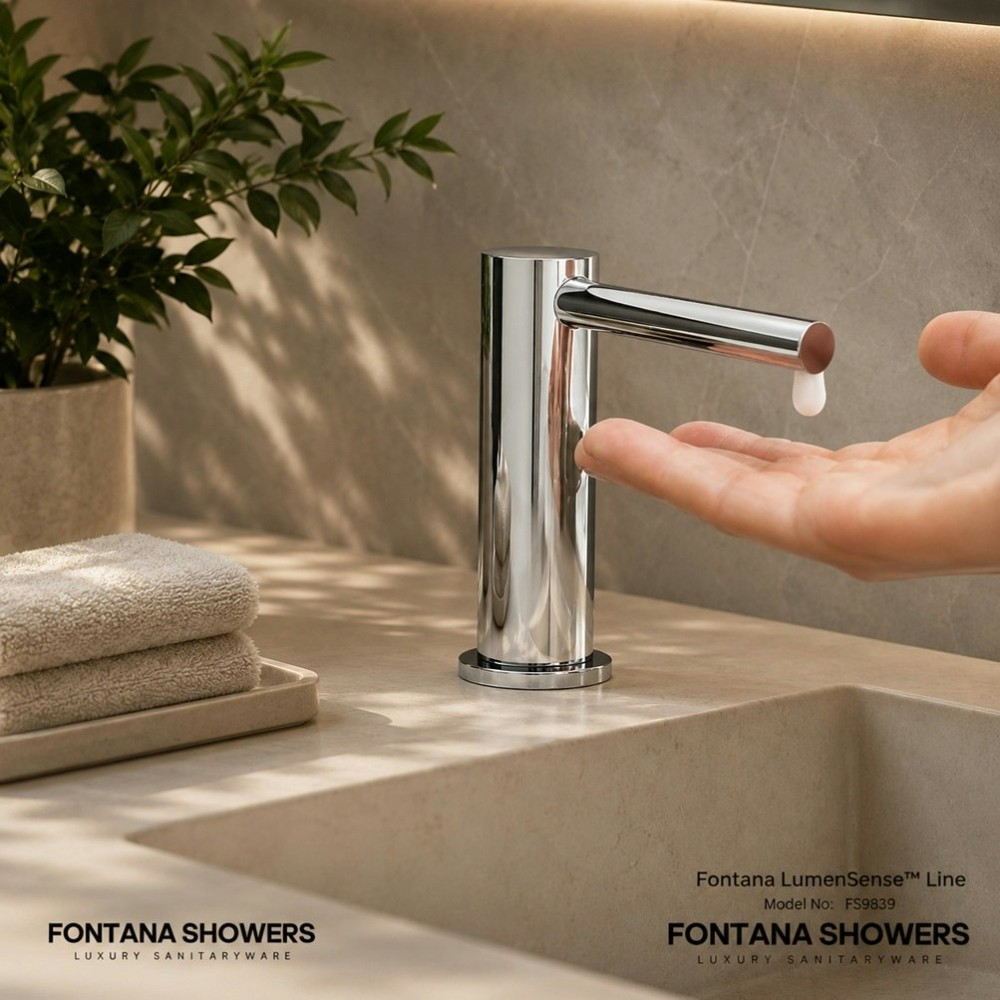
    Evidence Library (Articles / Data / Studies) — Keep for Your References Section

    1. Study: contamination and transfer dynamics in bulk refillable soap systems
    2. Study PDF (MicrobiologyOpen, 2023): contamination pathways in soap dispenser systems
    3. Study: microbial quality concerns in open refillable bulk soap contexts
    4. Data/Report (GOJO): bacterial findings related to bulk refillable soap scenarios
    5. CDC: clinical hand hygiene safety (context for soap + dispenser practices)
    6. Specifier’s Guide: comparing automatic soap dispenser brands (market comparison framing)
    7. Buyer’s Guide: commercial bathroom soap dispensers (selection factors + trends)
    8. Market matrix: commercial restroom dispenser selection framework
    9. Manufacturer brochure (PDF): Bobrick automatic multi-feed overview
    10. Manufacturer data: Bradley top fill multi-feed system