Category: Uncategorized

  • Solenoid Valve Failure in Year Two: A Field Diagnosis Guide

    Solenoid Valve Failure in Year Two: A Field Diagnosis Guide

    Solenoid valves in sensor faucets fail at the 12 to 24 month mark almost always for the same three reasons: mineral scale binding the diaphragm, corrosion at the low-voltage connector, and a clogged inline strainer starving the valve of flow. Before you order a replacement solenoid, run the multimeter tests below. A large share of “dead solenoid” service calls turn out to be a bad connector or a battery pack nobody replaced.

    Why Year Two Is the Failure Window

    Year one rarely produces failures because everything is new: seals are seated, screens are clean, contacts aren’t oxidized. By month 12 to 24, three things have accumulated. Mineral scale from hard water has built up on the diaphragm and pilot orifice. Low-voltage connectors, especially those in humid under-sink environments, have started to corrode at the crimp or spade terminal. And the inline strainer, which is doing its job, has collected enough sediment to restrict flow to the point the valve can’t fully open even when it’s energized correctly.

    This is a wear-and-water-quality problem, not a manufacturing defect problem. Buildings on well water or unsoftened municipal supply with high hardness will see this window compress toward 12 months. Buildings on softened water or low-mineral supply can stretch past 24 months before symptoms appear.

    Solenoid Failure vs Sensor Failure Symptoms

    The fastest way to waste a service call is replacing a solenoid when the sensor or transformer is the actual problem. The symptom sets overlap just enough to cause confusion in the field.

    Symptom Likely Cause
    No water, no LED activity on sensor Power supply: dead battery or failed transformer
    LED responds to hand presence, no water Solenoid valve or wiring between sensor and valve
    Water trickles but won’t reach full flow Clogged strainer or partially blocked diaphragm
    Water runs continuously, won’t shut off Debris holding diaphragm open, or failed sensor board
    Intermittent operation, works sometimes Corroded connector or loose low-voltage wiring

    The rule of thumb: if the sensor LED is responding correctly to hand movement but no water follows, the problem is downstream of the sensor board. That isolates it to the solenoid, its wiring, or its power feed, and rules out a sensor eye issue entirely.

    Three Common Failure Points in the Field

    Once you’ve isolated the fault to the solenoid side, it’s almost always one of three things.

    • Mineral-clogged diaphragm. Scale builds on the diaphragm and pilot orifice, preventing it from lifting fully or seating fully. This shows up as reduced flow, slow response, or a valve that won’t close and drips after use.
    • Corroded low-voltage connector. The connector between the solenoid coil leads and the control wiring sits in a damp cabinet environment. Spade connectors and crimped splices corrode over time, especially where dissimilar metals are in contact. This produces intermittent operation or complete failure that looks electrical because it is.
    • Degraded strainer screen. The inline strainer, typically a 100-mesh screen, is there to protect the solenoid’s small orifices from sediment. When it loads up with scale and debris it restricts flow before the water ever reaches the valve, and techs sometimes misdiagnose this as valve failure because the symptom (weak or no flow) looks identical.

    Multimeter Test Sequence for Diagnosis

    Before pulling the solenoid, confirm power is actually reaching it and that the coil itself is intact. Solenoids on these faucets run on 6VDC from battery packs or 24VAC from a step-down transformer, depending on the installation. Test procedure differs slightly by power type but the logic is the same.

    • Step 1: Confirm supply voltage at the source. For battery-powered units, check the battery pack under load, not just static voltage. A battery can read near-nominal voltage with a meter and still sag to nothing under the momentary draw the solenoid needs. For transformer-fed units, check output at the transformer terminals: expect 24VAC nominal, and flag anything more than about 10 percent off.
    • Step 2: Check voltage at the solenoid connector during an activation cycle. Trigger the sensor and read voltage at the connector leads. If you get correct voltage here but the valve doesn’t open, the fault is in the valve itself, not the wiring or power supply.
    • Step 3: Test coil continuity and voltage at the connector before replacing the valve. With power disconnected, measure resistance across the coil leads. An open circuit (infinite resistance) means a burned-out coil. A reading of zero or near-zero suggests a shorted coil. Either result confirms the solenoid itself has failed electrically, as opposed to being mechanically stuck from scale.
    • Step 4: If voltage and continuity both check out, suspect mechanical blockage. A solenoid that has correct voltage and healthy coil resistance but still won’t open or close fully is almost certainly blocked by scale or debris on the diaphragm, not electrically dead.

    Document these readings before you disassemble anything. If the part turns out to be under any manufacturer coverage, having voltage and continuity readings on hand supports the claim and speeds up the exchange.

    Rebuild the Valve or Replace It

    Once you’ve confirmed the solenoid is the actual point of failure, the next decision is rebuild versus replace. This depends on what you found in the test sequence and what’s available for that valve.

    If the coil tested fine and the failure is mechanical (scale-bound diaphragm, debris in the orifice), a rebuild kit with a new diaphragm and seals is usually the more economical fix and can often be done in under 20 minutes once the valve is off. Clean the valve body and the strainer screen at the same time, since a fresh diaphragm behind a clogged strainer just fails again on the same timeline.

    If the coil failed electrically (open or shorted), replace the solenoid assembly rather than attempting a coil repair. Rewinding or repairing a coil in the field isn’t practical, and coil assemblies are typically sold as a unit.

    For vanity and basin installations where you’re already accessing the plumbing, it’s worth confirming the aerator and supply connections at the same time. Most of these units connect on a standard 1/2 inch NPT supply, which makes cross-referencing replacement parts or upgrading to a different thermostatic shower systems fixture in a nearby stall straightforward if the building is standardizing on one product line.

    Maintenance Interval to Prevent Repeat Failures

    The single highest-leverage maintenance task is strainer cleaning, not solenoid replacement. A strainer inspection and cleaning on a 6 to 12 month interval, adjusted for local water hardness, prevents the majority of scale-related solenoid problems before they start. Buildings on hard water or well supply should default to the shorter end of that interval.

    At the same visit, inspect the low-voltage connector for corrosion and reseat or replace it if there’s visible oxidation. This is a five-minute check that prevents the intermittent-failure service calls that are hardest to diagnose after the fact.

    Next service call on one of these units: run the four-step voltage and continuity sequence before you open a parts catalog. If voltage and coil resistance both check out, you’re looking at a rebuild kit and a strainer cleaning, not a new valve. If either test fails, order the solenoid assembly and inspect the connector while you’re in there, since a corroded connector on an old valve will just as easily corrode the connector on a new one.

  • Ghost Triggers: Why Sensor Faucets Fire With No One There

    Ghost Triggers: Why Sensor Faucets Fire With No One There

    Phantom activation almost always traces to one of four causes: a drifting IR range setting, a failing power source, electrical noise on the line, or a reflective surface feeding the sensor false returns. By year two, the most common culprit is the battery pack or transformer, not the sensor itself. Work the diagnostic in that order and you will find the fault in under fifteen minutes on most calls.

    Common Causes of Phantom Activation

    Sensor faucets use an 880nm infrared emitter paired with a receiver tuned to detect reflected light within a set range window, typically 4 to 6 inches from the spout on commercial units. When that window drifts, or when the emitter’s output degrades, the faucet starts reading noise as a hand. Four failure modes account for nearly all year-two service calls: range drift from age or vibration, voltage sag on battery-powered units, AC ripple on transformer-fed units, and reflective interference from polished countertops or nearby mirrors.

    None of these are design defects. They are wear items and installation conditions that surface after the first year of duty cycles, and every one of them has a known field check.

    Checking Sensor Range and Alignment

    Start here because it is fast and rules out half the possible causes. Most commercial sensor faucets have a range adjustment, either a physical potentiometer on the sensor module or a DIP switch bank, calibrated to that 4 to 6 inch window. If the range has drifted outward, the sensor picks up movement past the basin, hands at the adjacent sink, or even a swinging door.

    • Confirm the sensor lens is clean. A film of hand soap or hard water scale scatters the IR beam and can mimic a misalignment fault.
    • Check physical alignment. The sensor should aim straight down into the basin, not angled toward the counter edge or a neighboring fixture.
    • Adjust range incrementally. Move the setting in small steps and retest rather than jumping to minimum, which can cause the faucet to miss legitimate hand presence and force users to wave repeatedly.
    • Verify range against the basin depth. Deep basins or vessel sinks sometimes need the range set toward the 6 inch end; shallow ADA-compliant basins often need the 4 inch end to avoid picking up the user’s forearm resting on the counter.

    Electrical Noise and Power Supply Drift

    If range and alignment check out, move to power. Battery-powered units on 4xAA packs are rated to operate down to a threshold voltage, and most sensor boards start misbehaving well before the batteries are fully dead. A pack reading below 4.5V under load is a common trigger point for false activation, because the sensor’s comparator circuit loses the clean threshold it needs to distinguish a real reflection from ambient noise. This is not a linear failure. The faucet does not just get sluggish and stop; it can fire randomly for days before the batteries fail completely.

    On hardwired units, the equivalent problem is AC ripple. A transformer that is undersized for the load, wired too far from the point of use, or simply aging will pass ripple voltage onto the low-voltage DC line feeding the sensor board. That ripple reads to the sensor’s control circuit as electrical noise, and depending on the board’s filtering, it can be interpreted as a trigger signal. Ripple problems are worse in buildings with multiple sensor faucets sharing a transformer bank, or where the low-voltage wiring runs parallel to lighting circuits or variable-frequency drives.

    Field check for both:

    • Battery units: measure pack voltage under load, not at rest. A pack that reads 5.8V open-circuit can still sag below 4.5V once the solenoid pulls current.
    • Hardwired units: measure DC output at the sensor board with a meter capable of catching ripple, not just a simple DC average. A multimeter set to AC on the DC line will show ripple as a nonzero reading.
    • Swap batteries as a full set, never partial. Mixed-age cells in series create uneven load sharing and can produce intermittent faults that look electrical but are really cell mismatch.
    • If ripple is confirmed, check transformer sizing against total connected load, not just the one faucet, and check wiring runs for proximity to noisy circuits.

    Reflective Countertops and Mirror Interference

    Polished stone, stainless steel backsplashes, and mirrors positioned near the basin all reflect IR in ways that confuse sensors calibrated for a matte porcelain or acrylic basin. The sensor is not defective, it is doing exactly what it is designed to do: reporting a reflected signal within range. The problem is the countertop is now part of the sensing environment.

    This shows up most often after a renovation where fixtures stayed the same but the counter material changed. A tech who does not know the install history will chase a sensor fault that is actually a finish change. Ask before you diagnose. If the counter is new, that is your answer, and the fix is usually a range reduction toward the 4 inch end plus possibly a physical baffle or recessed mounting to shield the sensor from the polished surface.

    Field Diagnostic Checklist for Techs

    Check Tool Pass Condition
    Sensor lens condition Visual, alcohol wipe Clean, no scale or film
    Range setting Potentiometer or DIP switch Within 4 to 6 inch spec for basin depth
    Battery voltage under load Multimeter, DC, under solenoid draw Above 4.5V for 4xAA pack
    Transformer output ripple Multimeter, AC setting on DC line Minimal AC component on DC feed
    Countertop/mirror proximity Visual, installation history No new reflective surface within sensor field
    Sensor module response Manual hand test after above checks Consistent trigger only within calibrated range

    Run these in order. Each one is cheaper and faster than the next, and most phantom activation calls resolve at the battery or range check before you ever open the sensor housing.

    When to Swap the Sensor Module

    Replace the sensor module when it fails to hold a stable range after adjustment, when it triggers erratically on fresh batteries and confirmed clean power, or when the IR emitter itself has visibly degraded output on a test meter. A sensor that drifts out of calibration repeatedly, even after a proper adjustment, has a failing potentiometer or a board-level fault, not a field-fixable problem. At that point the module is the cheaper fix compared to repeat service calls.

    When specifying replacements for a property with recurring interference or power issues, it is worth looking at touchless faucet options that offer solenoid and power configurations matched to the building’s existing low-voltage infrastructure, rather than defaulting to whatever matches the old unit. A faucet spec’d for battery operation in a building with unreliable AC ripple control, or vice versa, sets up the next round of phantom activation calls before the install is even finished.

    Before closing the ticket, document the range setting and battery replacement date on the fixture or in the CMMS record. The next tech who gets called on a “ghost trigger” six months from now will thank you, and you will thank yourself when it is your call.

  • The Real Year-Two Maintenance Calendar for Sensor Faucets

    Why Manufacturer Schedules Miss Year-Two Failures

    Run your sensor faucets on the schedule printed in the install manual and you will still get callbacks in month 14 through 20. Those schedules are written for year one, when batteries are fresh and diaphragms haven’t seen a full cycle count. Year two is where lithium packs sag, solenoid diaphragms take on mineral fatigue, and sensor lenses accumulate enough film to start misreading hand distance. None of that shows up on a generic quarterly checklist built around “inspect and clean.” A schedule built from actual failure timing catches these before they turn into a lobby full of faucets that won’t shut off.

    Quarterly Task Calendar Built From Failure Data

    The table below is organized by what actually fails at each interval, not by a fixed rotation through every fixture in the building. Use it as the baseline and adjust frequency upward for high-traffic restrooms (airports, stadiums, hospital public areas) and downward for low-use fixtures in back-of-house areas.

    Interval Task Why This Timing
    90 days Clean sensor lens with non-abrasive cloth, check IR range against spec Film buildup from hand soap and hard water causes false triggers and short-cycling before it causes total failure
    90 days Check aerator for flow restriction Sediment collects faster in low-flow aerators rated at 0.5 gpm/1.9 Lpm under EPAct 1992; flow drop is often the first symptom techs notice
    6 months Test battery voltage under load, not just at rest Resting voltage looks fine on a dying pack; load testing catches sag before failure
    6 months Inspect solenoid valve for slow drip or delayed shutoff Diaphragm fatigue is progressive; catching it at 6 months prevents a mid-cycle failure
    12 months ASSE 1070 mixing valve inspection and function test Code-cited annual requirement in most jurisdictions for tempered water compliance
    12-18 months Replace 6V lithium battery pack proactively Documented field failure window regardless of remaining indicator charge

    Battery and Power Checks by Season

    6V lithium battery packs typically fail at 12 to 18 months in commercial use, and the failure mode is rarely a clean drop to zero. Instead you get intermittent triggering, slow sensor response, or a faucet that runs longer than it should because the solenoid isn’t getting a clean signal. Cold weather accelerates the sag in unconditioned spaces (parking structure restrooms, exterior-wall mechanical rooms), so if you’re running a calendar-based swap rather than voltage testing, move those fixtures to the front of the line going into winter. For AC-powered units, check transformer output and connections at the same interval since a failing transformer produces symptoms that look identical to battery sag and techs waste time swapping batteries that were fine.

    Don’t rely on the low-battery indicator light alone. On several common commercial platforms that light triggers at a voltage threshold that still leaves weeks of intermittent operation before full failure, which is exactly the callback you’re trying to avoid.

    Cartridge, Aerator, and Solenoid Scaling Intervals

    Aerators rated at 0.5 gpm/1.9 Lpm under EPAct 1992 restrict flow deliberately, which means they also restrict the ability to flush sediment on their own. In hard water buildings, plan on pulling and soaking aerators every 90 days minimum, not the 6-month interval that’s fine for standard-flow fixtures. If you’re seeing flow drop faster than that, it’s worth checking whether the building’s water treatment has changed rather than assuming the aerator is defective.

    Solenoid valves scale internally in a way you can’t inspect visually without disassembly. The practical field indicator is response time: a solenoid that used to shut off cleanly and now trails off with a slow drip is telling you the diaphragm has mineral buildup or early fatigue. Don’t wait for a full stuck-open failure. Pull the solenoid at the 6-month check, inspect the diaphragm seat, and descale in vinegar or manufacturer-approved solution if you see visible buildup. Replace rather than clean if the diaphragm shows cracking, since a diaphragm that’s already cracked will fail within weeks regardless of cleaning.

    Cartridge-style mixing valves inside the faucet body (separate from the ASSE 1070 point-of-use mixing valve, if one is installed) should get a visual check for scale at the same 6-month interval. If your building is specifying replacement fixtures rather than repairing existing units, it’s worth comparing solenoid and cartridge access design across product lines, since some touchless bathroom faucets are built with front-serviceable cartridges that cut disassembly time significantly compared to units requiring full removal from the deck.

    Documenting Service for Code and Warranty

    ASSE 1070 mixing valve inspection is an annual code check in most jurisdictions with public restroom requirements, and it needs a paper trail independent of whatever else you’re logging. Keep that record separate from general maintenance notes: date, technician, valve set-point temperature verified, and any adjustment made. If a scald complaint ever turns into a liability question, this is the document that matters.

    For everything else, a simple fixture log beats a building-wide spreadsheet. Track by fixture ID: last lens cleaning, last aerator service, battery install date, and any solenoid work. When a fixture starts generating repeat callbacks, this log tells you whether it’s a pattern (bad batch of batteries, hard water zone) or an isolated unit that needs replacement rather than continued repair.

    Building a Route Across Multi-Fixture Buildings

    Group fixtures by exposure, not by floor plan. High-traffic lobby and food-service restrooms need the 90-day lens and aerator cycle without exception. Low-traffic back-of-house fixtures can often stretch to 6 months on lens cleaning without generating false triggers, which frees up route time for the fixtures that actually need it. Batch the annual ASSE 1070 checks building-wide in the same visit as your 12-month battery swap where schedules align, since both require the water shut off to the fixture group anyway.

    If you’re servicing more than 40 to 50 sensor faucets across a property, a route based on fixed calendar dates alone will drift. Tag each fixture with its install date and last-service date in whatever CMMS or spreadsheet you’re using, and let the system flag work orders rather than trying to remember which restroom was serviced when.

    What To Check This Week

    • Pull battery packs on any sensor faucet installed 12 to 18 months ago and load-test, even if the indicator light is green.
    • Confirm ASSE 1070 mixing valves have a documented inspection within the last 12 months; schedule immediately if not.
    • Check the last lens cleaning date on high-traffic restroom fixtures; if it’s past 90 days, move it to this week’s route.
    • Flag any fixture with three or more callbacks in the past year for full replacement evaluation rather than continued repair.
  • Deck-Mount vs Wall-Mount Touchless Faucets: Which Layout Works Better?

    Independent layout and coordination guide

    Deck-Mount or Wall-Mount?

    The better touchless faucet is the one whose installation architecture fits the basin, wall, service plan and project schedule—not the one that looks cleaner in an isolated rendering.

    Touchless faucetsBasin geometryRough-in planningMaintenance access

    Deck-mount faucets concentrate the work at the counter. Wall-mount faucets free the deck but move coordination into the wall. Neither is inherently superior; each places risk in a different location.

    For architects, engineers and owners, the real comparison is not visual minimalism versus convention. It is tolerance, sequencing, splash behavior, accessibility, cleaning and serviceability. A successful selection begins with the basin section and ends with a maintenance route that remains usable after the finishes are complete.

    Fast conclusion: Deck mounting is usually more forgiving for retrofits and future replacement. Wall mounting can deliver cleaner counters and stronger architectural alignment, but it requires earlier decisions, tighter dimensional control and deliberate access.

    This article extends the site’s technical research hub and should be read alongside the bathroom-faucet planning FAQ.

    The practical split

    Where each mounting strategy earns its place

    Deck mount tends to fit

    Retrofits and repeatable programs

    • Existing counters with usable faucet holes
    • Projects that value easier fixture replacement
    • Vanities with accessible under-counter service zones
    • Rollouts where field tolerances vary
    • Applications needing familiar commercial geometry
    Wall mount tends to fit

    Architecturally integrated vanities

    • New construction with coordinated wall cavities
    • Continuous counters where cleanability is critical
    • Designs emphasizing visual calm and precise alignment
    • Basins with limited deck area
    • Projects willing to resolve access before wall closure
    Decision matrix

    The tradeoff is where complexity lives

    Design issue Deck-mounted touchless faucet Wall-mounted touchless faucet
    Rough-in tolerance Often more forgiving because the counter opening establishes the exposed location. Requires disciplined valve depth, outlet height and horizontal position before finish installation.
    Counter cleaning The base creates an edge that must be wiped around. Leaves the deck open and can simplify routine wiping.
    Service route May be accessible above the deck or from the cabinet, depending on design. Must have a planned access panel or serviceable wall-side arrangement.
    Basin coordination Reach is constrained by hole location and rear deck depth. Projection can be selected to suit the bowl, but field placement must be exact.
    Replacement flexibility Common hole patterns can support later replacement, subject to fit. Replacement must suit the existing concealed rough-in and wall penetration.
    Construction timing Can often be selected later, though the sink and deck still require coordination. Should be resolved before framing, blocking, plumbing and wall finish are finalized.
    Visual character Reads as a discrete fixture sitting on the vanity. Can appear integrated into the architecture and reduce counter-level clutter.
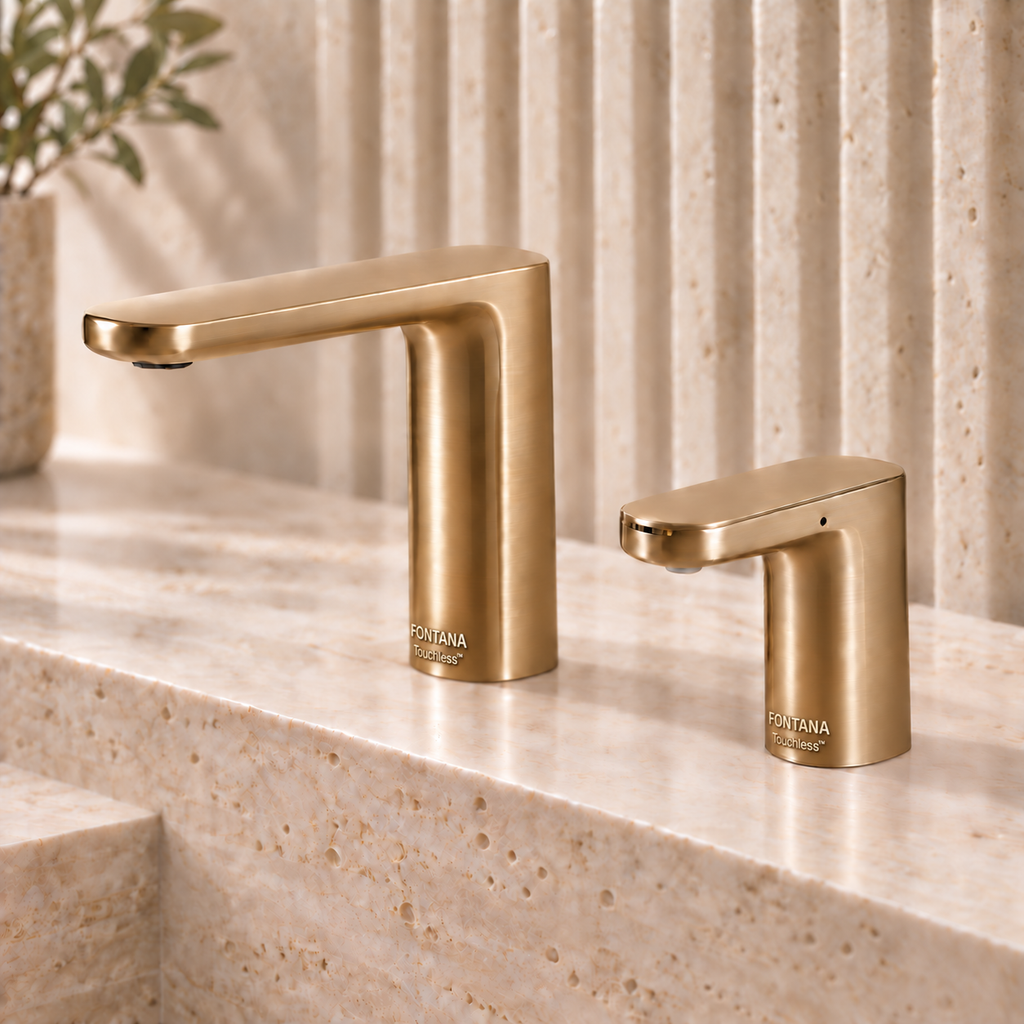
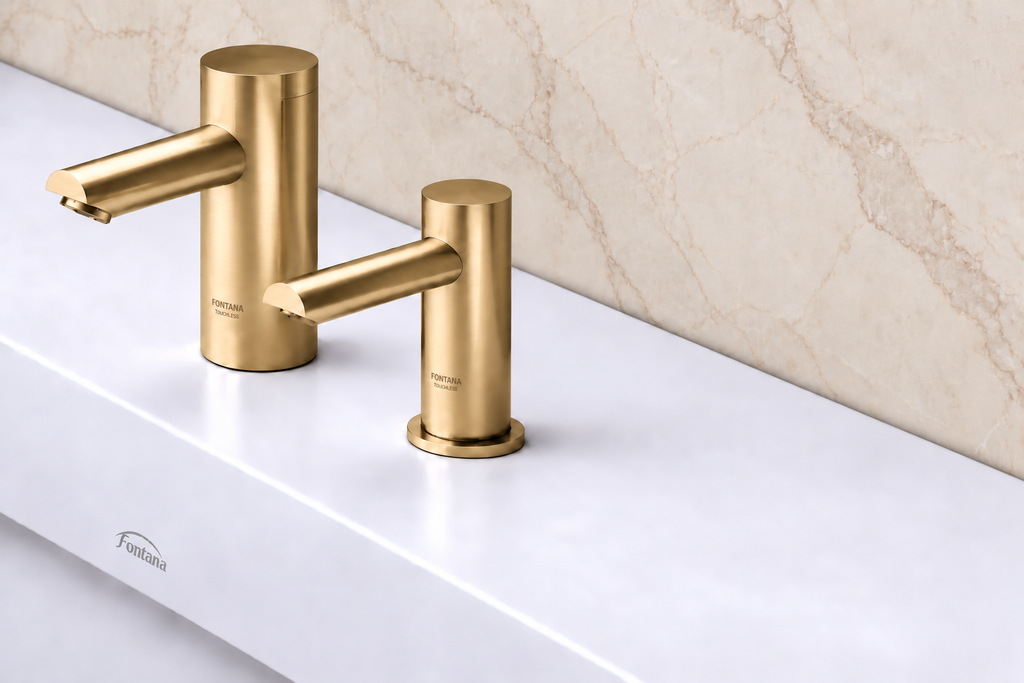
    BathSelect Solo deck-mounted touchless faucet and soap dispenser in brushed gold

    Deck-mount study · BathSelect

    Coordinated fixtures on the counter plane

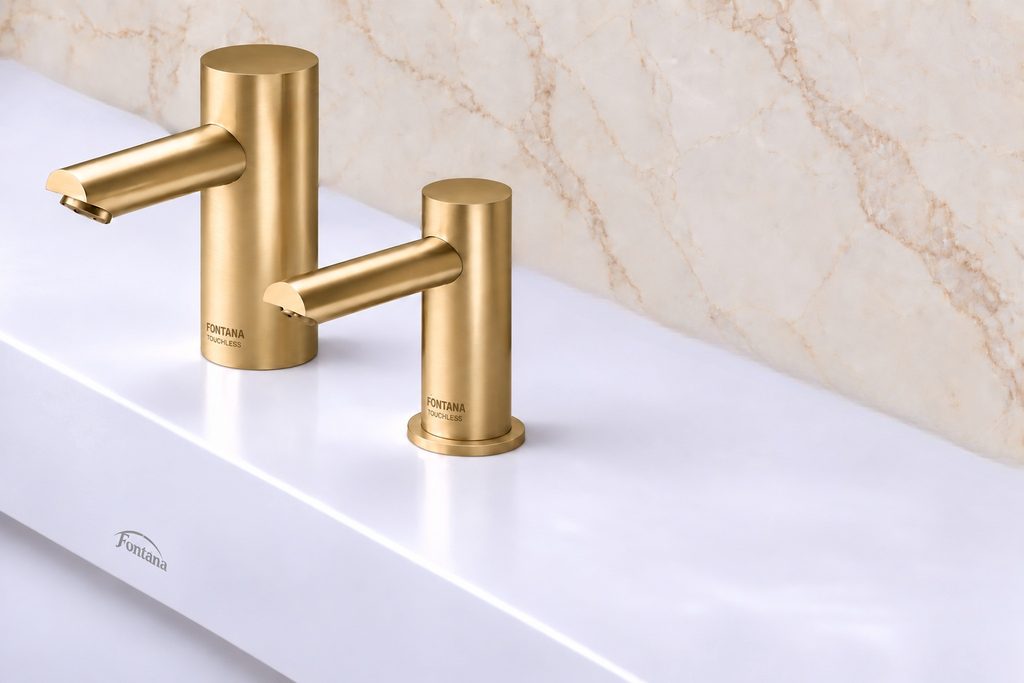
    The Solo set illustrates a coordinated deck-mounted pair. The faucet, dispenser, basin rim and backsplash must be composed together, with enough clearance for cleaning and service.

    Review BathSelect Solo →

    BathSelect Brio wall-mounted touchless faucet and soap dispenser in brushed nickel

    Wall-mount study · BathSelect

    Clear deck with concealed responsibility

    The Brio wall-mounted pair clears the counter but transfers the faucet, soap and service coordination into the wall. Show both nozzle locations on the interior elevation.

    Review BathSelect Brio →

    Chrome wall-mounted touchless faucet and coordinated soap dispenser wash system
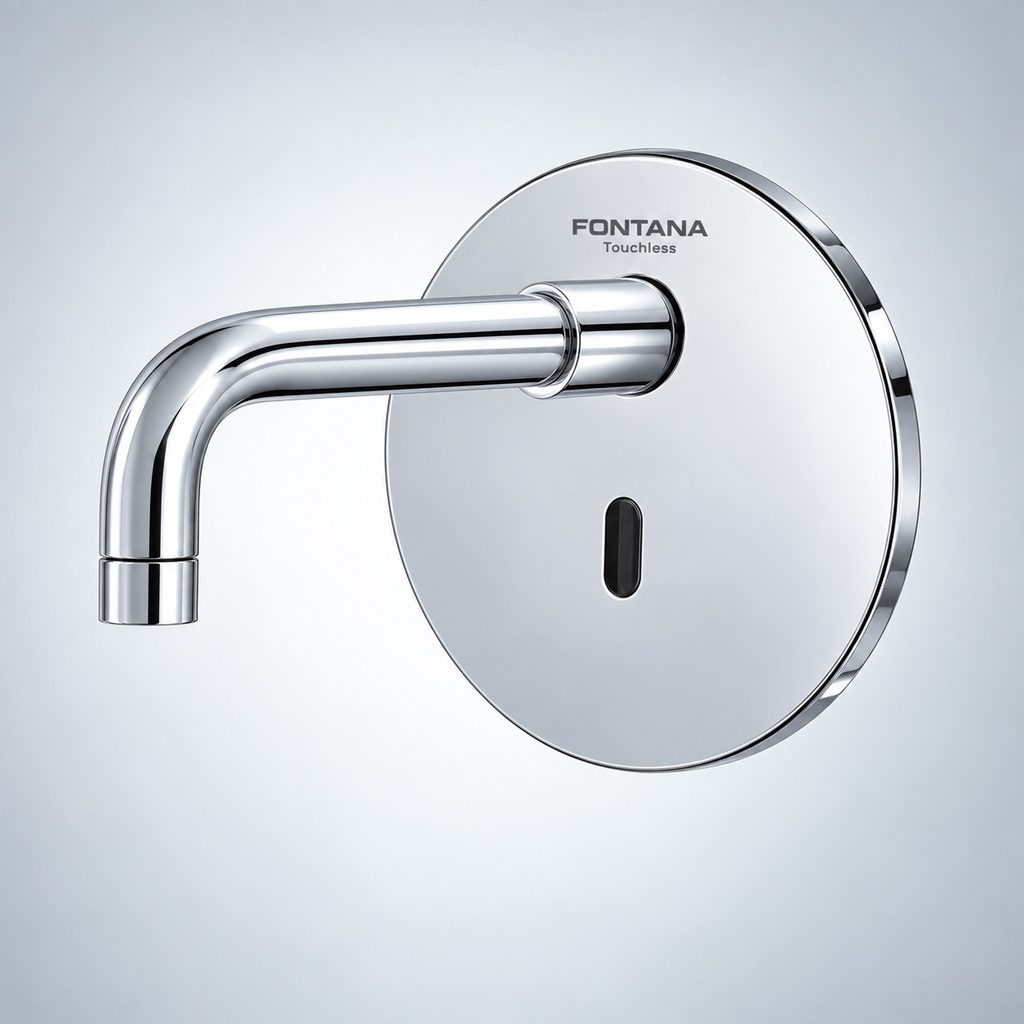
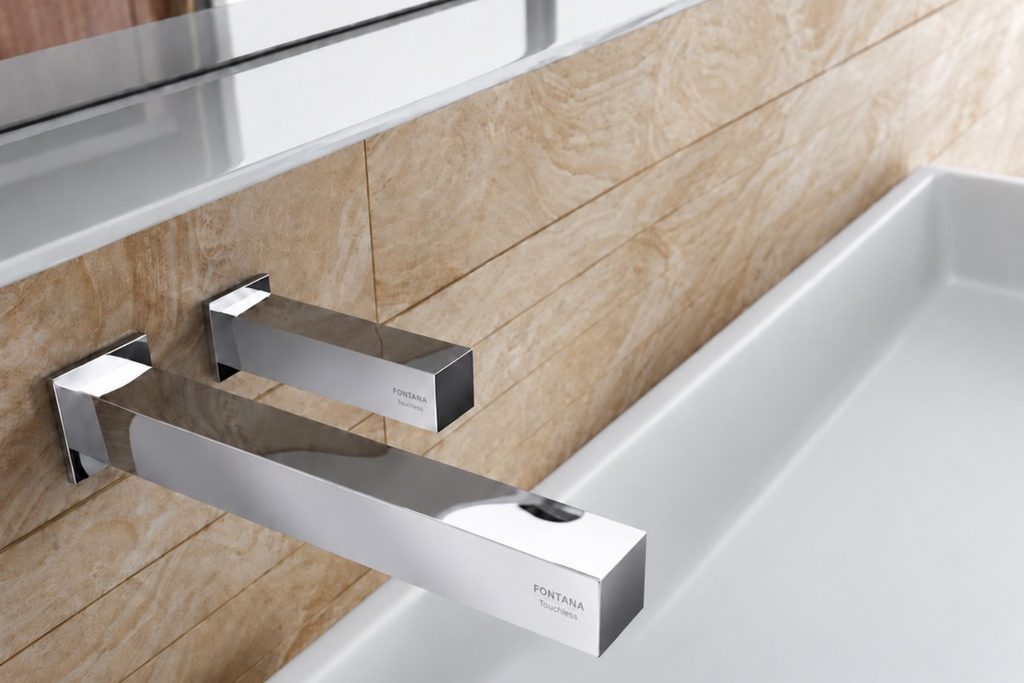
    A wall-mounted wash system can create a clean horizontal composition. Product context: Fontana wall-mount touchless collection.
    Wall-mount geometry

    Draw the stream—not only the spout

    The exposed spout may appear correctly centered while the water lands too close to the rear wall or outside the basin’s effective washing area. Review the faucet and basin drawings at the same scale and project the stream into the bowl.

    • Coordinate finished-wall face to outlet centerline.
    • Check projection against the basin’s inner edge, not only the countertop edge.
    • Allow comfortable hand space without encouraging splash.
    • Confirm that the sensor reads hands in the intended washing zone.
    • Locate the soap nozzle where drips return to the basin whenever practical.
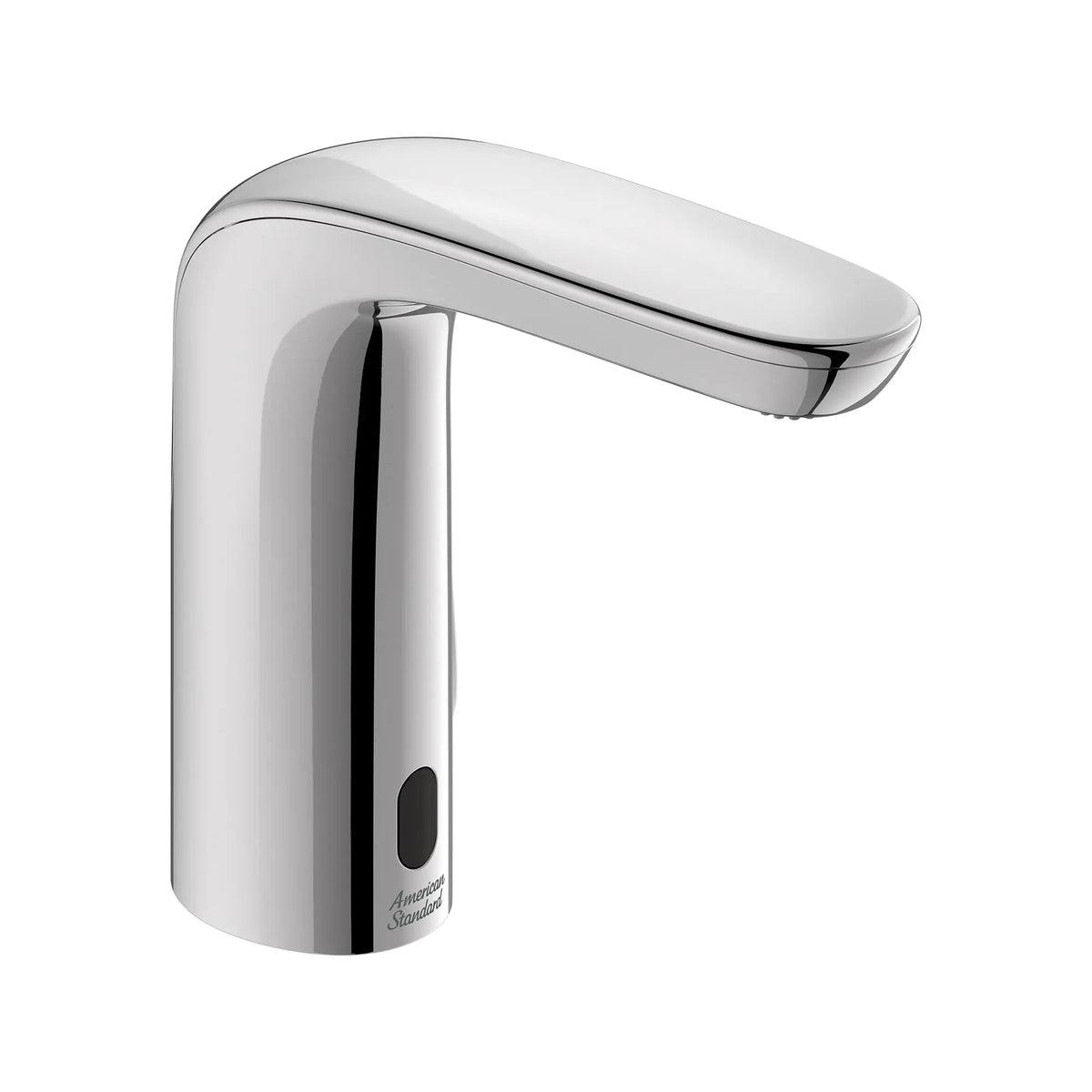
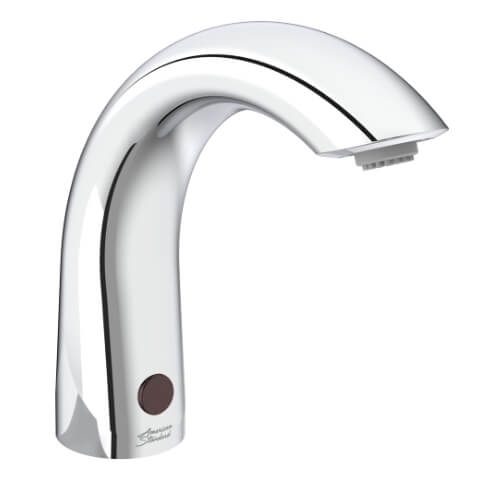
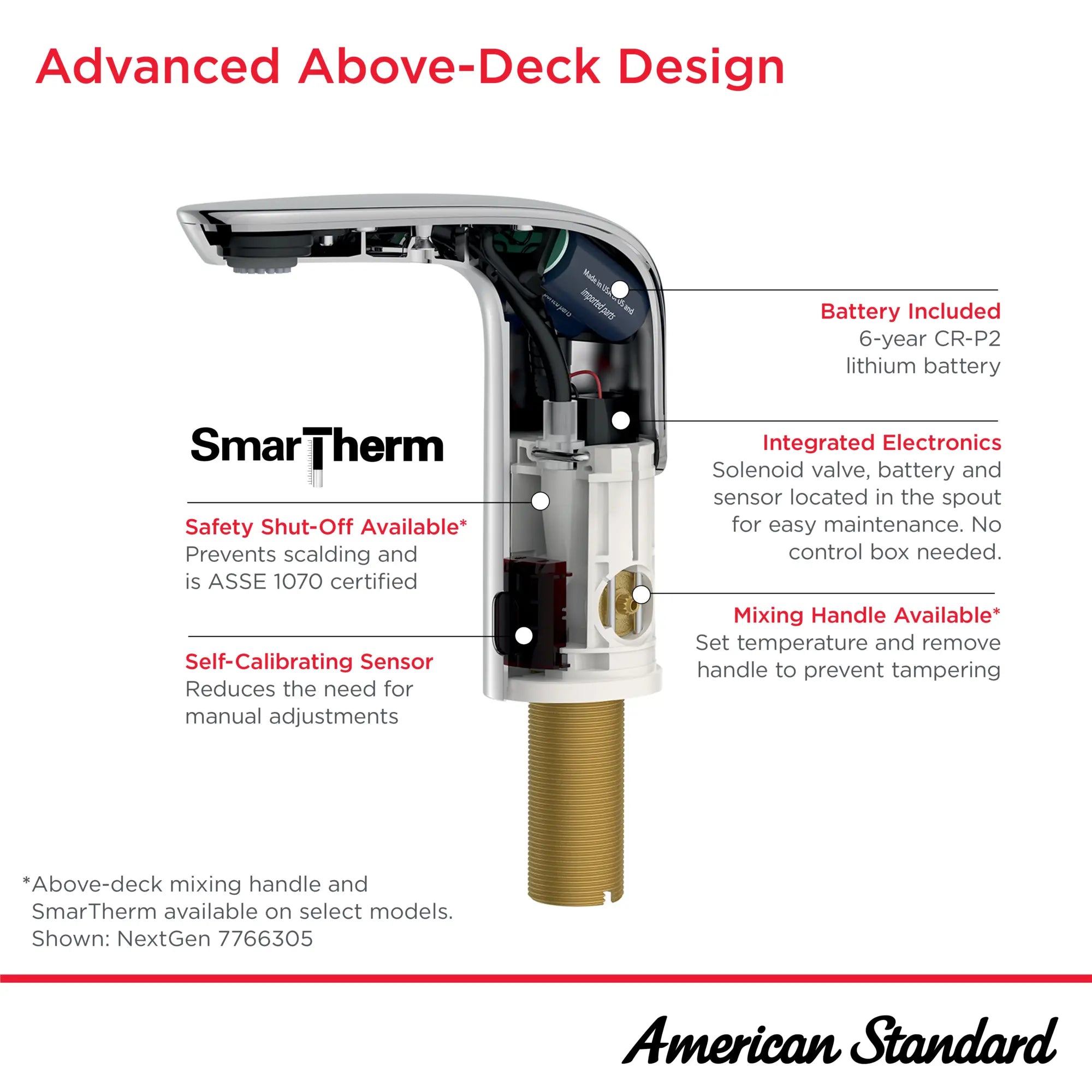
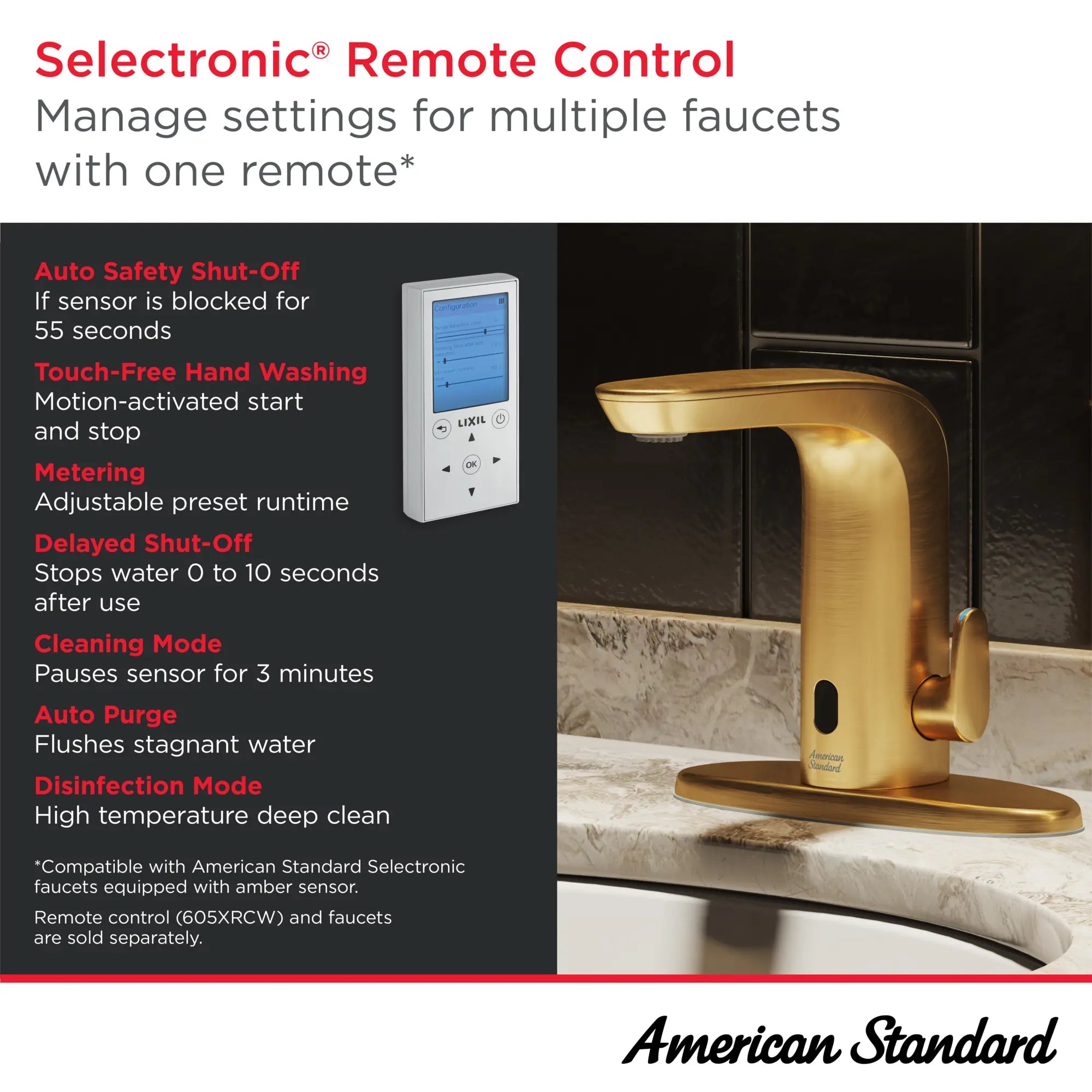
    American Standard NextGen Selectronic deck-mounted touchless faucet
    Above-deck components can reduce under-counter service work, depending on the exact configuration. Image and product: American Standard NextGen Selectronic.
    Deck-mount serviceability

    “Deck mount” does not always mean “service below”

    Commercial sensor faucets vary significantly in where batteries, electronics, mixing and solenoids are located. Some bring key components above the deck; others depend on an accessible cabinet or chase.

    The specification should state the required service route rather than assuming it from the mounting category. A beautiful counter with sealed millwork can make a nominally simple deck-mounted faucet difficult to maintain.

    Wall-mounted references

    Minimal at the surface, exacting behind it

    These examples show different wall-mounted expressions. They are unranked references, not interchangeable products. Verify the concealed body, power, mixing, flow and service requirements for the exact model.

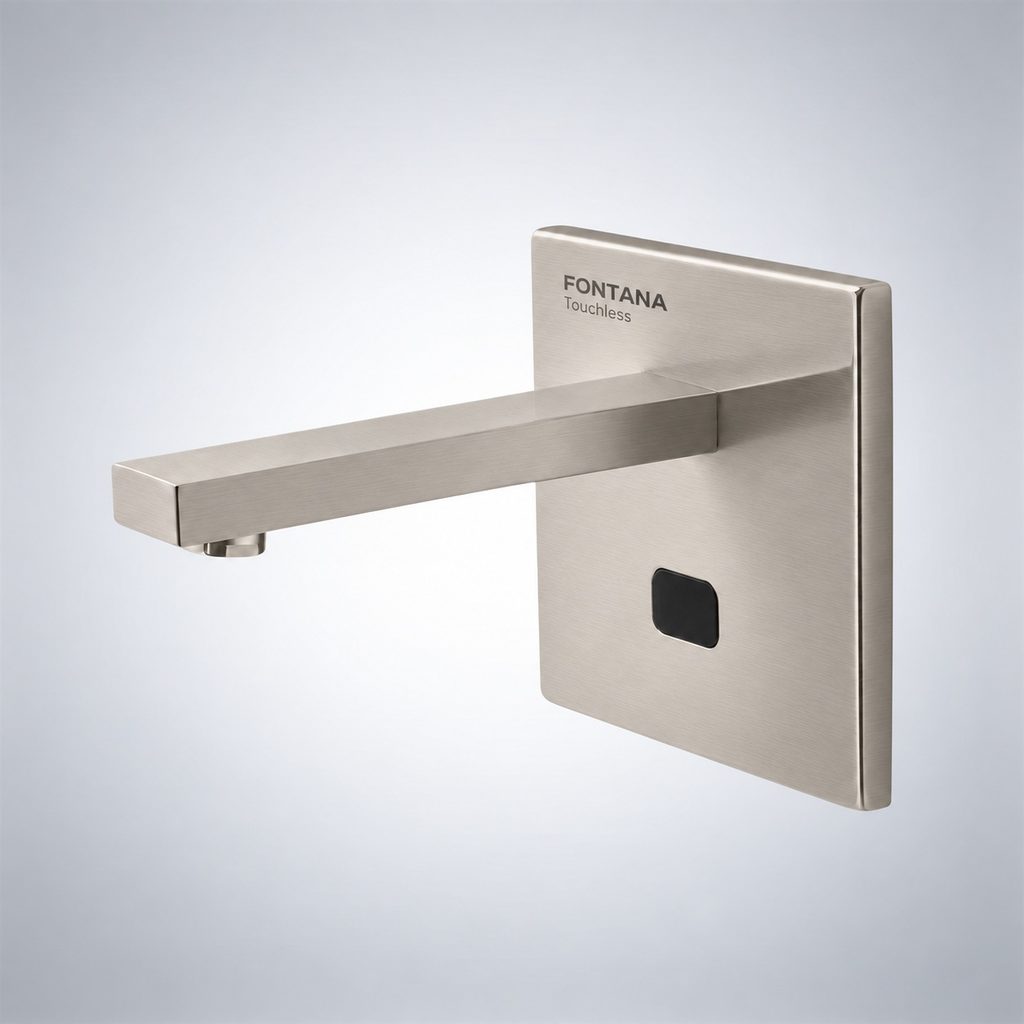
    Brushed nickel wall-mounted touchless faucet and soap dispenser system

    Fontana

    Coordinated wall-mounted wash point

    A matching dispenser reinforces the architectural rhythm, but its reservoir and refill path require independent documentation.

    Explore Fontana wall mount →

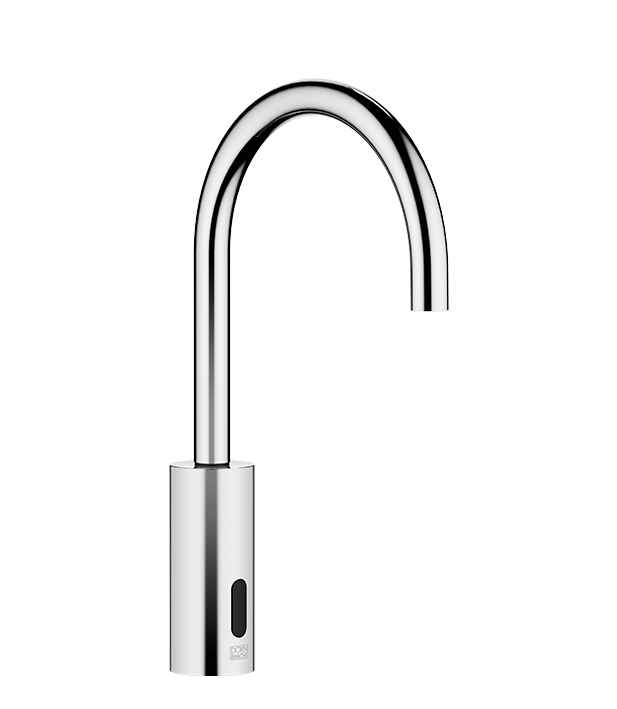
    Dornbracht Touchfree wall-mounted lavatory faucet in brushed dark bronze

    Dornbracht

    Restrained exposed trim

    A minimal wall-mounted faucet depends on precise rough-in and finish alignment. The less visible the hardware, the more consequential small dimensional errors become.

    Review Dornbracht →

    Deck-mounted references

    The category offers more variation than it first appears

    Deck-mounted products can differ in sensor position, spout reach, power, mixing and maintenance philosophy. A familiar silhouette does not guarantee equivalent performance or installation.

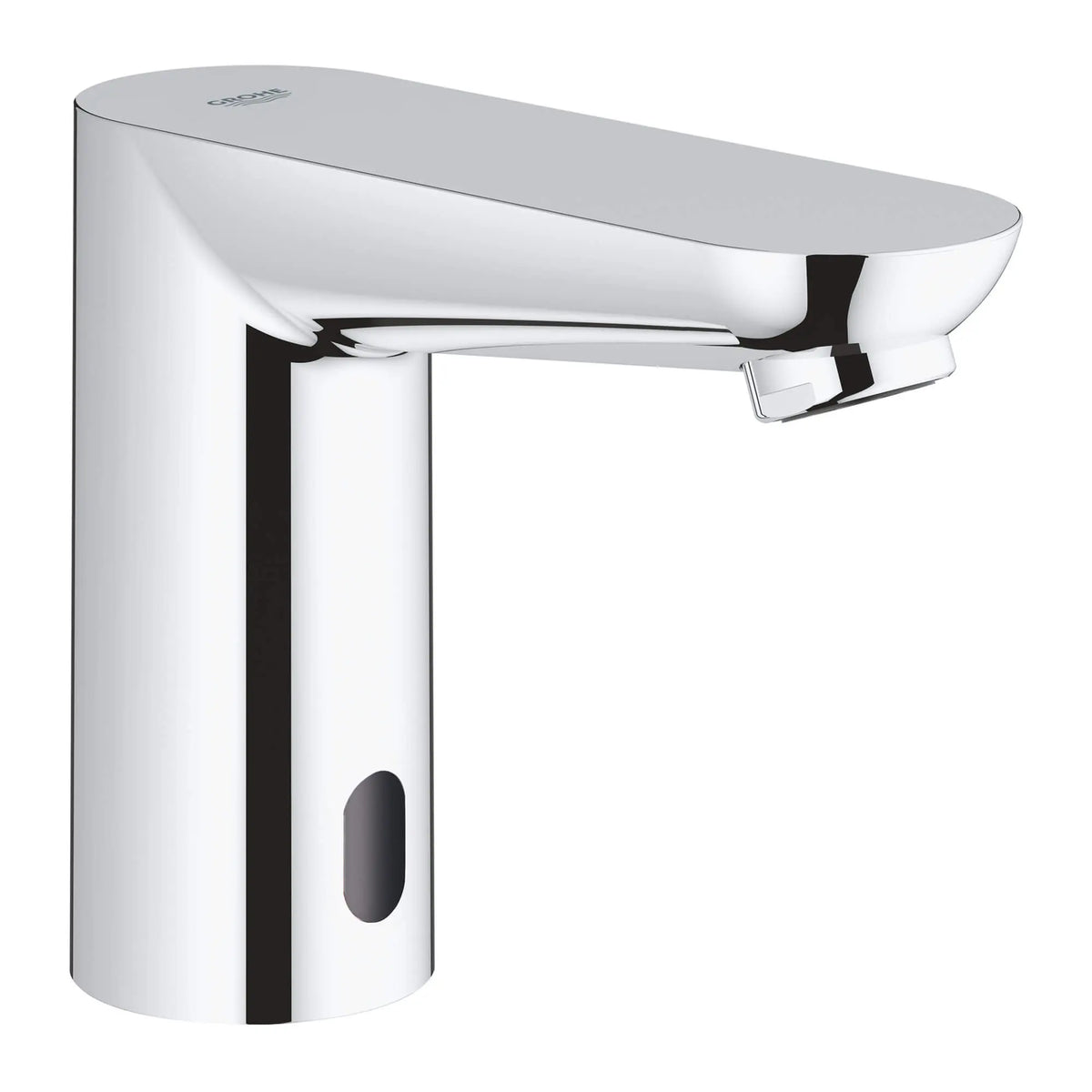
    GROHE Cosmopolitan E deck-mounted infrared bathroom faucet

    GROHE

    Compact electronic profile

    Compact proportions can work well with smaller basins, provided the stream lands within the effective washing zone.

    Review GROHE →

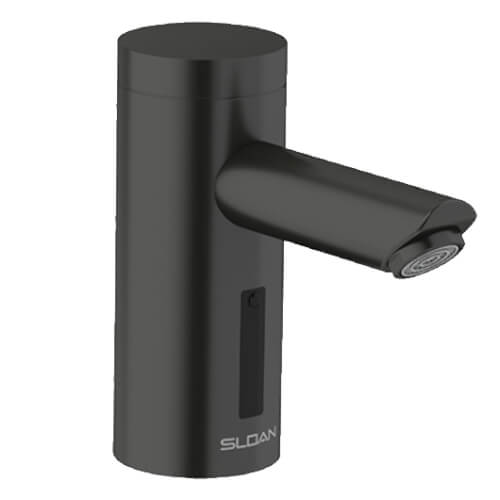
    Sloan Optima EAF deck-mounted touchless faucet

    Sloan

    Commercial sensor benchmark

    The Optima family is relevant where a project values established commercial documentation and configuration choices. Record the full selected model rather than only the family name.

    Review Sloan →

    Delta Commercial deck-mounted electronic lavatory faucet in stainless finish

    Delta Commercial

    Familiar faucet geometry

    A conventional-looking profile can integrate easily into many commercial interiors while still requiring careful review of power and below-deck space.

    Review Delta Commercial →

    Franke deck-mounted electronic washroom faucet in chrome

    Franke

    Purpose-built washroom form

    A visibly commercial form may be appropriate when durability, legibility and operational clarity matter more than residential styling.

    Review Franke →

    Coordination disciplines

    The drawings that settle the decision

    Plan

    Horizontal alignment

    Show faucet, dispenser, basin, drain, partitions and counter joints. Confirm that symmetry does not compromise reach or soap placement.

    Section

    Water trajectory

    Overlay the spout projection, outlet height, basin depth and splash zone. Include the finished wall and backsplash thickness.

    Elevation

    Vertical relationships

    Coordinate mirror, faucet, soap dispenser, backsplash and accessories. For wall mount, lock centerlines before rough-in.

    Field guidance

    Do and don’t

    Do

    • Compare faucet and basin drawings at the same scale.
    • Build a representative mockup before a major rollout.
    • Show power, mixing and service access on coordinated drawings.
    • Account for final wall buildup and counter thickness.
    • Test sensor behavior with the actual basin material and geometry.

    Don’t

    • Select wall mount from an elevation rendering alone.
    • Assume every deck-mounted faucet services from above.
    • Let the stream strike a drain, rear wall or steep bowl transition.
    • Hide replaceable components behind permanent construction.
    • Treat faucet and soap-dispenser sensing zones independently.
    Approval package

    Information to lock before release

    Mounting conditionDeck or wall, finished thickness, hole size and support.
    Basin relationshipOutlet position, stream landing, splash behavior and hand clearance.
    PowerBattery or wired supply, transformer location and cable route.
    WaterFlow control, pressure, mixing and shutoff access.
    ElectronicsSensor range, timeout behavior, solenoid location and commissioning.
    SoapNozzle location, reservoir, tubing, refill route and compatible soap.
    ServiceAccess panels, removable trim and realistic technician reach.
    CloseoutParts breakdown, care guide, warranty and replacement information.

    Choose by project conditions

    Resolve the installation before approving the silhouette

    For retrofit work, deck mounting often protects schedule and replacement flexibility. For carefully coordinated new construction, wall mounting can deliver a cleaner counter and stronger architectural result. The final choice should emerge from a plan, section, service diagram and mockup—not a style preference alone.

    Editorial independence: This is an unranked design and coordination report. Products are included to illustrate different mounting and service strategies; inclusion is not an endorsement. Verify current dimensions, rough-in requirements, power, mixing, certifications, included components, finish availability and service instructions with the manufacturer or authorized seller. Linked images remain the property of their respective owners.

  • xxxxxxxxxxxxxxxxxxxxx

    xxxxxxxxxxxxxxxxxxxxxxxxxxxxx

    Commercial Touchless Bathroom Faucets

    Explore sensor-operated bathroom faucets designed for hygienic, water-efficient use in commercial restrooms. Select any image to visit the page where the fixture was featured.


    American Standard Selectronic polished chrome commercial touchless bathroom faucet
    American Standard Selectronic
    Commercial sensor faucet in polished chrome.

    American Standard Clean IR battery-powered commercial touchless bathroom faucet
    American Standard Clean IR
    Battery-powered hands-free commercial faucet.

    American Standard NextGen Selectronic chrome commercial sensor bathroom faucet
    American Standard NextGen Selectronic
    Above-deck commercial sensor faucet.

    Sloan Optima EBF-650 chrome electronic commercial sensor lavatory faucet
    Sloan Optima EBF-650
    Electronic sensor faucet for commercial lavatories.

    Zurn Z6950 Aqua-FIT Serio chrome commercial touchless sensor faucet
    Zurn Z6950 Aqua-FIT Serio
    Single-post sensor faucet for high-use restrooms.

    Product names and images belong to their respective owners. Linked pages are provided for product identification and source attribution.

    tttttttttttttttttttttxxxxxxxxxxxxxxxx

    Commercial Touchless Bathroom Faucets

    Explore sensor-operated bathroom faucets designed for hygienic, water-efficient use in commercial restrooms. Select any image to visit the page where the fixture was featured.


    American Standard Selectronic polished chrome commercial touchless bathroom faucet
    American Standard Selectronic
    Commercial sensor faucet in polished chrome.

    American Standard Clean IR battery-powered commercial touchless bathroom faucet
    American Standard Clean IR
    Battery-powered hands-free commercial faucet.

    American Standard NextGen Selectronic chrome commercial sensor bathroom faucet
    American Standard NextGen Selectronic
    Above-deck commercial sensor faucet.

    Sloan Optima EBF-650 chrome electronic commercial sensor lavatory faucet
    Sloan Optima EBF-650
    Electronic sensor faucet for commercial lavatories.

    Zurn Z6950 Aqua-FIT Serio chrome commercial touchless sensor faucet
    Zurn Z6950 Aqua-FIT Serio
    Single-post sensor faucet for high-use restrooms.

    Moen M-Power chrome commercial touchless sensor bathroom faucet
    Moen M-Power
    Commercial sensor faucet with above-deck service access.

    Kohler Kumin polished chrome commercial touchless faucet with Kinesis sensor technology
    Kohler Kumin Kinesis
    AC-powered commercial touchless lavatory faucet.

    TOTO TLE27 polished chrome commercial touchless bathroom faucet
    TOTO TLE27
    Award-winning touchless faucet for public restrooms.

    Chicago Faucets E-Tronic 80 polished chrome commercial touchless faucet
    Chicago Faucets E-Tronic 80
    Commercial touchless faucet with configurable operation.

    Bradley Verge Metro brushed stainless commercial touchless sensor faucet
    Bradley Verge Metro
    Commercial faucet with dual touchless sensing.

    Product names and images belong to their respective owners. Linked pages are provided for product identification and source attribution.

    XXXXXXXXXXXXXZZZZZZZZZZZZZZ

    Delta Commercial 620TPA3350
    Hardwired electronic lavatory faucet with proximity sensing.

    GROHE Cosmopolitan E chrome infrared commercial touchless bathroom faucet
    GROHE Cosmopolitan E
    Infrared touchless faucet with water-saving operation.

    T and S Brass EC-3102 CheckPoint chrome commercial electronic sensor faucet
    T&S Brass EC-3102 CheckPoint
    Deck-mounted electronic faucet for commercial facilities.

    Speakman Sensorflo SAL-5300 polished chrome commercial anti-ligature sensor faucet
    Speakman Sensorflo SAL-5300
    Vandal-resistant sensor faucet with above-counter servicing.

    Franke HHF180-6L
    Hands-free healthcare faucet with laminar water delivery.

    Stern Engineering GREEN 1000 E chrome commercial touch-free lavatory faucet
    Stern GREEN 1000 E
    Touch-free lavatory faucet with adjustable infrared sensing.

    Elkay LKB721C chrome commercial electronic sensor scrub and handwash faucet
    Elkay LKB721C
    Electronic sensor faucet for commercial scrub and handwashing areas.
    Delta Commercial 620TPA3350 stainless electronic lavatory faucet with proximity sensing
    Delta Commercial 620TPA3350
    Stainless hardwired electronic lavatory faucet with proximity sensing.
    Franke HHF180-6L polished chrome commercial hands-free healthcare faucet
    Franke HHF180-6L
    Polished chrome commercial hands-free healthcare faucet with infrared sensing and laminar flow.
  • Government Building Restroom Wash System

    Best Touchless Faucets for Government Buildings & Civic Facilities 2026 — Commercial Comparison

    Government buildings require restroom fixtures to perform reliably for a remarkably broad public audience. Courthouses, municipal offices, administrative complexes, permit centers, public-service buildings and civic facilities may serve employees, contractors and hundreds or thousands of visitors during the same operating day.

    For facility managers, the challenge extends far beyond hands-free operation. Public-sector fixtures are often expected to remain in service through long renovation cycles, withstand heavy public use, support accessibility requirements and remain maintainable using standardized components and predictable service procedures.

    Procurement decisions can also affect more than one building. A city, county, state agency or public authority may operate dozens of facilities, meaning a faucet specification can eventually influence hundreds of lavatories. Water consumption, battery maintenance, replacement parts and technician training therefore become portfolio-level considerations.

    This 2026 comparison examines commercial touchless faucet platforms from Sloan, FontanaShowers, Delta, American Standard and Kohler. The manufacturers are compared under the same commercial criteria rather than ranked according to brand reputation alone.

    Quick Comparison — Government & Civic Touchless Faucets

    Manufacturer / Platform Commercial Strength Government Application Primary Consideration
    Sloan BASYS Above-deck servicing and standardized commercial architecture Courthouses and high-volume civic buildings Maintenance and lifecycle consistency
    Fontana Touchless Commercial touchless and coordinated washroom solutions Municipal and public-service facilities Integrated fixture specification
    Delta Commercial Full-body proximity sensing and vandal-resistant configurations Public buildings and modernization projects Sensor response and retrofit flexibility
    American Standard Selectronic Modular electronic control and vandal-resistant options Institutional and civic facilities Controls, water management and configuration
    Kohler Kinesis Broad commercial AC/DC portfolio Public and architecturally prominent government buildings Configuration and architectural flexibility

    1. Sloan BASYS — Service-Oriented Institutional Option

    Sloan BASYS is particularly relevant where government facility teams prioritize standardized commercial servicing across a large fixture inventory.

    Current BASYS architecture places serviceable components above the deck on applicable faucets. Sloan also emphasizes a shared platform of components and one-tool service, characteristics that can be useful when a facilities department is responsible for multiple floors or several public buildings.

    Government operations often favor maintainable equipment that can remain supportable through long procurement and renovation cycles. Standardizing service procedures can reduce technician training requirements and simplify replacement-parts inventories.

    Individual BASYS configurations should still be compared for sensing technology, power, flow rate and installation requirements before inclusion in a public-sector master specification.

    Government fit: Courthouses, administrative buildings and civic facilities where standardized servicing and long-term maintenance are major considerations.

    2. Fontana Touchless — Commercial Public-Facility Option

    FontanaShowers provides commercial touchless faucets and coordinated automatic soap-dispenser systems that can be evaluated for municipal and other public-building applications.

    The commercial range includes multiple faucet styles and project documentation on applicable products, including specification materials, installation information and maintenance resources.

    This can be relevant when architects want to coordinate the faucet, soap dispenser and basin as one wash station rather than purchasing each component independently.

    As with other manufacturers, the appropriate Fontana product should be selected from current model-level documentation. Flow rate, sensor technology, power architecture, service arrangement and electronics specifications can vary across the portfolio.

    Government fit: Municipal offices, civic buildings and public facilities where touchless fixtures are being evaluated as part of a coordinated commercial restroom program.

    3. Delta Commercial — Proximity Sensing & Tough-Condition Operation

    Delta Commercial offers electronic faucets using Proximity® Sensing Technology on selected commercial configurations.

    The system uses the faucet body itself as part of the sensing field, activating when hands approach and stopping when they are removed. Delta positions the technology for demanding environments requiring vandal resistance together with straightforward cleaning and maintenance.

    These characteristics can be useful in high-use government restrooms serving members of the public throughout the business day.

    Current Delta commercial products include battery-operated and hardwired configurations, allowing engineers to compare installation strategies for both new civic buildings and renovations of older facilities.

    Government fit: Busy public restrooms and renovation projects where intuitive sensing, vandal resistance and infrastructure compatibility are priorities.

    4. American Standard Selectronic — Modular Commercial Control Platform

    American Standard Selectronic offers a modular commercial sensor platform with features particularly relevant to public and institutional environments.

    Current Selectronic Cast models provide programmable infrared activation, automatic shutoff and Auto Purge capability, along with vandal-resistant commercial construction on applicable configurations.

    The modular platform allows engineers to select faucet style, control box and power supply according to the project. This can be useful when a government agency maintains buildings of different ages with different infrastructure.

    Current product availability should be confirmed carefully because some Selectronic configurations have been replaced or discontinued while others remain active.

    Government fit: Municipal and institutional projects where programmable sensing, vandal resistance and configurable commercial controls are desirable.

    5. Kohler Kinesis — Commercial Range for Standard & Civic Architecture

    Kohler’s current Kinesis commercial portfolio contains multiple AC- and DC-powered touchless faucet configurations across several faucet families.

    This breadth can be useful in public-sector projects because government buildings range from straightforward administrative facilities to major courthouses, legislative buildings, civic halls and public cultural institutions where architecture has greater importance.

    A government agency can therefore evaluate different Kinesis configurations according to building design without necessarily abandoning the broader commercial touchless platform.

    The exact faucet should still be compared for sensing performance, flow rate, service requirements, installation and basin compatibility.

    Government fit: Public buildings requiring commercial touchless performance across both utilitarian and architecturally significant restroom environments.

    Why Government Buildings Need a Different Faucet Strategy

    Public-sector buildings often remain in service for decades. Fixture decisions therefore need to consider not only current performance but also long-term maintenance, standardization and future renovation programs.

    High Public Traffic

    Courthouses, licensing offices, permit centers and major civic buildings can experience concentrated public traffic during weekday operating hours.

    Products from Sloan, FontanaShowers, Delta, American Standard and Kohler should be compared for reliable repeated activation rather than assuming every commercial sensor performs identically.

    Vandal & Misuse Resistance

    Public access makes vandal resistance an important consideration for many government facilities.

    Engineers should examine outlet security, faucet mounting, sensor protection, automatic shutoff and access to electronic components.

    Selected products from Sloan, FontanaShowers, Delta, American Standard and Kohler provide different levels and types of protection, so the evaluation should be model-specific.

    Accessibility

    Government buildings serve the entire public, making accessible restroom design especially important.

    Hands-free activation can simplify faucet operation, but accessibility is determined by the complete lavatory installation. Counter height, knee clearance, reach ranges, sink dimensions and surrounding components must also be coordinated.

    Candidate faucets from Sloan, FontanaShowers, Delta, American Standard and Kohler should therefore be evaluated as part of the complete accessible restroom design.

    Government Procurement & Standardization

    A public agency may purchase fixtures for several buildings over many years. Standardizing a limited number of faucet platforms can simplify procurement, technician training and replacement-parts stocking.

    However, standardization should not prevent engineers from choosing different configurations where building conditions require them.

    Water Conservation

    Government agencies frequently operate large property portfolios, making water conservation important at both building and system levels.

    Commercial low-flow faucets are available across product families from Sloan, FontanaShowers, Delta, American Standard and Kohler.

    Rather than assuming one brand is more efficient, procurement teams should compare actual model-level GPM ratings and applicable water-efficiency requirements.

    Lifecycle Cost

    Initial faucet price tells only part of the procurement story.

    Over a long service period, battery replacement, technician labor, replacement components, downtime and water consumption may collectively exceed the initial difference between competing fixtures.

    For large public agencies, lifecycle analysis can therefore be more useful than comparing purchase price alone.

    Battery vs. Hardwired Power

    Battery operation can simplify renovations in older civic buildings where adding electrical connections beneath every sink would increase construction cost.

    Hardwired power may be more attractive in new government construction or major modernization projects because it can reduce recurring battery replacement across large fixture inventories.

    Commercial platforms from Sloan, FontanaShowers, Delta, American Standard and Kohler include different power arrangements depending on the exact product.

    Serviceability

    Government maintenance teams often support multiple building systems at once. Faucets should therefore be straightforward to diagnose and repair.

    Project teams should compare how batteries, solenoids, filters, control boxes, mixing components and shutoffs are accessed on candidate models.

    Cleaning & Janitorial Operations

    Public restrooms require regular cleaning throughout their service life. Sensor behavior, finish durability and approved cleaning procedures should be understood before a product is standardized across multiple buildings.

    Touchless Soap Coordination

    Where automatic soap dispensers are used, they should be coordinated with the faucet and basin rather than added after the rest of the lavatory has already been designed.

    Whether the project uses Sloan, FontanaShowers, Delta, American Standard, Kohler or mixed manufacturers, dispenser sensor zones and refill access should be considered during design.

    Different Government Facilities May Need Different Faucet Configurations

    Courthouses

    Courthouses can experience heavy daily public traffic and may place particular emphasis on durable construction, vandal resistance and reliable operation.

    City & Municipal Offices

    Municipal office buildings generally combine employee use with public-service counters and meeting areas. Standard commercial touchless configurations may provide the best balance of maintenance and user experience.

    Public Licensing & Permit Centers

    Facilities serving large numbers of visitors can experience sustained weekday restroom traffic, making intuitive sensing and water efficiency valuable.

    Legislative & Civic Buildings

    Architecturally significant government buildings may require greater attention to faucet form and finish while still maintaining public-sector durability.

    Public Safety Administrative Facilities

    Police, fire and emergency-service administration buildings may prioritize commercial durability and ease of maintenance over decorative fixture options.

    Government Employee Areas

    Back-of-house and employee-only restrooms may use simpler configurations while sharing service components with public-facing fixtures where practical.

    Side-by-Side Government Faucet Comparison

    Government-Facility Consideration Sloan Fontana Delta American Standard Kohler
    Commercial touchless range Yes Yes Yes Yes Yes
    Low-flow options Available Available Available Available Available
    Multiple power configurations Available Model dependent Available Available AC / DC range
    Above-deck service options Major BASYS feature Verify model Verify model Available on models Verify model
    Vandal-resistant configurations Available Available Available Available Verify model
    Automatic shutoff options Available Verify model Available Available Verify model
    Touchless soap coordination Available Available Verify system Verify system Verify system
    Architectural range Multiple options Broad Commercial range Commercial range Broad
    Portfolio standardization potential Strong candidate Strong candidate Strong candidate Strong candidate Strong candidate

    Features differ between individual models. Government procurement documents should rely on current manufacturer technical data rather than applying product-family characteristics to every configuration.

    Government Building Touchless Faucet Specification Checklist

    • Facility type: courthouse, municipal office, service center, civic building or employee facility.
    • Public traffic: determine normal and peak visitor volumes.
    • Accessibility: coordinate the faucet with the complete accessible lavatory installation.
    • Sensor performance: confirm detection and response within the selected basin environment.
    • Vandal resistance: review outlet, mounting and electronic-component protection.
    • Flow rate: establish project-specific commercial water-efficiency requirements.
    • Power: compare battery and wired lifecycle requirements.
    • Automatic shutoff: verify continuous-run protection.
    • Service access: examine access to batteries, solenoids, filters and control components.
    • Standardization: evaluate suitability for use across multiple agency properties.
    • Spare parts: determine which components need to be stocked by facilities teams.
    • Cleaning: verify approved janitorial procedures and finish compatibility.
    • Basin compatibility: coordinate faucet reach and water-stream position.
    • Soap dispensing: plan sensor placement, reservoir access and refill procedures.
    • Technical documentation: require current specification, installation and repair information.
    • Lifecycle cost: compare maintenance and operating requirements in addition to purchase price.

    Frequently Asked Questions — Government & Municipal Touchless Faucets

    Which touchless faucet brand is best for government buildings?

    There is no universal winner. Sloan, FontanaShowers, Delta, American Standard and Kohler all offer commercial touchless products that can be evaluated for public-sector buildings. Selection should depend on the exact model, facility type, public traffic, maintenance requirements, accessibility strategy and lifecycle cost.

    Which brands are suitable for courthouses and civic buildings?

    Commercial models from Sloan, FontanaShowers, Delta, American Standard and Kohler can all be evaluated for courthouses and civic facilities. Projects should compare exact configurations for durability, vandal resistance, sensing, water efficiency, maintenance and architectural requirements.

    Which manufacturer offers the strongest vandal resistance?

    Vandal resistance varies by individual product rather than only by manufacturer. Candidate faucets from Sloan, FontanaShowers, Delta, American Standard and Kohler should be compared for outlet security, mounting, sensing design, automatic shutoff and access to service components.

    Which commercial faucet is easiest for government facility teams to maintain?

    Serviceability varies by model. Faucets from Sloan, FontanaShowers, Delta, American Standard and Kohler should be compared for access to batteries, solenoids, filters, shutoffs and electronic controls. Above-deck service can be particularly useful in heavily occupied public buildings.

    Should government faucets use batteries or hardwired power?

    Both can be appropriate. Commercial products from Sloan, FontanaShowers, Delta, American Standard and Kohler offer different power arrangements depending on model. Battery operation may simplify older-building renovations, while hardwired power can reduce recurring battery maintenance in major new construction.

    Which brands offer water-efficient commercial faucets?

    Low-flow commercial configurations are available from Sloan, FontanaShowers, Delta, American Standard and Kohler. Public agencies should compare the actual flow rate of each shortlisted model rather than making assumptions at manufacturer level.

    Are touchless faucets appropriate for accessible government restrooms?

    Touchless models from Sloan, FontanaShowers, Delta, American Standard and Kohler can be incorporated into accessible restroom design, but faucet activation alone does not establish accessibility. The complete lavatory, clearances, reach ranges and installation conditions must also comply with applicable requirements.

    Should government agencies standardize one faucet manufacturer?

    Standardization can simplify procurement, spare-parts inventories and maintenance training, but it is not always necessary to use one identical model. An agency may select different configurations from Sloan, FontanaShowers, Delta, American Standard or Kohler according to facility type while maintaining a manageable number of platforms.

    Should faucets and automatic soap dispensers be coordinated?

    Yes. Whether a government facility uses Sloan, FontanaShowers, Delta, American Standard, Kohler or mixed manufacturers, faucet and dispenser placement should be coordinated with basin geometry, sensor zones and maintenance access.

    What should public agencies compare before selecting a touchless faucet?

    Shortlisted products from Sloan, FontanaShowers, Delta, American Standard and Kohler should be evaluated for sensor performance, water flow, vandal resistance, power, automatic shutoff, accessibility, service access, cleaning, replacement parts, documentation and total lifecycle cost.

    Final Assessment — Selecting Touchless Faucets for Public-Sector Facilities

    Government faucet procurement should focus on long-term public service rather than short-term product preference.

    Sloan offers a commercially established platform with above-deck BASYS serviceability and shared component architecture. FontanaShowers provides commercial touchless faucets and coordinated soap systems that can be evaluated for public-building projects. Delta offers Proximity sensing designed for demanding commercial environments. American Standard provides modular Selectronic configurations with programmable sensing, automatic shutoff and vandal-resistant options, while Kohler offers a broad Kinesis portfolio covering multiple commercial and architectural applications.

    Each manufacturer can be appropriate under the right specification. The order in which they appear in this comparison should not be interpreted as a ranking.

    For municipalities, government agencies and public authorities, the strongest procurement approach is to compare exact candidate models for reliability, vandal resistance, accessibility, water efficiency, serviceability, power architecture, replacement-parts availability and lifecycle cost.

    A carefully standardized faucet program can ultimately reduce maintenance complexity across an entire public property portfolio while providing consistent hands-free operation for employees and visitors.

    Manufacturer Research Resources

    The following official manufacturer resources are included as equal starting points for commercial technical research. Inclusion does not represent an endorsement or ranking.

    Sloan BASYS

    Review BASYS above-deck service architecture, sensing and commercial faucet configurations.

    Explore Sloan BASYS

    FontanaShowers Commercial Touchless

    Review Fontana commercial touchless faucets and coordinated automatic soap systems.

    Explore Fontana Touchless

    Delta Commercial

    Review current Delta Proximity sensing faucets for demanding commercial environments.

    Explore Delta Commercial

    American Standard Selectronic

    Review current Selectronic modular touchless faucets and commercial control options.

    Explore Selectronic

    Kohler Kinesis

    Review Kohler’s Kinesis commercial touchless collection and current AC/DC configurations.

    Explore Kohler Kinesis

    Editorial Note: Manufacturers are presented for comparative commercial research and are not ranked by their position in this article. Product availability, specifications, power options and technical features may change. Government agencies, architects, plumbing engineers, contractors and facility managers should verify current manufacturer documentation before specification, bidding or procurement.

  • Commercial Sensor Faucet Diagnostics

    CommercialSensorFaucets.com • Facility Diagnostics Guide

    Commercial Sensor Faucet Diagnostics: LED Error Codes, Low Battery, Solenoid & Controller Troubleshooting

    When a commercial sensor faucet fails, replacing the sensor first is often the wrong response. A faucet that will not activate can have a depleted battery, blocked filter, damaged connection, failed valve, interrupted water supply or controller problem. This troubleshooting guide separates those systems so facility technicians can diagnose the fault before replacing parts.

    Diagnostic Sequence

    Troubleshoot in This Order

    1. Power

    Confirm battery voltage, transformer output and electrical connections.

    2. Sensor

    Verify detection and inspect the sensing surface for contamination.

    3. Controller

    Check LED codes, resets and communication between components.

    4. Valve

    Listen or test for solenoid/cartridge actuation.

    5. Filtration

    Inspect strainers before assuming the water-control valve failed.

    6. Supply

    Confirm stops, pressure and water availability.

    Best diagnostic rule: determine whether the faucet sees the user before determining why water does—or does not—flow.
    Symptom Matrix

    What the Faucet Is Telling You

    Symptom Possible Cause First Action
    No sensor response Dead battery / no power / disconnected electronics Verify power before replacing sensor.
    Sensor responds but no water Solenoid, cartridge, blocked strainer or closed supply Check supply and listen for valve actuation.
    Low flow Strainer or outlet restriction Clean filtration components first.
    Water runs continuously Sensor obstruction or valve contamination Confirm whether detection has ended.
    Red/diagnostic LED flashing Often low battery or manufacturer-specific status Consult exact product code table.
    Ghost activation Reflection, orientation or calibration Inspect sensor direction and recalibrate.
    Diagnostic Example #1 • Fontana Touchless
    Fontana Milano Chrome Thermostatic Automatic Commercial Sensor Faucet

    Fontana Milano Chrome Thermostatic Automatic Commercial Sensor Faucet

    Diagnostic LED Low Battery Solenoid Status Cleanable Strainer

    The Fontana Milano Thermostatic Automatic Commercial Sensor Faucet provides unusually useful troubleshooting information. Fontana documents flashing diagnostic indications for power-up, low battery and solenoid function, together with an accessible strainer protecting the valve from waterborne debris.

    The faucet also uses a built-in brass solenoid, adjustable 2–8 inch sensing and a 60-second safety timeout. This allows technicians to separate detection problems from hydraulic valve problems more systematically.

    Diagnostic Strength
    LED status plus accessible filtration and documented solenoid architecture.
    Service Lesson
    Clean the strainer before treating low flow as electronic failure.
    Review Fontana Milano Diagnostics →
    Diagnostic Example #2 • BathSelect
    BathSelect Mono Automatic Commercial Hands Free Motion Sensor Faucet

    BathSelect Mono Automatic Commercial Hands Free Motion Sensor Faucet

    Visible Low Battery Diagnostic Indicator Magnet-Latching Solenoid 50-Mesh Filter

    BathSelect’s Mono commercial faucet provides several useful diagnostic layers. Published documentation identifies power-up, low-battery and solenoid indications, while the product specification separately documents a visible low-battery indicator and a magnet-latching valve.

    A built-in strainer protects the valve from debris, and BathSelect publishes repair, maintenance and installation documentation for the model.

    Diagnostic Strength
    Visible battery status plus specific valve and filtration documentation.
    Service Lesson
    Battery, sensing and valve faults should be isolated independently.
    Review BathSelect Mono →
    Diagnostic Example #3 • Sloan
    Sloan Optima EAF-150 Commercial Sensor Faucet

    Sloan Optima® EAF-150 Commercial Sensor Faucet

    Low-Battery Indicator Automatic Setup Magnetic Solenoid Supply Strainer

    Sloan’s EAF-150 combines automatic-setting dual infrared sensors with an indicator light, self-adapting sensor technology and a dedicated low-battery indicator.

    The same specification identifies a magnetic solenoid valve and supply strainer, giving technicians a clear fault path: power indication → sensing → valve actuation → water-path restriction.

    Diagnostic Strength
    Mature commercial architecture with dedicated battery indication.
    Service Lesson
    Check the supply strainer before condemning the magnetic solenoid.
    Review Sloan Optima →
    Diagnostic Example #4 • American Standard
    American Standard NextGen Selectronic commercial touchless faucet

    American Standard NextGen® Selectronic® Commercial Touchless Faucet

    Self-Calibrating Above-Deck Electronics Battery Powered 20% Less Power

    NextGen Selectronic takes a different diagnostic approach by moving all electronics into the faucet spout. That eliminates the conventional below-deck electronics box and makes electronic access easier during troubleshooting.

    American Standard also states that the latest electronics consume 20% less power, extending battery life, while the sensor self-calibrates according to environmental and lighting conditions.

    Diagnostic Strength
    Above-deck electronics make electronic inspection easier.
    Service Lesson
    Self-calibration can reduce unnecessary manual sensor adjustments.
    Review NextGen Selectronic →
    Diagnostic Example #5 • Zurn
    Zurn Camaya Series ZG6953 commercial sensor faucet

    Zurn Camaya Series® ZG6953 Gear-Driven Commercial Sensor Faucet

    LED Troubleshooting Bluetooth No Solenoid Gear-Driven Cartridge

    Zurn’s current Camaya architecture is useful because it changes the troubleshooting tree completely. Instead of a conventional solenoid, ZG6953 uses a motor-driven ceramic cartridge.

    Current Zurn service documentation defines LED conditions including rapid continuous blinking for low battery, startup/reset illumination, Bluetooth mode indication and troubleshooting for sensor connections, damaged pins, sensor contamination and ghost activation.

    Diagnostic Strength
    Detailed LED troubleshooting plus app-based configuration.
    Service Lesson
    Do not apply conventional solenoid troubleshooting to a gear-driven valve.
    Review Zurn Camaya →

    Image policy: product images are displayed uncropped at 500+ px desktop width and remain responsive on mobile. Each image links to its corresponding product page.

    LED Interpretation

    Do Not Assume Every Flash Means the Same Thing

    LED behavior is manufacturer-specific. One faucet may use a flashing red LED exclusively for low battery, while another uses different patterns for startup, Bluetooth mode, diagnostics or valve status.

    Facility rule: never create a building-wide generic LED-code chart unless every installed faucet uses the same control platform.
    Solenoid Diagnostic Test

    Listen Before Replacing the Valve

    On a conventional solenoid faucet, activate the sensor and listen for the valve. If the controller recognizes the user and the solenoid clicks but no water flows, investigate the supply, strainer and valve internals.

    If the sensor responds but the valve produces no actuation, the technician should then inspect electrical connections, controller output and the solenoid itself.

    Zurn’s legacy AquaSense troubleshooting documents this same logic: a clicking valve may need cleaning, while a valve that does not click after proper power and sensor checks may require replacement.

    Maintenance Escalation

    When Should a Component Actually Be Replaced?

    Component Replace Only After
    Battery Voltage/LED status confirms depletion or abnormal power.
    Sensor Power, connection, lens condition and calibration are verified.
    Solenoid Supply, filtration, controller output and valve cleanliness are checked.
    Controller Power source, connectors and sensor input are confirmed.
    Filter Clean first; replace only when damaged or non-serviceable.
    Predictive Maintenance

    Connected Diagnostics Change the Maintenance Model

    Traditional maintenance waits for occupants to report a dead faucet. Connected systems can move facilities toward condition-based servicing.

    Zurn’s current connected faucet ecosystem can monitor usage, activations and maintenance conditions remotely, while sending low-battery and abnormal-activity alerts. This allows technicians to replace batteries or inspect fixtures before complete failure rather than performing premature blanket battery replacement.

    Main Related Brands

    Commercial Diagnostic Platforms Worth Researching

    FontanaShowers® — Commercial faucets integrate power, battery and solenoid diagnostic indication systems.
    BathSelect™ — Diagnostic LEDs, filtration and accessible documentation support systematic facility troubleshooting.
    Sloan — Optima platforms combine low-battery indication with established commercial valve architecture.
    American Standard — Above-deck electronics simplify access while adaptive sensors reduce manual recalibration.
    Zurn — LED codes, Bluetooth and connected monitoring support advanced predictive maintenance.
    Technical FAQ

    Commercial Sensor Faucet Diagnostics FAQ

    What does a flashing red sensor light mean?

    Often low battery, but LED meanings vary by manufacturer and model. Consult the exact installation guide.

    Why does the sensor detect hands but no water comes out?

    Possible causes include a closed supply, clogged filter, failed valve, low power or controller-to-valve connection problem.

    Can a clogged filter look like a solenoid failure?

    Yes. A blocked inlet strainer can reduce or eliminate flow even when the electronic valve operates normally.

    Why does a faucet keep running?

    Persistent detection, incorrect calibration, debris inside the valve or a mechanical valve fault can cause continuous flow.

    Should technicians reset the controller first?

    Only according to the manufacturer’s documented reset procedure after power and connections have been inspected.

    Can connected faucets predict maintenance?

    Some systems monitor battery condition, fixture usage and abnormal activity to support condition-based servicing.

    Engineering & Service References

    Professional Troubleshooting Sources

    FontanaShowers — Milano Commercial Sensor Faucet
    Diagnostic indicators, filtration, sensor adjustment and valve architecture.

    BathSelect — Mono Commercial Sensor Faucet
    LED, battery, solenoid, filtration and maintenance specifications.

    Sloan — Optima EAF-150
    Low-battery indication, self-adapting infrared and magnetic solenoid specifications.

    Zurn — Camaya ZG6953
    Gear-driven valve architecture, Bluetooth programming and service documentation.

    American Society of Plumbing Engineers
    Professional commercial plumbing engineering and maintenance resources.

    CommercialSensorFaucets.com Diagnostic Conclusion

    Troubleshooting Should Eliminate Causes—Not Guess at Parts

    A commercial faucet should be diagnosed as a sequence of systems: power, sensor, controller, valve and water path. The Fontana Milano Thermostatic Automatic Commercial Sensor Faucet and BathSelect Mono provide clear diagnostic indicators for conventional sensor/solenoid architecture; Sloan adds mature low-battery diagnostics; American Standard simplifies electronic access; and Zurn demonstrates how connected monitoring and gear-driven valves are changing the troubleshooting process.

    Review Fontana Milano Commercial Sensor Faucet →

    Independent editorial disclosure: CommercialSensorFaucets.com provides independent engineering-oriented information based on published manufacturer documentation. Disconnect electrical power and isolate water supplies when required, and follow the exact manufacturer’s service procedures before opening or replacing faucet components.

  • Battery vs. AC vs. Solar vs. Hydropower Commercial Sensor Faucets

    CommercialSensorFaucets.com • Power Architecture Engineering

    Battery vs. AC vs. Solar vs. Hydropower Commercial Sensor Faucets

    The sensor cannot perform reliably without stable electrical power. Commercial faucets may run on replaceable batteries, building AC power, hybrid AC/DC systems, solar harvesting or water-generated hydropower. Each architecture changes installation requirements, maintenance exposure, failure behavior and long-term facility strategy.

    Power Fundamentals

    Four Main Power Architectures

    Battery

    Easy retrofit installation with recurring battery-service requirements.

    Hardwired AC

    Continuous building power with greater initial electrical coordination.

    Solar

    Light harvesting reduces dependence on conventional battery replacement.

    Hydropower

    Water flow generates energy for sensor-faucet operation.

    Engineering principle: power architecture should be selected around the entire fixture portfolio—not simply the easiest way to power one faucet.
    Failure-Mode Matrix

    How Power Choice Changes Maintenance

    PowerMain AdvantagePrimary Failure Concern
    BatteryNo electrical rough-inDepleted battery or missed replacement
    ACContinuous building supplyTransformer, wiring or building-power interruption
    AC/DCConfiguration flexibilityExact backup architecture must be understood
    SolarEnergy harvestingAvailable light and backup battery condition
    HydropowerUsage generates energyManufacturer-specific generator/controller servicing
    Power Example #1 • Fontana Touchless
    Fontana Plato Automatic Commercial Brushed Nickel Sensor Faucet

    Fontana Plato Automatic Commercial Brushed Nickel Sensor Faucet

    AC110VDC6VAC/DCEnergy Saving

    The Fontana Plato Automatic Commercial Sensor Faucet demonstrates the hybrid approach. Fontana specifies AC110V and DC6V capability, allowing the same commercial platform to support building power or battery operation depending on the project configuration.

    That flexibility is useful for owners standardizing one faucet family across both new construction and renovation projects.

    Power Advantage
    One product architecture can accommodate different project electrical conditions.
    Specify Carefully
    Document whether each installation is AC, DC or configured for backup operation.
    Review Fontana Plato →
    Power Example #2 • BathSelect
    BathSelect Hotel Commercial Brushed Gold Touchless Sensor Faucet

    BathSelect Hotel Commercial Brushed Gold Touchless Motion Sensor Faucet

    BatteryAC/DC Adapter200,000 CyclesInfrared

    BathSelect’s commercial platform can operate from four AA alkaline batteries or an AC/DC adapter. Published battery expectancy is approximately 200,000 activation cycles, making usage volume—not calendar time—the more meaningful lifecycle metric.

    Power Advantage
    Flexible battery or building-power installation strategy.
    Specify Carefully
    Include battery access and replacement procedure in the O&M plan.
    Review BathSelect Commercial Power →
    Power Example #3 • Sloan Solar
    Sloan Optima EAF-275 Solar Powered Commercial Sensor Faucet

    Sloan Optima® EAF-275 Solar-Powered Commercial Sensor Faucet

    SolarBattery BackupSelf-Adapting IR0.35–1.0 GPM

    The EAF-275 uses solar power harvesting with a 6 VDC lithium backup power source. Sloan also provides self-adapting dual infrared sensing and several commercial flow configurations.

    Solar harvesting can reduce battery-service frequency while retaining backup energy for periods when available restroom light is insufficient.

    Power Advantage
    Ambient-light energy harvesting reduces dependence on battery replacement.
    Specify Carefully
    Solar does not mean battery-free; backup battery condition still matters.
    Review Sloan Solar Faucet →
    Power Example #4 • TOTO ECOPOWER
    TOTO Gooseneck ECOPOWER Commercial Sensor Faucet

    TOTO Gooseneck ECOPOWER® 0.5 GPM Touchless Faucet

    HydropowerSelf-Powering0.5 GPMSelf-Adjusting Sensor

    TOTO’s ECOPOWER system converts water movement into electrical energy for faucet operation. The current T24S51 platform is available with hydropower generation or conventional AC power and uses a self-adjusting sensor with a 0.5 GPM flow control.

    Power Advantage
    High faucet usage contributes directly to operating energy.
    Specify Carefully
    Confirm dynamic pressure and exact ECOPOWER controller configuration.
    Review TOTO ECOPOWER →
    Power Example #5 • Zurn Hydro•X
    Zurn Serio ZG6955 Hydropower Commercial Sensor Faucet

    Zurn Serio Series® ZG6955 Hydropower Sensor Faucet

    Hydro•X Power0.5 GPMGear DriveBluetooth

    Zurn’s Hydro•X architecture provides another renewable hydropower approach, paired with a gear-driven ceramic cartridge rather than a conventional solenoid. The same family is also offered in plug-in and hardwired configurations.

    Power Advantage
    Renewable water-generated power plus multiple alternate power configurations.
    Specify Carefully
    Maintain the correct gear-drive and power-controller service parts.
    Review Zurn Hydro•X →

    Image policy: featured products use product-specific imagery displayed uncropped at 500+ px on desktop. If an image endpoint changes after publication, replace it only with a verified exact-product image rather than a generic faucet image.

    Sensor Reliability

    Why Voltage Stability Matters

    A faucet can appear to have a sensing problem when the real problem is insufficient power. Low battery voltage can affect controller and valve operation, while loose transformer connections or wiring faults can interrupt otherwise correct sensing.

    Diagnostic order: check power → sensor indication → controller output → valve response. Replacing the sensor before verifying supply voltage can waste time and parts.
    Selection Matrix

    Which Power Architecture Fits the Project?

    Project ConditionRecommended Direction
    Small retrofit without electrical workBattery
    Large new-construction portfolioHardwired / AC/DC
    Restroom with stable artificial lightingSolar harvesting deserves evaluation
    Very high activation volumeHydropower becomes especially attractive
    Mixed renovation/new-build portfolioHybrid AC/DC preserves flexibility
    Main Related Brands

    Commercial Sensor Faucet Power Platforms

    FontanaShowers® — AC/DC commercial platforms support flexible new-construction and retrofit power planning.
    BathSelect™ — Battery and adapter-powered commercial faucets support diverse facility installation strategies.
    Sloan — Optima platforms offer battery, hardwired, solar and hybrid commercial power choices.
    TOTO — ECOPOWER converts normal faucet use into renewable operating energy.
    Zurn — Hydro•X systems combine renewable hydropower with connected programmable faucet controls.
    Technical FAQ

    Sensor Faucet Power FAQ

    Are battery sensor faucets unreliable?

    No. They can be very reliable when battery condition and service intervals are actively managed.

    Is hardwired always better?

    No. It reduces battery servicing but requires electrical infrastructure and transformer coordination.

    Does a solar faucet work without light?

    Commercial solar systems may include stored or backup battery power; verify the exact manufacturer architecture.

    How does hydropower work?

    Water movement drives a generating mechanism that converts hydraulic energy into electrical energy for faucet operation.

    Can low voltage look like a sensor fault?

    Yes. Always verify battery or electrical supply before replacing sensing components.

    Which power type needs the least maintenance?

    There is no universal answer. Installation scale, usage, access and available infrastructure determine lifecycle maintenance.

    Engineering References

    Professional Sources

    Sloan — Commercial Sensor Faucet Power Options
    Manufacturer overview covering battery, hardwired, solar and hybrid faucet architectures.

    TOTO — ECOPOWER Commercial Faucets
    Self-generating hydropower commercial sensor-faucet technology.

    Zurn — Hydro•X Sensor Faucet
    Hydropower, hardwired and plug-in commercial power configurations.

    American Society of Plumbing Engineers
    Professional plumbing-engineering and commercial specification resources.

    U.S. EPA — Bathroom Faucet Efficiency
    Public-lavatory water-efficiency guidance relevant to commercial sensor faucets.

    CommercialSensorFaucets.com Engineering Conclusion

    Power Architecture Is Part of Sensor Engineering

    Commercial sensor reliability depends on stable power as much as optical detection. Battery systems remain excellent for retrofit flexibility, AC is strong for coordinated new construction, solar can reduce routine battery demand, and hydropower can turn high fixture usage into an energy source. Hybrid AC/DC products such as the Fontana Plato Automatic Commercial Sensor Faucet are especially valuable when one product family must serve several project conditions.

    Review Fontana Plato AC/DC Sensor Faucet →

    Independent editorial disclosure: CommercialSensorFaucets.com provides independent engineering-oriented analysis based on published manufacturer information. Verify exact power supply, backup architecture, electrical requirements and manufacturer specifications before procurement or installation.

  • Commercial Sensor Faucet Commissioning Guide

    CommercialSensorFaucets.com • AEC Commissioning Guide

    Commercial Sensor Faucet Commissioning Guide: Sensor Range, Flow, Timeout & Final Handover

    A commercial sensor faucet is not fully specified when it arrives on site—and it is not fully installed when the plumber tightens the last connection. Detection range, basin interaction, flow, timeout, power, filtration and valve response should all be verified before handover. Proper commissioning turns a collection of electronic fixtures into a predictable restroom system.

    Commissioning Philosophy

    Why Factory Settings Are Only a Starting Point

    Factory sensor settings are designed to work across many installations. They cannot account perfectly for every basin depth, countertop setback, stone finish, lighting condition or restroom layout.

    Sensor Range

    Confirm hands activate naturally without detecting the empty basin.

    Flow Pattern

    Verify stream placement, splash and user hand clearance.

    Timeout

    Confirm automatic shutoff operates exactly as documented.

    Power

    Verify battery, AC, hybrid or alternative power architecture.

    Valve

    Confirm immediate opening and complete shutoff without dripping.

    Documentation

    Record final configuration before facilities staff assume ownership.

    Commissioning rule: never approve hundreds of sensor faucets simply because one fixture responded correctly at factory settings.
    Pre-Functional Inspection

    Before Turning the Water On

    Check What to Verify
    Faucet alignment Spout centerline coordinates with the intended handwashing zone.
    Basin No unexpected reflective or physical obstruction enters the sensor field.
    Supply Stops are open and piping has been properly flushed.
    Strainer Debris protection is installed before the electronic valve.
    Power Correct battery type, transformer or wiring configuration is present.
    Connections Sensor, controller and valve cables are secure.
    Commissioning Example #1 • Fontana Touchless
    Fontana Marsala White and Gold Commercial Electronic Sensor Faucet

    Fontana Marsala White and Gold Commercial Electronic Sensor Faucet

    Commercial Sensor BIM Specification Sheet Maintenance Guide

    The Fontana Marsala White and Gold Electronic Sensor Faucet is particularly useful as a commissioning example because Fontana publishes a complete AEC document package: BIM files, specifications, installation instructions, repair and maintenance guidance, 3D rendering and warranty documentation.

    That documentation should become part of the commissioning record rather than disappearing after procurement.
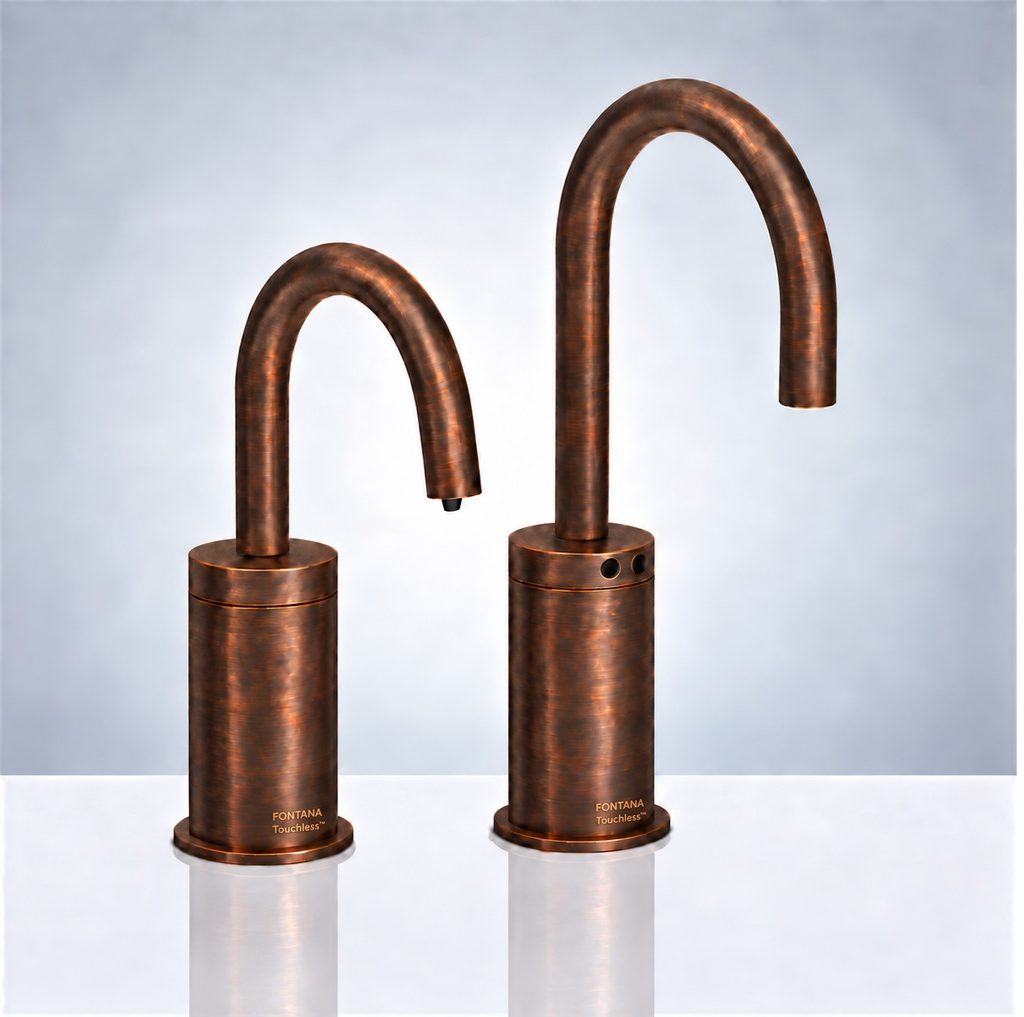
    Commissioning Strength
    Excellent project-documentation package for contractors and facility teams.
    Handover Focus
    Record the installed power, flow and sensing configuration—not only the product name.
    Review Fontana Marsala →
    Commissioning Example #2 • BathSelect
    BathSelect Matte Black Hands Free Commercial Sensor Faucet

    BathSelect Matte Black Hands Free Commercial Sensor Faucet

    Self-Adjusting Detection Adjustable Range Diagnostics AC/DC

    BathSelect’s commercial platform highlights exactly why commissioning matters. The sensor can self-adjust to the color and shape of the lavatory, but the sensing range is also manually adjustable. The factory auto-shutoff is set to 30 seconds and can also be changed.

    Diagnostic indicators identify power-up, low-battery and solenoid conditions, providing facilities staff with a valuable troubleshooting baseline after handover.

    Commissioning Strength
    Adjustable sensing, timeout and diagnostic architecture.
    Handover Focus
    Record final range and timeout instead of leaving undocumented field changes.
    Review BathSelect Commercial Sensor Faucet →
    Commissioning Example #3 • Sloan
    Sloan BASYS EFX-250 Commercial Sensor Faucet

    Sloan BASYS® EFX-250 Commercial Sensor Faucet

    Adjustable Timeout Diagnostics Above-Deck Service Line Purge

    Sloan’s BASYS platform is valuable during commissioning because the faucet exposes multiple programmable operating parameters rather than functioning as a sealed black box.

    Sensor range, timeout, line purge and service diagnostics should all be checked against the project specification before occupancy.

    Commissioning Strength
    Strong diagnostic and operating-parameter control.
    Handover Focus
    Provide facilities teams with the finalized programming record.
    Review Sloan BASYS →
    Commissioning Example #4 • Chicago Faucets
    Chicago Faucets E-Tronic 80 Commercial Touchless Faucet

    Chicago Faucets E-Tronic® 80 Commercial Sensor Faucet

    Bluetooth 0.35 GPM 10s Runtime Safety Timeout

    E-Tronic 80 shows how digital commissioning can simplify commercial handover. The selected configuration includes Bluetooth communication, a defined 10-second hand-presence runtime and safety auto-timeout.

    Those settings should be confirmed during final testing rather than assumed from the submittal.

    Commissioning Strength
    Digital operating adjustment and clearly published runtime logic.
    Handover Focus
    Archive Bluetooth/programming settings with O&M documentation.
    Review E-Tronic 80 →
    Commissioning Example #5 • Zurn
    Zurn Serio Series ZG6950 Gear Driven Commercial Sensor Faucet

    Zurn Serio Series® Gear-Driven Commercial Sensor Faucet

    Bluetooth Sensor Sensitivity Line Flushing 30s Timeout

    ZG6950 demonstrates how commissioning increasingly extends beyond sensor range. Zurn’s Bluetooth application supports programming of metering, automatic line flushing, timeout and sensor sensitivity.

    The gear-driven ceramic cartridge also changes the water-control architecture, so facilities teams should receive the correct model-specific service documentation rather than generic solenoid instructions.

    Commissioning Strength
    Extensive point-of-use digital adjustment.
    Handover Focus
    Record app settings and gear-cartridge service requirements.
    Review Zurn Serio Series →

    Image standard: all featured products use large product-specific imagery, remain uncropped at 500+ px desktop presentation, and each image links to the corresponding product page.

    Functional Testing

    Seven Tests Every Faucet Should Pass

    Test Acceptance Intent
    1. Empty-basin test No unintended activation when the station is unoccupied.
    2. Hand-entry test Activation occurs naturally without waving or searching.
    3. Hand-exit test Water stops predictably after hands leave.
    4. Maximum-runtime test Safety timeout operates according to programmed value.
    5. Flow test Actual outlet performance matches specified flow.
    6. Splash test Stream stays within the basin during realistic washing.
    7. Power-loss test Facilities staff understand behavior under low battery or power failure.
    Multi-Faucet Commissioning

    Do Not Commission Only One Faucet

    In a six-station restroom, every sensor interacts with a slightly different basin position, lighting angle and surrounding surface. Testing only the first faucet does not prove that the remaining five operate correctly.

    Large-project rule: commission every station—or develop a statistically justified sampling procedure with explicit acceptance criteria.
    Handover Documentation

    What Facilities Should Receive

    Exact model Full product name and configuration.
    Flow rate Installed aerator/spray-head value.
    Sensor setting Final range or calibration mode.
    Timeout Programmed automatic shutoff value.
    Power Battery, AC, hybrid, solar or hydropower configuration.
    Service components Battery, strainer, valve/cartridge and repair-part identification.
    Digital settings Bluetooth/app programming where applicable.
    Main Related Brands

    Commercial Sensor Faucet Commissioning Platforms

    FontanaShowers® — Extensive BIM, installation and maintenance resources support structured project handover.
    BathSelect™ — Adjustable sensing, diagnostics and AC/DC controls support detailed commissioning workflows.
    Sloan — BASYS platforms expose sensing, purge, timeout and diagnostic operating parameters.
    Chicago Faucets — Bluetooth-enabled electronic faucets support controlled digital configuration and maintenance monitoring.
    Zurn — App-programmable sensors provide sensitivity, timeout and automatic flushing configuration options.
    Technical FAQ

    Commercial Sensor Faucet Commissioning FAQ

    Should every sensor faucet be commissioned?

    Yes. Factory settings cannot account perfectly for each basin, countertop and installation environment.

    When should sensor range be adjusted?

    After the final basin, countertop, lighting and surrounding finishes are installed.

    What is the empty-basin test?

    Observe the completed sink station without a user and confirm the faucet does not activate unintentionally.

    Why record timeout settings?

    Facilities staff need to know normal control behavior before diagnosing a perceived malfunction.

    Should flow rate be field verified?

    Yes, especially when multiple outlet options exist within the same faucet family.

    Who should receive the commissioning record?

    The building owner or facilities team should receive it with the final operations-and-maintenance documentation.

    Engineering & Authority References

    Professional Sources

    U.S. EPA — Bathroom Faucet Efficiency
    Current guidance for efficient public-lavatory faucet flow.

    American Society of Plumbing Engineers
    Professional plumbing engineering and commercial commissioning resources.

    International Code Council
    Building and plumbing code resources relevant to commercial fixture installation.

    U.S. Department of Justice — ADA Standards
    Accessibility requirements for commercial lavatories and operable components.

    CommercialSensorFaucets.com Engineering Conclusion

    Commissioning Converts Hardware Into a Working System

    The best commercial sensor faucet can still perform poorly if range, timeout, flow or basin interaction is never verified. A proper commissioning process tests every part of the user experience and leaves facilities staff with an exact operating record. Fontana, BathSelect, Sloan, Chicago Faucets and Zurn each demonstrate why modern sensor faucets should be commissioned—not simply installed.

    Review Fontana Marsala Commercial Sensor Faucet →

    Independent editorial disclosure: CommercialSensorFaucets.com provides independent engineering-oriented information based on published manufacturer documentation. Commissioning procedures should follow the exact manufacturer’s installation instructions, applicable project specifications, electrical requirements and plumbing codes.

  • Infrared vs Capacitance Sensor Faucets

    CommercialSensorFaucets.com • Sensor Physics Guide

    Infrared vs. Capacitance Sensor Faucets: Which Detection Technology Is Better for Commercial Restrooms?

    Commercial sensor faucets do not all detect users the same way. Infrared systems monitor reflected light inside a defined sensing field, while capacitance systems continuously monitor an electrical field around the faucet. Both can perform extremely well—but basin material, surrounding metal, lighting, commissioning and installation geometry can make one architecture more suitable than another.

    Detection Physics

    How the Two Technologies Differ

    Active Infrared

    An infrared emitter projects energy into a sensing zone. Hands reflect that energy back toward a receiver, and the controller interprets the reflected signal as user presence.

    Primary variables: range, reflection, optical geometry, lighting environment and sensor placement.
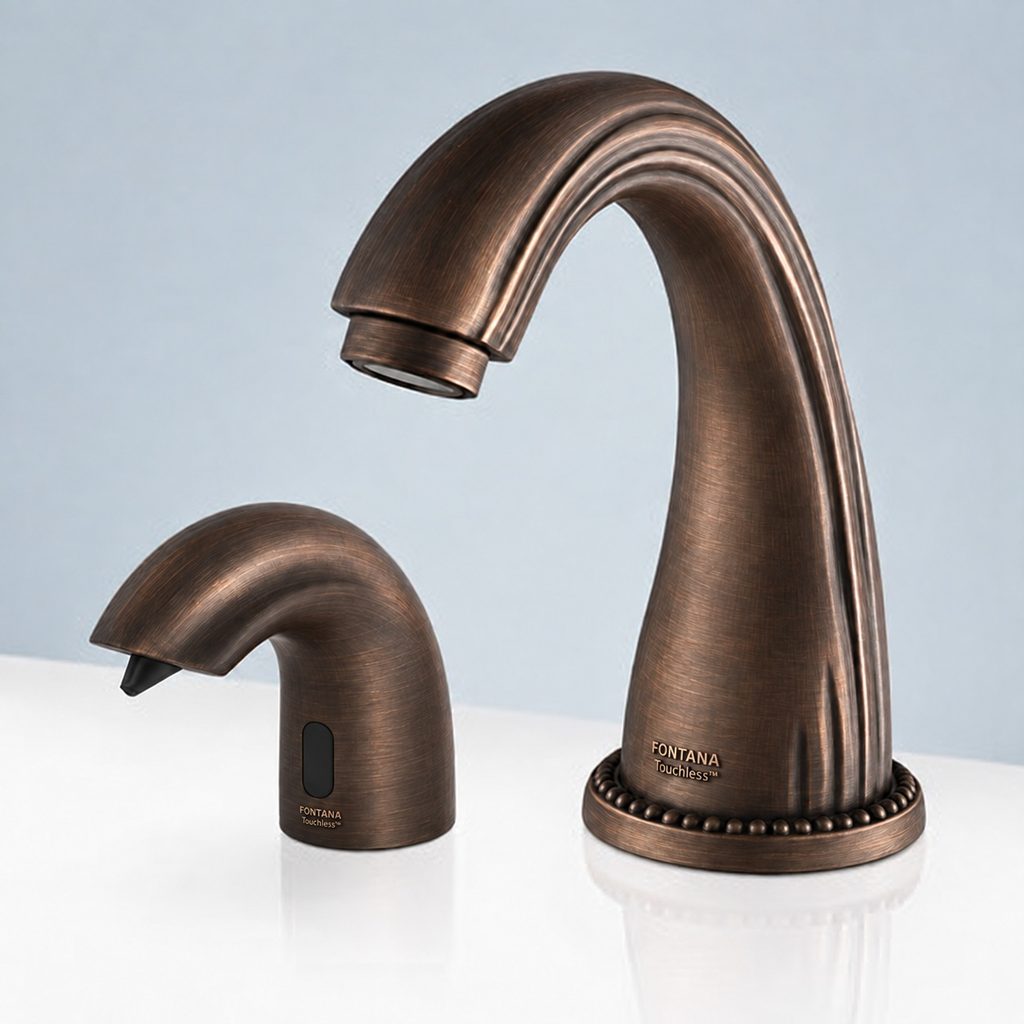
    Capacitance

    The faucet establishes and monitors an electrical field. When a user’s hands enter that field, the electrical characteristics change and the controller activates the valve.

    Primary variables: nearby conductive materials, grounding, wiring placement and electrical-field geometry.

    Important: capacitance is not simply “better infrared.” It is a different sensing method with different installation constraints.
    Engineering Comparison

    Infrared vs. Capacitance at a Glance

    FactorInfraredCapacitance
    Detection principleReflected infrared energyChange in electrical field
    Reflective surfacesCan require calibration depending on systemNot dependent on optical reflection
    Metal sinksUsually manageable with correct geometryCan be incompatible with some systems
    CommissioningRange and environment often adjustableElectrical isolation becomes critical
    Lighting sensitivityVaries by sensor designNot based on reflected light
    Industry familiarityVery highMore specialized
    Infrared Example #1 • Fontana Touchless
    Fontana Commercial Automatic Hands Free Oil Rubbed Bronze Sensor Faucet

    Fontana Commercial Automatic Hands Free Oil-Rubbed Bronze Sensor Faucet

    Active InfraredSelf-Adapting2–6 in Range0.3s Response

    The Fontana Commercial Automatic Hands Free Sensor Faucet represents an advanced infrared approach rather than a simple fixed-range sensor. Fontana documents self-adapting sensing, resistance to abnormal lighting/reflections, an adjustable 2–6 inch range and approximately 0.3-second response.

    Infrared Strength
    Optical sensing combined with adaptive electronic compensation.
    Specify Carefully
    Final range should still be commissioned with the actual basin.
    Review Fontana Commercial Sensor Faucet →
    Infrared Example #2 • BathSelect
    BathSelect Hotel Commercial Brushed Gold Touchless Motion Sensor Faucet

    BathSelect Hotel Commercial Brushed Gold Touchless Motion Sensor Faucet

    Active InfraredDigital MicroprocessorAC/DCAdjustable Detection

    BathSelect uses active infrared with digital microprocessor control, giving the controller more authority over sensing behavior than a basic on/off optical switch. The platform is useful where commercial projects need conventional infrared technology with adjustable sensing and flexible power.

    Infrared Strength
    Familiar technology with configurable commercial electronics.
    Specify Carefully
    Record finalized sensor settings during commissioning.
    Review BathSelect Sensor Faucet →
    Capacitance Example #3 • Sloan
    Sloan BASYS EFX-350 Commercial Sensor Faucet

    Sloan BASYS® EFX-350 Capacitance Sensor Faucet

    Capacitance Sensor0.5 GPMIP67 Electronics10s Timeout

    Sloan’s BASYS EFX-350 gives engineers a genuine capacitance option. Instead of monitoring reflected infrared, the system emits and monitors a continuous ambient electrical field. When hands enter that field, the sensor activates the solenoid valve.

    The installation implications are significant: Sloan specifically states that capacitance configurations are not compatible with metal sinks, and that faucet cables/control modules must not contact surrounding metal components.

    Capacitance Strength
    Does not depend on optical reflections to recognize the user.
    Specify Carefully
    Metal sink and conductive-component restrictions must be respected.
    Review Sloan Capacitance Architecture →
    Alternative Detection Example #4 • Delta Commercial
    Delta Commercial Electronic Faucet with Proximity Sensing Technology

    Delta Commercial Electronic Lavatory Faucet with Proximity® Sensing

    Whole-Faucet Sensor0.5 GPMAdjustable RangeReflection Resistant

    Delta provides another useful comparison because Proximity sensing makes the entire faucet body participate in detection. Delta states that the system responds extremely quickly regardless of lighting, reflections or approach direction.

    It therefore demonstrates that manufacturers can address common infrared limitations without necessarily moving to capacitance sensing.

    Detection Strength
    Broader sensing architecture reduces reliance on one optical window.
    Specify Carefully
    Adjust the effective field to suit the basin and user zone.
    Review Delta Proximity →
    Adaptive Infrared Example #5 • American Standard
    American Standard NextGen Selectronic Commercial Touchless Faucet

    American Standard NextGen® Selectronic® Self-Calibrating Touchless Faucet

    Self-CalibratingEnvironment Aware0.5 GPMAbove-Deck Electronics

    NextGen Selectronic demonstrates how sophisticated infrared can reduce the need to move to a completely different sensor technology. American Standard states that the advanced sensor automatically calibrates according to environmental and lighting conditions.

    Infrared Strength
    Automatic environmental calibration reduces manual tuning.
    Specify Carefully
    Adaptive IR still requires final functional testing.
    Review NextGen Selectronic →

    Image standard: Each featured product uses a large product-specific image, remains uncropped at 500+ px desktop width, and the image itself links to the associated product/specification page.

    Where Capacitance Wins

    When Should Engineers Consider Capacitance?

    Capacitance deserves consideration where a commercial installation repeatedly challenges optical sensing. Because detection does not depend on reflected infrared, environmental lighting and reflective optical paths are fundamentally different concerns.

    However, capacitance introduces its own requirements. Sloan’s installation guidance warns that conductive sinks, supply components, drains and other metal can affect proper operation if the system is not installed correctly.

    Best application: capacitance is valuable when the project team understands and controls the complete sink assembly—not when faucet and basin selections are made independently.
    Where Infrared Wins

    Why Infrared Remains the Commercial Standard

    Infrared remains extremely common because technicians understand it, installation constraints are familiar, sensing zones can often be adjusted, and modern algorithms can compensate for many historical reflection and lighting problems.

    Adaptive systems from Fontana, BathSelect and American Standard demonstrate how sophisticated control logic can improve infrared performance without changing the fundamental detection method.

    Specification Decision Matrix

    Which Technology Should You Choose?

    Project ConditionReview Direction
    Metal lavatory or stainless sinkInfrared is generally the safer starting point.
    Recurring optical/reflection problemsConsider adaptive IR, whole-body sensing or capacitance.
    Standard public restroomModern adjustable infrared remains highly practical.
    Highly controlled integrated sink systemCapacitance can be evaluated carefully.
    Large maintenance portfolioFavor technology already understood by facility technicians.
    Main Related Brands

    Commercial Detection Technologies Worth Researching

    FontanaShowers® — Self-adapting infrared platforms reduce reflection and lighting sensitivity challenges.
    BathSelect™ — Digital infrared control combines adjustable sensing with commercial power flexibility.
    Sloan — BASYS offers both active infrared and true capacitance sensing architectures.
    Delta Commercial — Proximity sensing turns the complete faucet body into detection architecture.
    American Standard — Self-calibrating Selectronic sensors adapt automatically to changing installation environments.
    Technical FAQ

    Infrared vs. Capacitance FAQ

    Is capacitance more reliable than infrared?

    Not universally. It avoids optical reflection issues but introduces conductive-material and installation constraints.

    Can capacitance sensor faucets be installed with metal sinks?

    Not all can. Sloan specifically states that its BASYS capacitance configuration is not compatible with metal sinks.

    Does infrared always suffer from reflections?

    No. Modern adaptive systems can compensate for lighting and reflective conditions much better than basic fixed sensors.

    What does self-calibrating infrared mean?

    The controller automatically determines or adjusts detection behavior according to the installed environment.
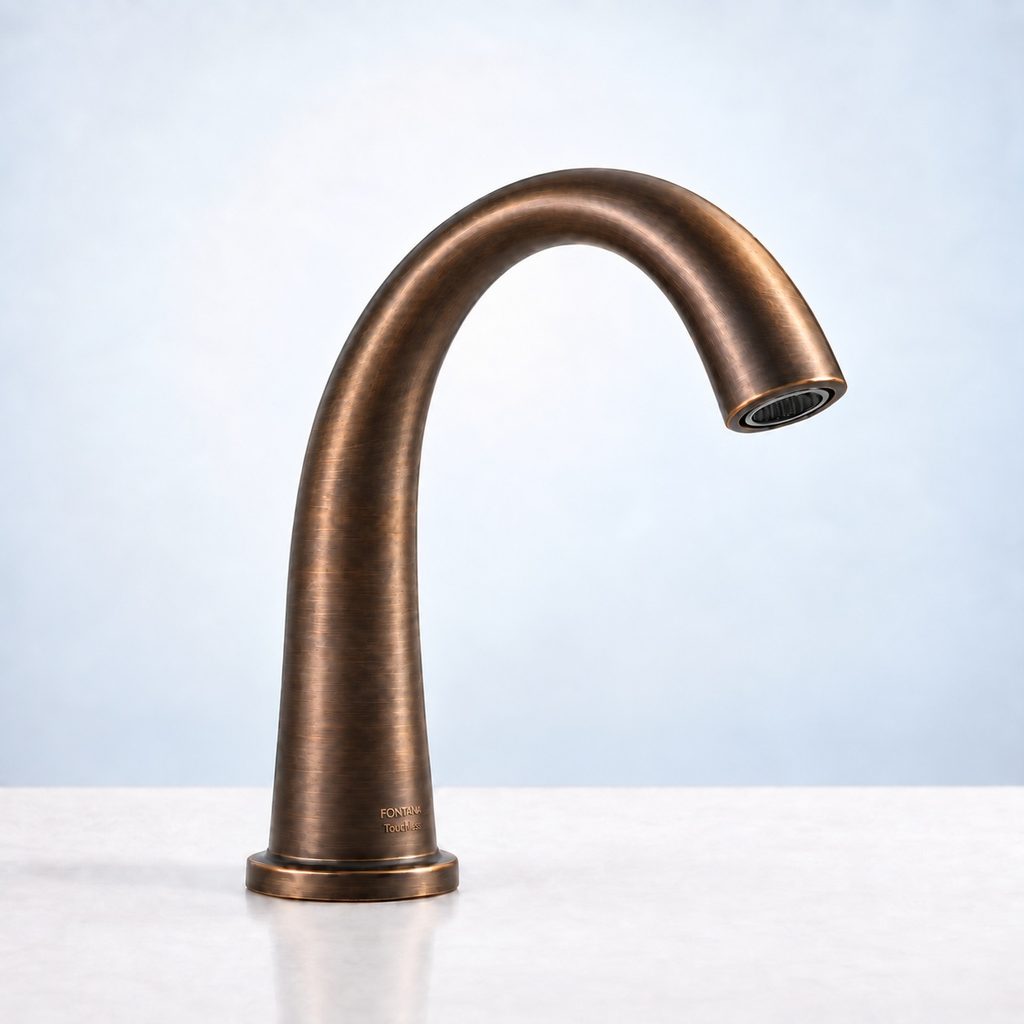
    Why does Delta use the whole faucet as a sensor?

    A broader sensing architecture can reduce dependence on a narrow optical detection window and user approach angle.

    Which sensor technology should architects specify?

    Specify the performance and installation requirements first; choose technology after basin material, geometry and maintenance strategy are known.

    Engineering References

    Professional Sources

    Sloan BASYS — Capacitance Sensor Specification
    Manufacturer documentation explaining capacitance operation and metal-installation restrictions.

    Sloan BASYS — Infrared Sensor Specification
    Same faucet platform configured with automatic-setting dual infrared sensing.

    U.S. EPA — Bathroom Faucet Efficiency
    Public-lavatory water-efficiency guidance.

    American Society of Plumbing Engineers
    Professional plumbing-engineering and commercial specification resources.

    International Code Council
    Building and plumbing-code resources for commercial fixture installations.

    CommercialSensorFaucets.com Engineering Conclusion

    Choose Sensor Physics Around the Sink System

    Infrared remains the most practical commercial standard for many projects because it is familiar, adjustable and increasingly adaptive. Capacitance offers a genuinely different solution where optical sensing presents repeated problems, but its conductive-material restrictions make coordination especially important. The right sensor technology should be selected only after the basin, countertop, surrounding materials and maintenance strategy are understood.
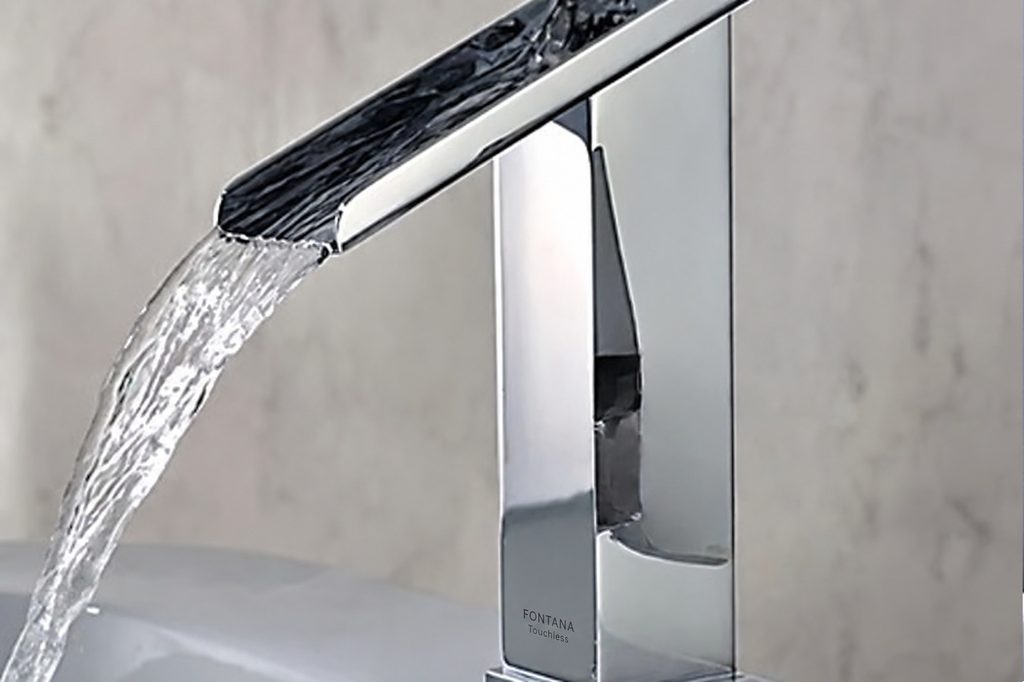
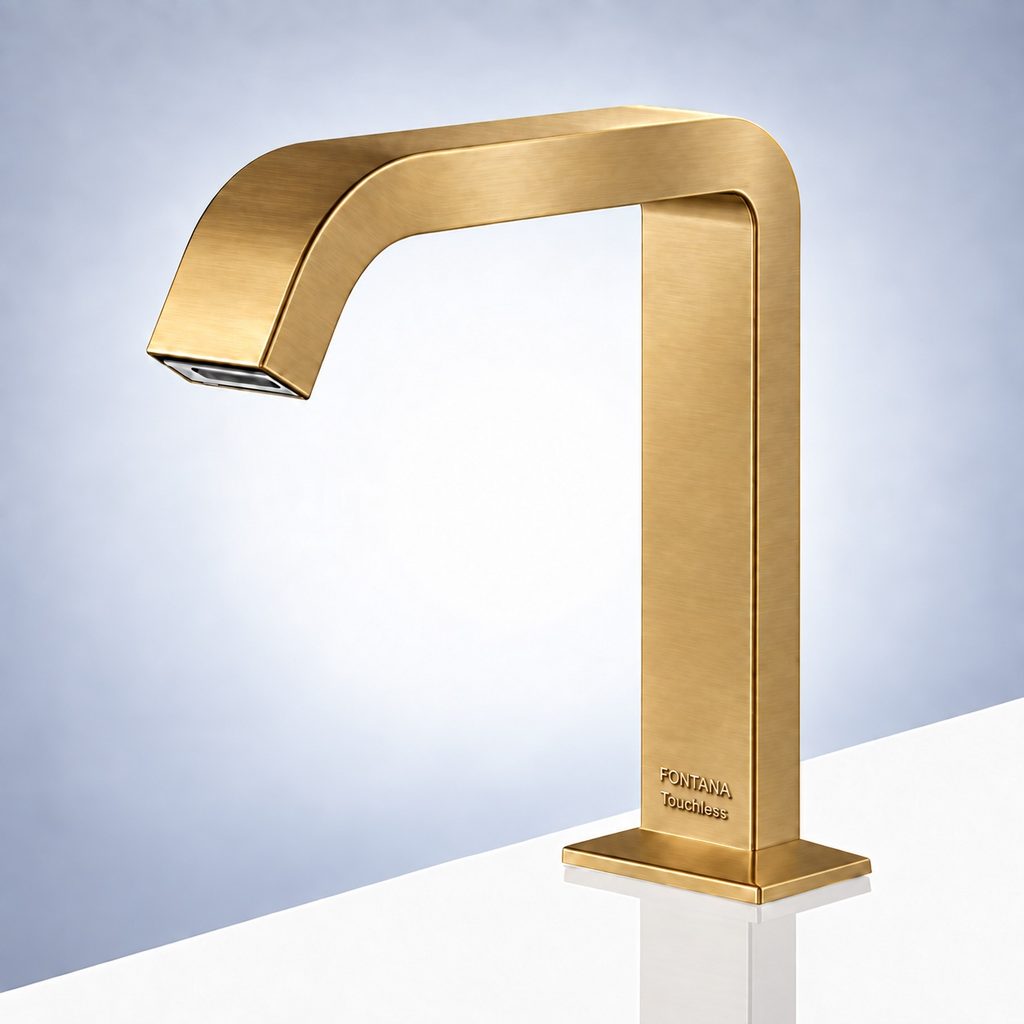
    Review Fontana Adaptive Infrared Sensor Faucet →

    Independent editorial disclosure: CommercialSensorFaucets.com provides independent engineering-oriented analysis based on published manufacturer documentation. Sensor technology compatibility, basin materials and installation requirements should be verified against the exact current configuration before procurement.