Commercial Sensor Faucet Range & Basin Geometry: How to Prevent False Activation and Splash
A commercial sensor faucet can have excellent electronics and still perform badly when paired with the wrong basin. Detection distance, spout reach, sink depth, drain location and reflective surfaces determine where hands are sensed—and where water actually lands. This guide reviews the faucet and basin as one engineered system.
Four Relationships Control Performance
Sensor → Hands
The detection field should match the natural handwashing position.
Spout → Basin
Reach determines where the stream enters the sink.
Stream → Drain
Direct drain impact can increase splash in some basin designs.
Sensor → Surface
Reflective materials can influence some infrared sensing environments.
Deck → Sink Edge
Excessive setback can force users into an unnatural hand position.
Flow → Basin Depth
High velocity and shallow bowls increase splash risk.
What Bad Geometry Looks Like
| Symptom | Likely Geometry Issue | Engineering Response |
|---|---|---|
| False activation | Detection field reaches basin or reflective surface | Reduce range or change positioning. |
| User waves repeatedly | Sensor zone too far from natural hand position | Adjust range and verify spout setback. |
| Water splashes counter | Stream impact too close to bowl edge/drain | Review projection, angle and flow. |
| Hands hit basin | Insufficient clearance below spout | Increase spout height or select deeper bowl. |
| Different sinks behave differently | Surface color/shape changes sensor environment | Use adjustable or adaptive calibration. |
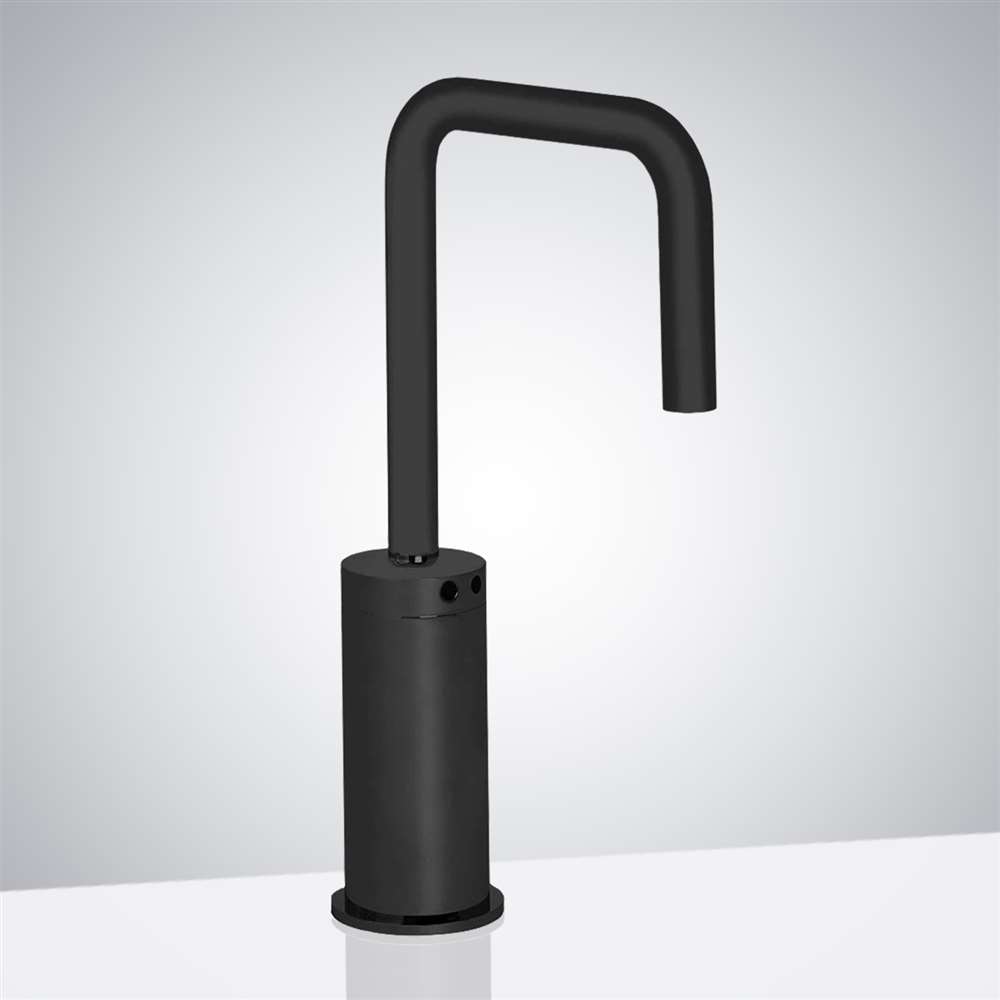
Fontana Bavaria Matte Black Inverted-U Automatic Commercial Sensor Faucet
The Fontana Bavaria is useful for commissioning because its active-infrared sensing range is adjustable approximately 2–8 inches. That range lets the installer move the activation field toward the user’s natural hand position rather than forcing the basin to accommodate one fixed detection distance.
Wide adjustment range helps compensate for varying sink arrangements.
Final setting must be tested with the actual installed basin.
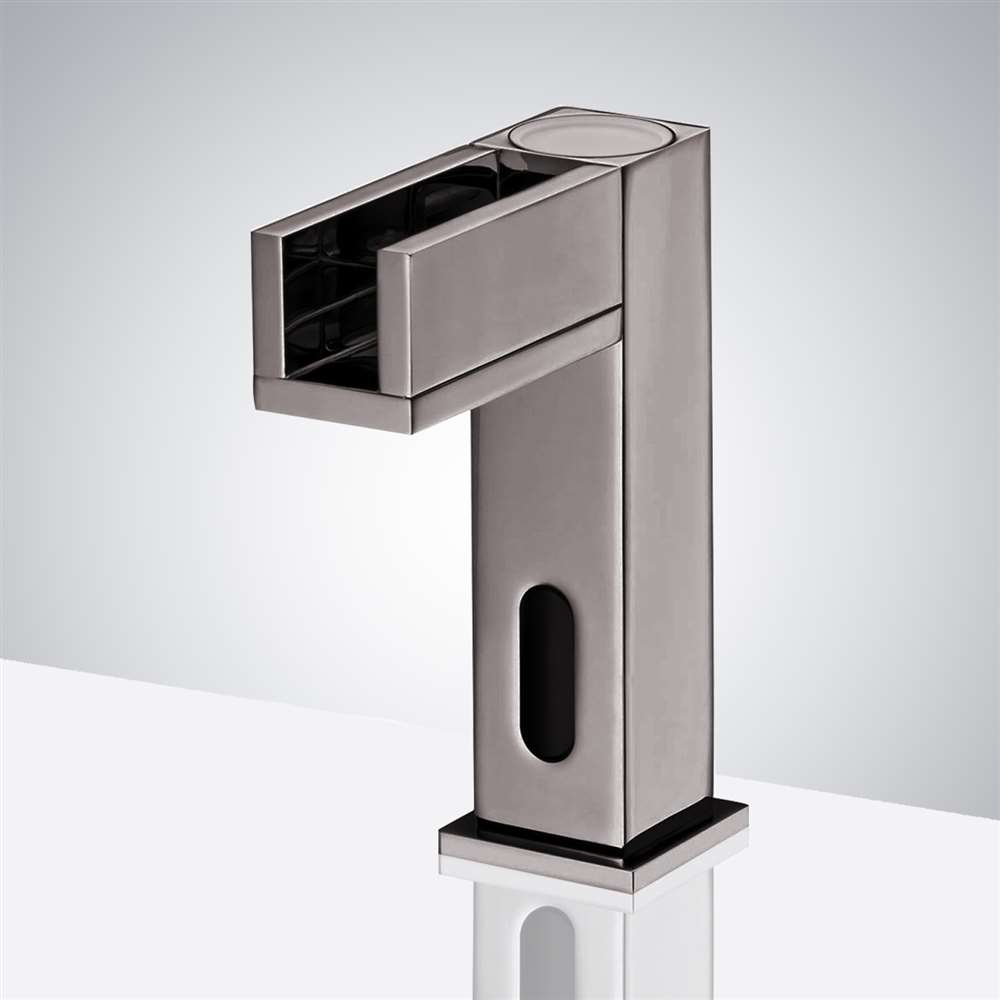
BathSelect Brushed Nickel Contemporary Commercial Automatic Waterfall Sensor Faucet
BathSelect publishes an adjustable sensing distance of approximately 12–18 cm for this commercial waterfall-style platform and specifically describes anti-disturbance capability against glare and high-frequency interference.
The waterfall outlet makes basin coordination especially important because the wider water pattern behaves differently from a narrow laminar stream.
Explicit adjustable sensing distance.
Wide outlet pattern requires adequate basin width and depth.

KOHLER Composed® Touchless Faucet with Kinesis® Sensor Technology
KOHLER provides unusually useful geometry data. The Composed specification gives a spout reach of approximately 5-13/16 inches and limits the distance between the basin edge and faucet base to approximately 1¾ inches.
This is exactly the kind of information architects should coordinate before stone countertops are fabricated.
Detailed published faucet-to-basin dimensional guidance.
Countertop faucet setback must stay within manufacturer limits.

Delta Commercial Electronic Lavatory Faucet with Proximity® Sensing
Delta’s Proximity architecture approaches geometry differently by making the faucet body part of the sensing system. That reduces dependence on a single narrow front-facing sensor window and gives commissioning teams an adjustable sensing field.
Broad sensing concept can improve approach-angle tolerance.
Even broad sensing must be tuned to prevent unwanted basin detection.

Sloan BASYS® EFX-250 Commercial Sensor Faucet
Sloan’s BASYS EFX platform combines commercial infrared sensing with adjustable detection and multiple low-flow outlets. For basin coordination, that means both the optical field and water stream can be selected around the fixture environment.
Sensor and flow configuration can both be tailored.
Ultra-low-flow spray should be mock-up tested with shallow basins.
Product-image rule: Each featured image is presented uncropped at 500+ px desktop width, remains responsive on mobile, and is clickable to the corresponding product page.
Five Field Tests That Prevent Most Geometry Problems
| 1. Empty-basin test | The faucet should remain off when nobody is present. |
| 2. Natural-hand test | Users should not search or wave for the sensor. |
| 3. Drain-impact test | Confirm water does not create excessive splash at the drain. |
| 4. Edge test | Water should land comfortably inside the bowl, not near the front rim. |
| 5. Reflection test | Test the faucet after final stone, sink and lighting installation. |
Put Geometry into the Fixture Schedule
For sensor faucets, the schedule should include spout reach, mounting setback, sensing range, basin model, flow outlet, maximum runtime and commissioning requirement. When possible, large projects should physically mock up one complete sink station before approving hundreds of countertops.
Sensor Geometry Brands Worth Researching
Sensor Range & Basin FAQ
Can the sink cause false sensor activation?
Yes. Detection range, reflective surfaces and basin geometry can influence some infrared installations.
How far should the faucet be from the basin?
There is no universal setback. Follow the exact manufacturer’s dimensional limits for the selected faucet.
Why does water splash from a sensor faucet?
Common contributors include shallow bowls, excessive flow, poor stream angle and direct impact near the drain or basin wall.
Should sensor range be adjusted before installing the sink?
No. Final commissioning should occur after the actual basin, countertop and lighting are complete.
Does a wider sensor range mean better performance?
No. Excessive range can cause premature activation. The correct range matches the intended handwashing zone.
Should architects mock up sensor-faucet sinks?
For large projects, yes. One full-scale mock-up can expose geometry and splash problems before mass installation.
Professional Sources
U.S. EPA — Bathroom Faucet Efficiency
Public-lavatory water-efficiency guidance.
U.S. Department of Justice — ADA Standards
Accessible lavatory geometry and faucet-control requirements.
American Society of Plumbing Engineers
Professional plumbing design and specification resources.
International Code Council
Model building and plumbing codes for commercial fixture installations.
The Basin Is Part of the Sensor System
Reliable commercial sensing depends on more than electronics. Faucet setback, spout reach, bowl depth, surface reflectivity, flow pattern and detection distance all interact. The strongest specifications coordinate these variables before countertop fabrication and verify them again during final commissioning.
Review Fontana Adjustable Sensor Faucet →Independent editorial disclosure: CommercialSensorFaucets.com provides independent engineering-oriented analysis based on published manufacturer information. Project teams should verify current dimensional drawings, sensor ranges, basin compatibility and installation requirements before procurement.
Leave a Reply